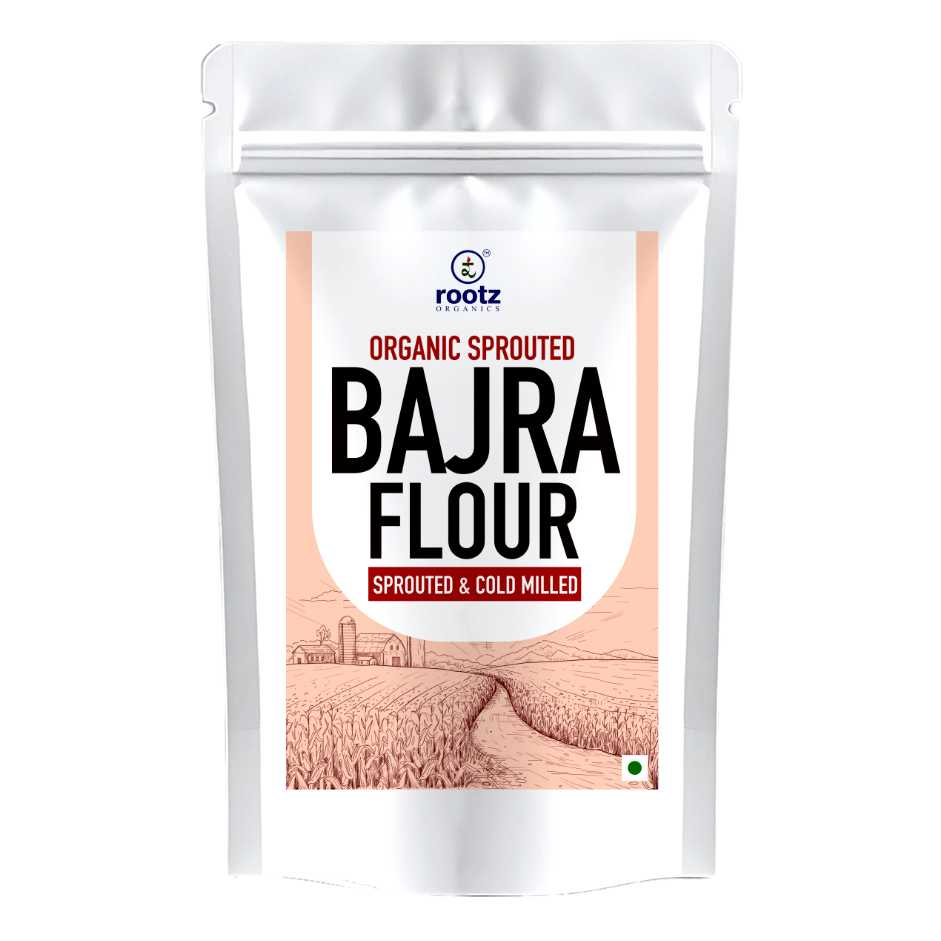

Organic Sprouted Bajra Flour: The Desert Grain That Gave Rajasthan Its Strength. Now Unlocked Completely.
Available in 900g and 1800g | rootzorganics.in
There is a reason Rajasthani farmers work in conditions that would exhaust most people.
Forty-five degree summers. Bone-dry winters. Hard physical labour from dawn to dusk. And through all of it, the endurance that generations of outsiders have marvelled at without understanding its source.
The answer, for centuries, was bajra.
Pearl millet. Bajra roti with ghee by the fire on a winter evening. Bajra khichdi. Bajra rabdi to start the day. The grain of the desert, drought-tolerant, mineral-dense, warming in cold weather and cooling in its digestion, sustained an entire region's physical strength for thousands of years.
The Government of India officially designated bajra as a nutri-cereal in 2018 for production, consumption and trade. The science behind this designation is compelling. Bajra contains 8 to 11mg of iron per 100g, more than most other Indian grain flours. Magnesium at 97 to 137mg per 100g. Zinc at 3.1 to 6.6mg. Phosphorus, calcium, B vitamins. A mineral density that few grains can match.
But here is what the traditional preparation understood and the modern packaged bajra flour does not deliver.
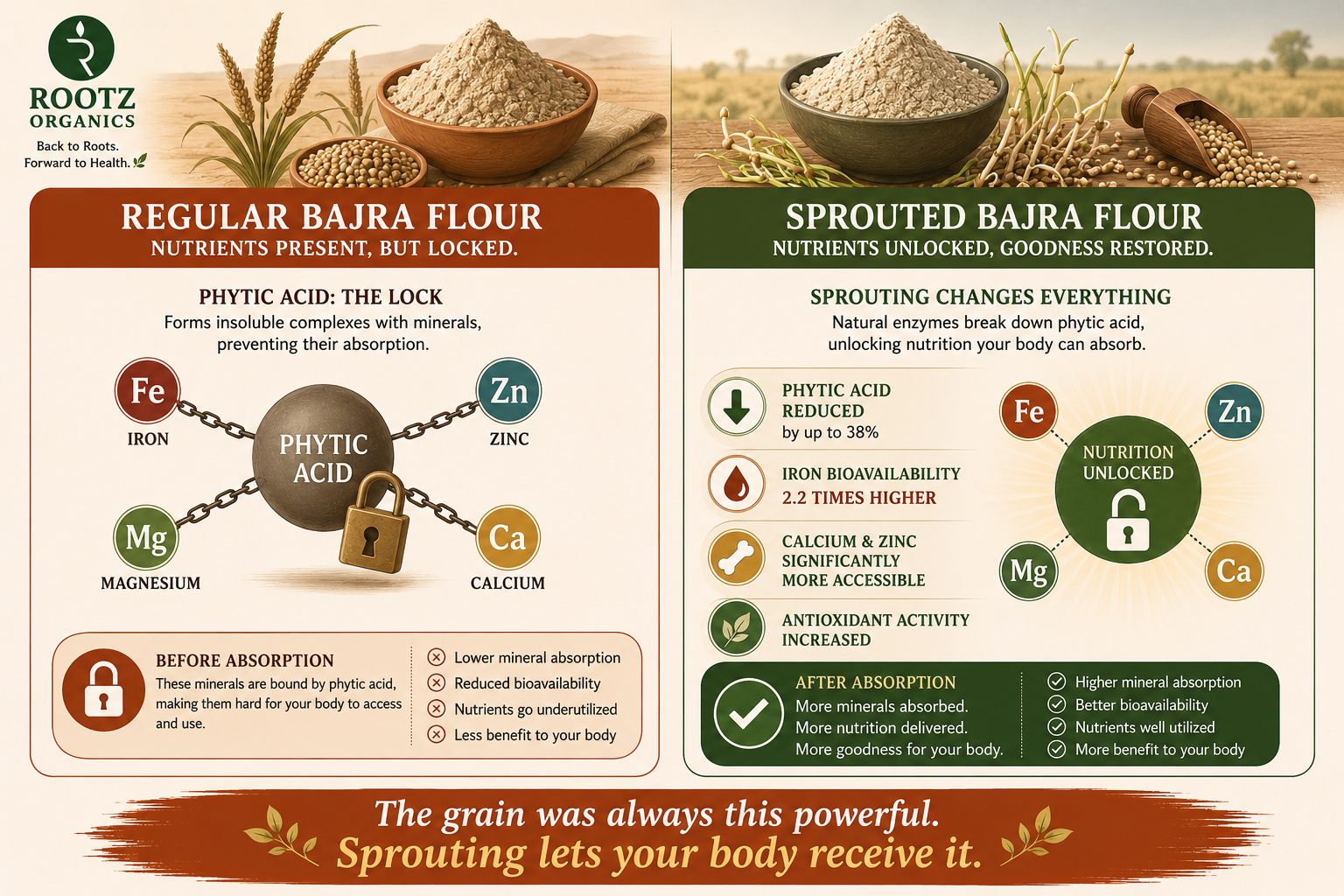
Bajra contains phytic acid and tannins that bind to those exceptional minerals before your body can absorb them. Germination, the process of sprouting the grain before milling, is the only method that dismantles this barrier. Research published in peer-reviewed journals confirmed that germination improves the bioavailable iron from pearl millet by 2.2 times. A meta-analysis of human trials showed ferritin levels increasing by up to 54.7 percent from pearl millet consumption when processing removes phytic acid.
The Rajasthani farmer's bajra roti delivered those minerals because traditional preparation included soaking, extended fermentation, and techniques that naturally reduced phytic acid. The modern packaged bajra flour your family buys skips all of that.
Sprouted bajra flour brings it back. The same legendary grain. Completely unlocked.
Order Rootz Organics Organic Sprouted Bajra Flour: rootzorganics.in
What Regular Bajra Flour Has Been Withholding
Bajra flour is widely available. Sprouted bajra flour is not. And that gap matters more than most people realise.
Every 100g of bajra grain carries iron, zinc, magnesium, calcium, and phosphorus in quantities that make it one of the most mineral-dense grains available in the Indian kitchen. The Government of India classifies it as a nutri-cereal for precisely this reason. The problem is not the grain. The problem is what happens between the grain and your bloodstream.
Phytic acid in unsprouted bajra forms insoluble complexes with iron, zinc, phosphorus, and magnesium, reducing their bioavailability for the body. In plain terms: the minerals are present. Phytic acid is deciding how much of them your body can actually use.
Research found that phytic acid in pearl millet was reduced by up to 38 percent through germination, the process that activates phytase enzymes that dismantle phytic acid from the inside. The bioaccessibility of iron and calcium was considerably enhanced upon sprouting of pearl millet, attributed to this decrease in anti-nutritional factors.
The iron that made bajra the grain of legendary Rajasthani endurance was not just present in the food. It was accessible. Because traditional preparation made it so.
Sprouting achieves in a controlled, verified, consistent process what traditional soaking and fermentation achieved instinctively for generations. Germination stands out as a simple and proven beneficial method for increasing dietary fibre, mineral content, complex B vitamins, and the antioxidant and anti-inflammatory activity of bajra.
What Sprouted Bajra Flour Delivers, Every Benefit, Now Complete
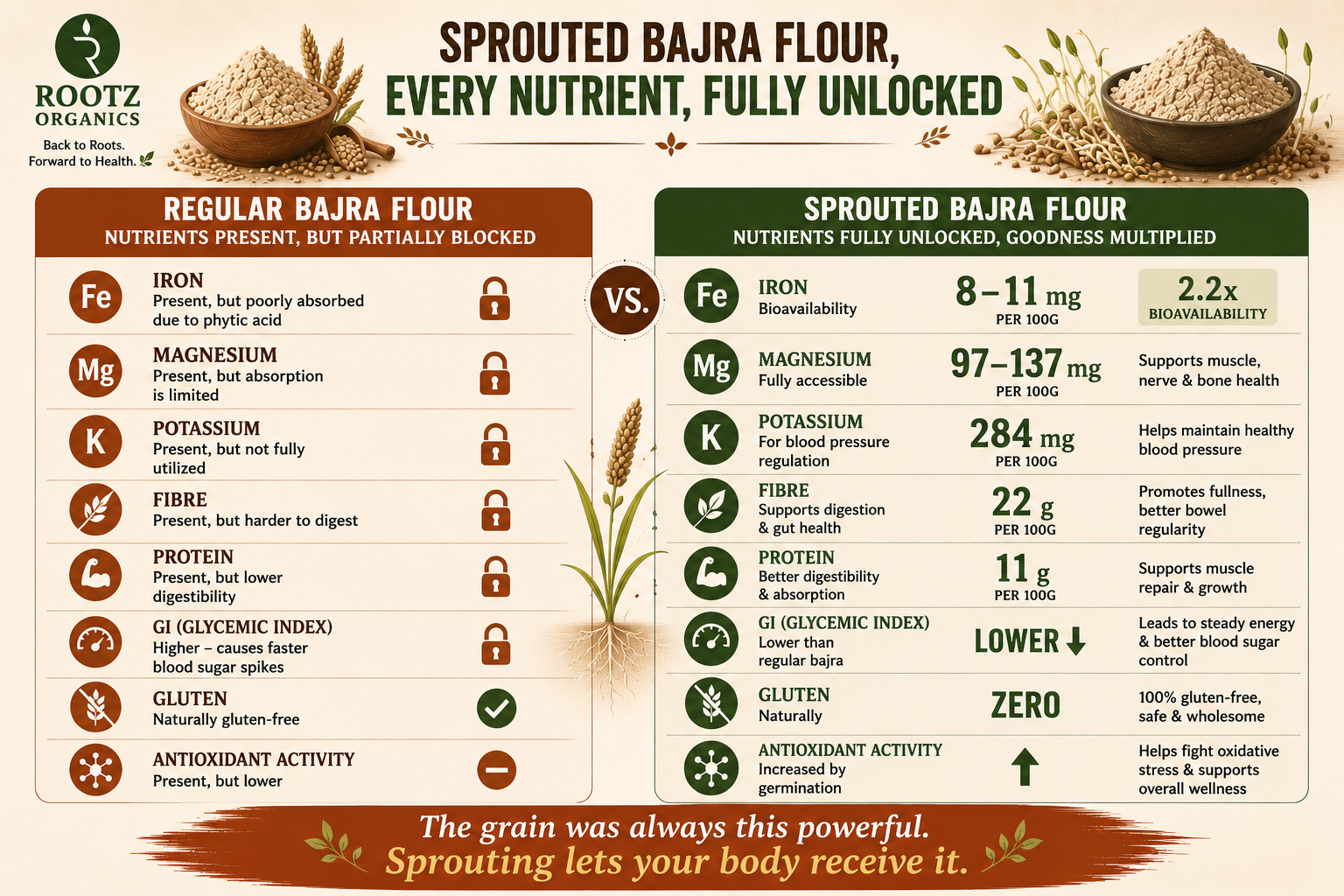
Iron: 8 to 11mg per 100g, now actually absorbed. Germination can improve bioavailable iron from pearl millet by 2.2 times, contributing to 95 percent of the physiological iron requirement of women. For the millions of Indian women living with iron deficiency anaemia, over 50 percent by most estimates, this is not a marginal nutritional improvement. It is the difference between a grain whose iron content moves the needle and one whose iron content stays on the label.
Magnesium: 97 to 137mg per 100g. Bajra is rich in magnesium, which helps relax blood vessels, aids in reducing blood pressure, and reduces strain on the heart. Magnesium is also involved in over 300 biochemical reactions in the body, including energy production, nerve function, and muscle recovery. For anyone managing blood pressure or heart health, magnesium from food is consistently more effective than magnesium from supplements, and sprouted bajra delivers it with the phytic acid barrier removed.
Heart protection that goes deeper than magnesium alone. Bajra is low in sodium and high in potassium, which helps regulate blood pressure. The combination of high potassium, high magnesium, high fibre, and phenolic antioxidants makes sprouted bajra one of the most comprehensively heart-protective grains in the Indian kitchen. In a country where cardiovascular disease is the leading cause of death and dietary factors are among the most modifiable risk variables, the grain your family eats every day is not a trivial variable.
Naturally gluten-free. Completely. Bajra has no relationship to wheat, barley, or rye. For anyone managing gluten sensitivity, wheat intolerance, or digestive issues connected to modern wheat, sprouted bajra flour is not a compromise alternative. It is a nutritionally superior one.
Low glycaemic index for stable blood sugar. Bajra is a good source of magnesium and other minerals that may help in reducing insulin resistance in the body. The carbs in pearl millet slow the digestion rate and maintain stable sugar levels for a longer period. Sprouting reduces the GI further still by partially breaking down complex starches, creating an even flatter post-meal glucose curve.
Warming in winter, lighter in summer. This is the property that made bajra the grain of desert climates. In Ayurvedic and traditional nutritional understanding, bajra has a warming energy, which is why bajra roti season in North India runs from October to February. But sprouting makes bajra lighter on digestion year-round by pre-breaking the complex proteins and starches that can make unsprouted bajra occasionally heavy on the stomach.
Fibre at 22g per 100g of whole grain, one of the highest fibre contents of any Indian grain. Supporting gut health, cholesterol management, bowel regularity, and the satiety that means a bajra roti breakfast carries you genuinely through the morning.
The People Whose Health This Changes
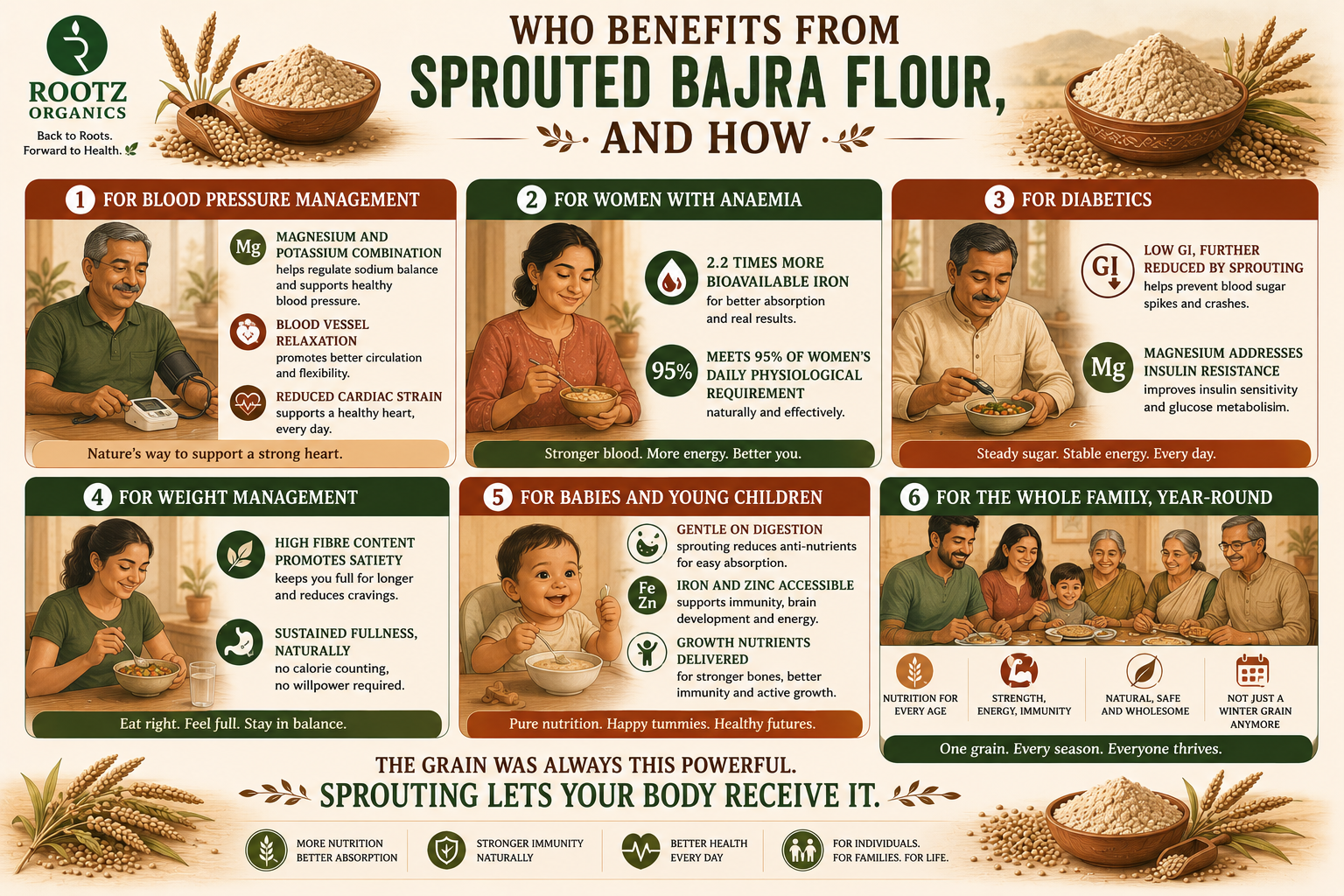
Anyone managing blood pressure or heart health. The combination of high magnesium, high potassium, low sodium, and high fibre in sprouted bajra creates a multi-layered cardiovascular protective mechanism at every meal. These are not supplements. They are nutrients arriving through food your family already eats, bajra roti, bajra khichdi, bajra dosa, with the full bioavailability that sprouting makes possible.
Women with iron deficiency or anaemia. You have been told to eat iron-rich food. Bajra contains more iron than most other Indian grain flours. But unsprouted bajra's phytic acid has been partially blocking what you were trying to receive. Germination improves bioavailable iron by 2.2 times, meeting 95 percent of the physiological iron requirement of women. Sprouted bajra is iron delivered, not just iron present.
Anyone managing diabetes or blood sugar. The complex carbohydrates in bajra digest slowly, and sprouting reduces the GI further. Bajra's magnesium content directly addresses insulin resistance, which is one of the mechanisms behind Type 2 diabetes. Combined with high fibre that slows glucose absorption, sprouted bajra produces a post-meal blood sugar curve that wheat flour, and even regular bajra flour, cannot match.
People managing weight without giving up satisfying food. Bajra's nutrient density and high fibre content help in promoting satiety and controlling calorie consumption, thereby supporting weight management efforts. A bajra roti is genuinely filling in a way that a wheat roti of the same size is not, because the fibre and protein composition signals satiety through the gut-brain axis before hunger returns. You do not eat less by willpower. You eat less because the grain has done its job.
Children and infants. Bajra benefits cover not only adults but infants as well. As it is easily digested and well tolerated, bajra can become a compulsory ingredient of baby food. Sprouted bajra is gentler still, the germination process partially pre-breaks complex proteins and starches, making it even more suitable for growing digestive systems. Porridge, soft khichdi, and dosa made from sprouted bajra flour deliver iron, zinc, and calcium to developing bodies at the stage when those nutrients most directly shape outcomes.
The household that eats bajra seasonally and wants to eat it year-round. Traditional bajra consumption in North India peaked in winter because bajra's warming properties made cold months the natural season. But sprouting changes the digestive character of bajra, making it lighter, more versatile, and suitable across seasons. Sprouted bajra rotis in summer do not carry the heaviness that keeps many families from eating bajra beyond February.
What Families Notice When They Switch to Sprouted Bajra Flour
The dough is easier.
Unsprouted bajra flour can be stiff and difficult to bind, which is why traditional bajra bhakri is patted by hand rather than rolled, and why many families avoid bajra because the preparation feels harder than wheat. Sprouted bajra flour makes a noticeably more pliable dough. The rotis roll. The bhakri pats more easily. The germination process has partially broken down the proteins that made the unsprouted grain resistant to rolling, and the result is a flour that behaves the way most families hoped bajra flour would.
The flavour is warmer and slightly sweeter. The germination process generates free sugars naturally, not added sugars, but the natural sweetness that comes from starches beginning to convert during germination. Bajra already has a characteristic earthiness that families either love immediately or grow into. Sprouted bajra has that earthiness with a gentler edge that most people find more accessible.
The heaviness disappears. Many families who ate bajra rotis in winter and found them too heavy for regular use report that sprouted bajra rotis are significantly lighter on the stomach. The partial pre-digestion from sprouting means your gut receives rotis that have already begun to break down, rather than doing all the structural work itself. Meals that settle faster. Digestion that does not announce itself after lunch.
And for families tracking iron and blood pressure, the numbers that shift quietly over weeks are the most convincing part of all.
Why Rootz Organics, Where the Sprouting Actually Completes
The sprouted grain market has one consistent problem: the word "sprouted" on a label is not regulated. Minimum sprouting, grains soaked briefly and dried, produces almost none of the phytate reduction or bioavailability improvement that proper germination achieves. You can buy "sprouted bajra flour" that has done almost nothing for the mineral accessibility of the grain. And unless the sourcing is certified organic, you may be buying bajra grown with conventional pesticide practices regardless of what the label says.
Rootz Organics Organic Sprouted Bajra Flour begins with certified organic pearl millet sourced from over 200 verified farms across India. Zero pesticides. Zero chemical fertilisers. Zero GMOs. Third-party certified under NPOP, India's National Programme for Organic Production, independently audited with every batch traceable from farm to pack.
The grain is soaked and germinated under controlled conditions until the transformation completes: phytic acid broken down, phytase enzymes activated, iron and calcium bioaccessibility enhanced, antioxidant activity increased. Then stone-ground at low heat on traditional chakki so that every benefit the germination created arrives in your flour intact rather than being degraded by industrial milling heat.
One ingredient. Organic sprouted bajra. Nothing added. Nothing removed.
The founder tests every product in her own kitchen first. Her family eats it before yours does.
900g or 1800g: Which Pack Is Right for Your Kitchen
900g: The Starting Point
For smaller households, first-time sprouted bajra buyers, or anyone transitioning from regular bajra flour. Approximately 25 to 30 generous servings. Enough for two to three weeks of bajra rotis for a small family or a month for an individual. The right pack to discover how sprouted bajra dough handles, how the rotis taste, and what your body tells you after two weeks of eating bajra with its full mineral bioavailability restored.
Most families who open the 900g pack order the 1800g before it runs out. The combination of easier preparation, better flavour, and the lightness on digestion that sprouted bajra delivers makes going back to regular bajra flour feel like a downgrade.
Best for: First-time buyers, smaller households, individuals, or anyone beginning the switch.
Order the 900g Pack: rootzorganics.in
1800g: The Household Commitment
For families eating bajra rotis regularly across winter and beyond, or households of three to five where bajra is a weekly kitchen staple. A full month of sprouted bajra cooking with no mid-month reorder, no week where the pack runs out and you reach for wheat flour instead.
The benefits of sprouted bajra compound with consistency. Iron bioavailability improving meal by meal across weeks. Blood pressure managed by the magnesium at every meal. The gut that keeps getting lighter as complex starches are pre-broken in every batch of flour. Blood sugar that trends more stable as the low-GI curve becomes your family's daily experience rather than an occasional one.
The 1800g pack is also significantly more economical per roti than the 900g. One order. One month. The legendary grain of Indian endurance, working at full capacity.
Best for: Families of 3 to 5 who cook bajra regularly or want to make it a year-round staple.
Order the 1800g Pack: rootzorganics.in
Ordering directly from rootzorganics.in gives you the freshest germinated and stone-ground batch and supports the organic farming community behind every pack.
How to Use Rootz Organics Sprouted Bajra Flour
Bajra bhakri: Add warm water gradually to sprouted bajra flour and knead to a soft, pliable dough. The sprouted flour handles noticeably better than regular bajra flour. Pat to a medium-thick round on a damp surface or roll carefully, cook on a hot tawa, and finish directly on the flame for traditional char. Serve hot with ghee and a pinch of salt. This is the bajra that Rajasthan built its strength on, now delivering all of it.
Bajra roti: Slightly thinner than bhakri, rolled carefully. Add a tablespoon of psyllium husk or whole wheat flour to the dough if needed for binding. The sprouted flour is more forgiving than regular bajra on rolling.
Bajra khichdi: Cook sprouted bajra flour or whole sprouted bajra grains with moong dal, cumin, turmeric, and A2 cow ghee. A complete protein and mineral meal in one pot. Warming, nourishing, and deeply satisfying on a cold evening.
Bajra porridge (rabdi): Cook sprouted bajra flour in water or milk with jaggery, cardamom, and a pinch of salt. The traditional Rajasthani breakfast that has sustained farmers through the harshest seasons. Made with sprouted flour, every mineral it contains reaches the body that eats it.
Bajra dosa or cheela: Mix with water to a thin batter, add cumin and curry leaves, cook on a hot tawa. Gluten-free, iron-rich, and significantly more digestible than a wheat-based alternative.
Frequently Asked Questions
What is the difference between sprouted bajra flour and regular bajra flour?
Both are made from pearl millet. The difference is the germination step before milling. Regular bajra flour retains phytic acid intact, which forms insoluble complexes with iron, zinc, magnesium, and calcium, partially blocking their absorption. Research confirms germination reduces phytic acid in bajra by up to 38 percent and improves bioavailable iron by 2.2 times. Germination also increases dietary fibre, complex B vitamins, and the antioxidant and anti-inflammatory activity of the grain. Same bajra. Every nutritional advantage significantly improved.
Is sprouted bajra flour good for heart health?
Yes, specifically. Bajra's combination of high magnesium, high potassium, low sodium, and high fibre creates a multi-layered cardiovascular protective mechanism. Magnesium relaxes blood vessels and reduces cardiac strain. Potassium helps flush sodium and regulate blood pressure. Soluble fibre reduces LDL cholesterol. Phenolic antioxidants reduce oxidative stress associated with cardiovascular disease. Sprouting makes all of these more bioavailable. For families with a history of heart disease or anyone managing blood pressure, sprouted bajra flour at regular meals is one of the most consistent dietary interventions available through food.
Is sprouted bajra flour good for iron deficiency?
Yes. Bajra contains 8 to 11mg of iron per 100g, one of the highest iron contents of any Indian grain flour. Research published in a meta-analysis of human trials found that germination improves bioavailable iron from pearl millet by 2.2 times, contributing to 95 percent of the physiological iron requirement of women. For anyone with diagnosed iron deficiency or anaemia, sprouted bajra used daily in rotis, khichdi, or porridge is one of the most consistent plant-based iron sources available in the Indian kitchen.
Is sprouted bajra flour safe for year-round consumption or only in winter?
Safe and beneficial year-round. The traditional association of bajra with winter comes from its warming energy in Ayurvedic understanding and the heavier preparation of unsprouted bajra rotis. Sprouting significantly lightens the digestive character of bajra by pre-breaking complex proteins and starches. Sprouted bajra rotis are lighter on the stomach than unsprouted ones and suitable across seasons.
Is sprouted bajra flour completely gluten-free?
Yes. Bajra is pearl millet, a grain with no relationship to wheat, barley, or rye. It is completely and naturally gluten-free. Rootz Organics processes sprouted bajra in a dedicated facility to protect its gluten-free integrity from cross-contamination.
How long do the 900g and 1800g packs last?
The 900g gives approximately 25 to 30 servings. For a family eating bajra rotis at one meal daily, this covers two to three weeks. For an individual, closer to a month. The 1800g covers a family of three to four eating bajra rotis regularly for approximately three to four weeks. Store in an airtight container, cool and dry place. Refrigerate during summer. Consume within 30 days of opening for best freshness and nutritional integrity.
Is Rootz Organics sprouted bajra flour genuinely certified organic?
Yes. Third-party certified under NPOP, India's National Programme for Organic Production. Sourced from 200-plus verified organic farms. Zero pesticides, zero chemical fertilisers, zero GMOs. Every batch independently traceable from farm to pack. The sprouting process is controlled and verified, not minimal or cosmetic.
Can I use sprouted bajra flour for baby food?
Yes. Bajra is well-tolerated and easily digested by infants, and sprouting makes it even gentler on developing digestive systems by pre-breaking complex proteins and starches. A thin sprouted bajra porridge cooked with water or milk, sweetened with jaggery, is a traditional and nutritious weaning food. Introduce after six months in consultation with your paediatrician, and increase consistency as the baby develops.
Health and happiness. Always.