

Organic Sona Masoori Rice: Every Family Went Organic on Atta. Almost Nobody Did It for Rice. Here Is Why That Has to Change.
Available in 900g, 1800g, 4.5kg and 9kg | rootzorganics.in
Think about everything your family has scrutinised in the last two years.
The atta. The oil. The dal. The vegetables. The spices. In health-conscious households across India, the conversation about what goes into the kitchen has become more careful, more informed, and more demanding than it has ever been.
And then rice arrives at the table, twice a day, in larger quantities than any other food on the plate, and nobody asks a single question.
Rice is the most eaten food in India. Not atta. Rice. Over 65 percent of Indian households eat rice as their primary daily staple. The average South Indian family eats rice at two meals every day. The average family of four in a rice-eating household goes through 8 to 12 kilograms of rice every month.
And conventional rice is one of the most pesticide-intensive crops in Indian agriculture.
Paddy cultivation in India uses more pesticides per hectare than almost any other food crop, insecticides, herbicides, fungicides applied across multiple growth stages. Beyond the field, commercial rice is polished with chemical solutions including glucose, talc, and in some cases paraben compounds, to achieve the bright white shine that consumers associate with freshness and quality.
The food your family eats more than anything else, at every meal, in every season, across every age group at the table: is the one nobody thought to make organic.
Rootz Organics Sona Masoori Rice fixes that. Certified organic from farm to pack. No pesticides. No chemical polishing. No adulteration. The rice your South Indian meals were built on, grown the way it was always supposed to be grown.
Order Rootz Organics Organic Sona Masoori Rice: rootzorganics.in
What Conventional Rice Is Not Telling You
Rice looks simple. It is not.
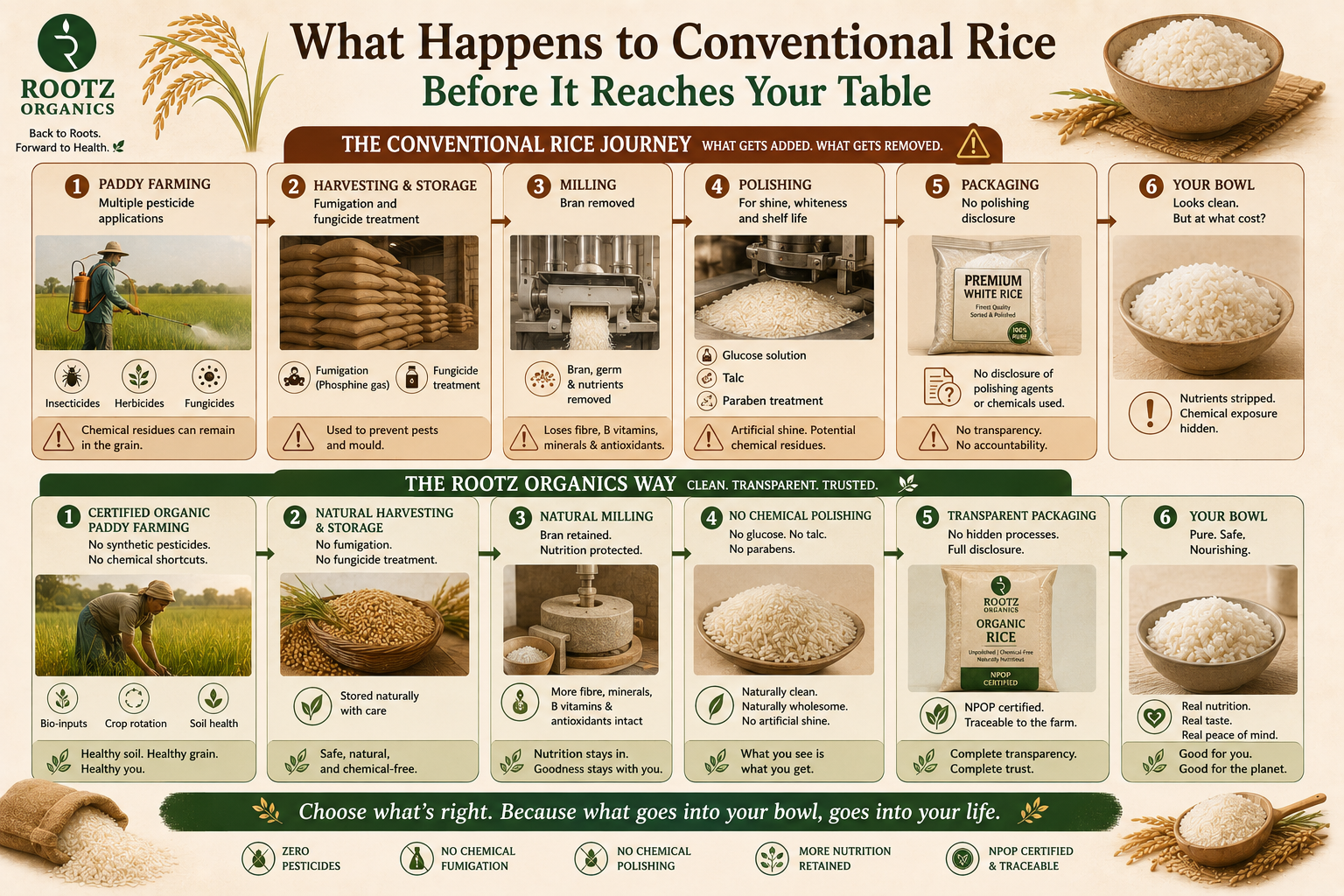
Paddy farming in India is chemically intensive. Herbicides are applied to manage weeds during the growing season. Insecticides protect the crop across multiple stages. Fungicides treat fungal disease during storage. By the time the paddy becomes the rice in your kitchen, it has been through a supply chain with chemical exposure at nearly every stage.
And then the polishing. Commercial white rice achieves its characteristic bright white appearance through a polishing process that strips the bran layer and then treats the grain surface with agents that enhance shine and extend shelf life. In India, glucose solution polishing is common. Talc-polished rice exists in the market. These are not disclosed on labels because labelling standards for polishing agents in rice are not mandatory.
The rice you serve at every meal. The curd rice that closes every South Indian lunch. The pongal on a Sunday morning. The kheer on a festival night. All of it passing through a supply chain that most families have never once examined, because rice felt too ordinary to question.
Organic Sona Masoori produced under verified conditions carries pesticide residue and heavy metal levels that comply with EU and USDA regulations. Conventional rice sourced from undisclosed farms and polished with undisclosed agents carries none of those assurances.
The gap between those two things is the gap between what most families are eating and what they think they are eating.
Why Sona Masoori, And What Makes It the Right Rice for Daily Eating
Not all rice is the same. And within the Indian rice landscape, Sona Masoori occupies a specific and important position.
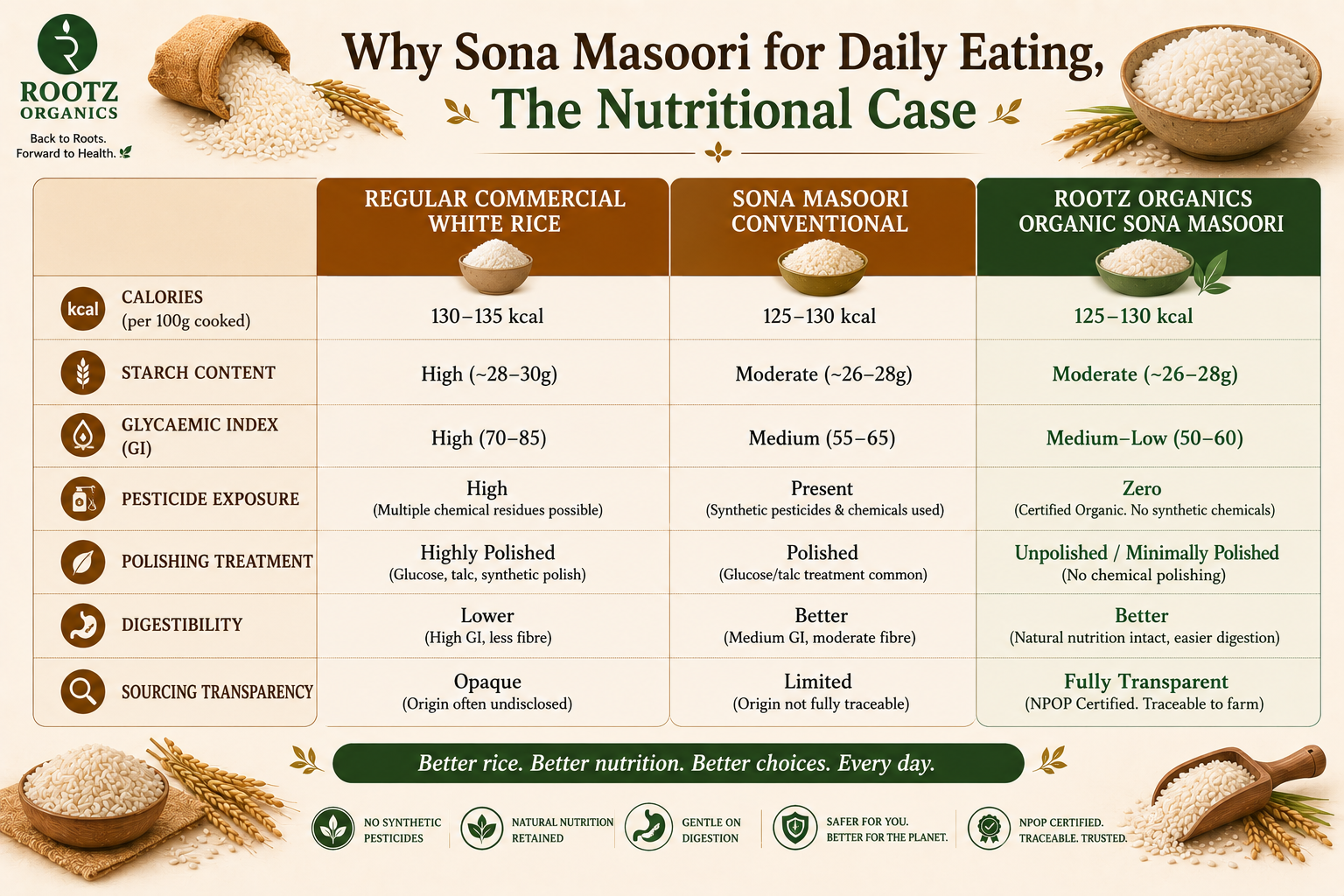
Sona Masoori is considered a healthier alternative to polished white rice, it contains fewer calories and starch, is easy to digest, and has a lower glycaemic index, making it a great choice for daily consumption especially for people focused on balanced nutrition.
Here is what the numbers show:
Calories: approximately 130 per 100g cooked. Lower than basmati, lower than most long-grain white rice varieties. For a family eating rice twice daily, this difference accumulates meaningfully across the week without requiring any change in how they eat.
Lower starch content than basmati. Sona Masoori has lower starch content than Basmati, making it a popular choice among health-conscious consumers and easier to digest for daily meals. Lower starch means less of the rapidly digestible carbohydrate that creates post-meal heaviness and the hunger that follows too quickly.
Glycaemic Index of approximately 64 for cooked Sona Masoori, moderate, and meaningfully lower in its actual blood sugar impact when eaten as part of a complete South Indian meal with dal, sambar, rasam, or curd, which further slow glucose absorption.
Light, fluffy, and aromatic. Organic Sona Masoori is a medium-grain, sweet-smelling rice that is lightweight and low in starch, grown in the southern states of India. It is not sticky. It is not heavy. It is the rice that South Indian cooking was built around because its texture and digestion profile are simply better suited to daily eating than the long-grain varieties.
Naturally gluten-free. Suitable for the entire family across every dietary need.
Versatility across every South Indian preparation. Pongal, curd rice, lemon rice, idli and dosa batter, biryani, khichdi, kheer. Sona Masoori performs across every preparation that South Indian and many other Indian regional kitchens require. It is not a specialist rice. It is the everyday rice. Which is exactly why the quality of its sourcing matters more than any other.
The Meals This Rice Is For
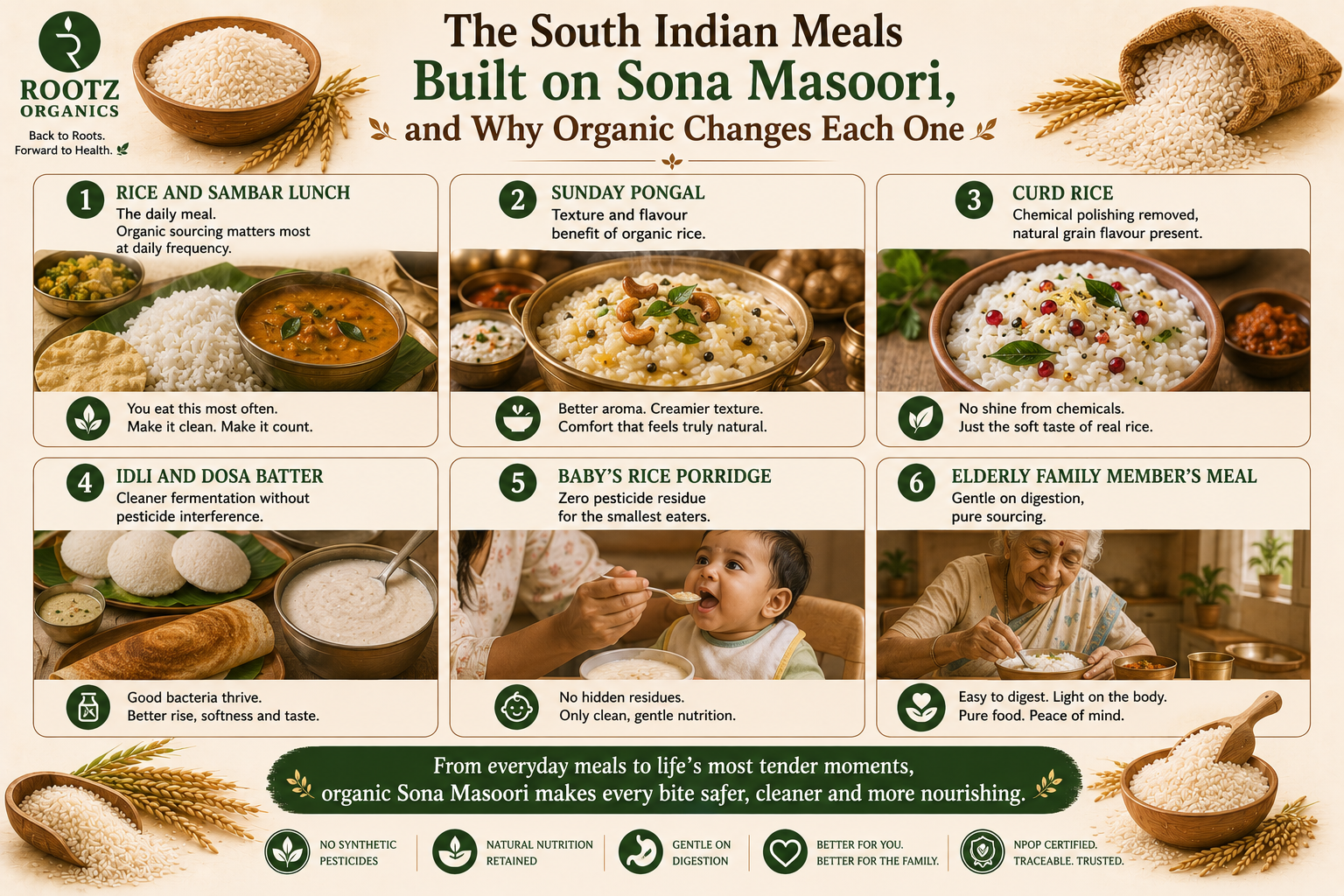
The daily South Indian lunch. Rice and sambar. Rice and rasam. Rice and curd. These are not special occasion meals. They are the foundation of daily nutrition for tens of millions of Indian families. The rice in these meals is eaten in larger quantities than any other ingredient at the table. Choosing organic Sona Masoori for these meals is not a premium decision. It is the obvious decision once you understand that the food eaten in the largest quantity deserves the highest sourcing standard.
The Sunday pongal. Sweet pongal and ven pongal are made from Sona Masoori because the rice's texture and starch profile create the specific consistency that pongal requires. Organic Sona Masoori produces pongal with a cleaner flavour and a depth that families who have made the switch consistently describe as the difference between pongal that is merely made and pongal that is genuinely good.
Curd rice. This is one of the most beloved preparations in South Indian cuisine, and one of the most sensitive to rice quality. The rice needs to be exactly the right softness, the right stickiness, the right flavour to carry the curd and the tempering. Organic Sona Masoori's natural flavour, without chemical polishing masking the grain's character, produces curd rice that tastes the way it is supposed to taste. Families who make the switch report immediately that the curd rice is different. Better. More the way they remember it from childhood.
Idli and dosa batter. Sona Masoori is one of the traditional batter rices for idli and dosa in South Indian households. The fermentation of organic rice, without pesticide residues that can interfere with microbial activity, produces a more reliably fermented batter. The idlis are softer. The dosas crisp more evenly. Clean rice ferments better because there is less competing with the natural fermentation process.
Rice for children and elderly family members. Sona Masoori rice is easy to digest and suitable for individuals with sensitive stomachs or digestive issues, preferred for its mild flavour and light texture. For households where the same rice is eaten by a toddler, working adults, and grandparents, Sona Masoori's digestibility profile means it works for every person at the table without compromise. Organic certification means the toddler's plate and the grandparent's plate contain no pesticide residue.
Why Rootz Organics Sona Masoori
Sona Masoori rice is one of the most loved and famous rice varieties from South India, aromatic, lightweight, low in starch, and versatile across every dish. Rootz Organics sources it with the standard every family meal deserves.
Every grain sourced from over 200 certified organic farms across South India. Zero pesticides. Zero chemical fertilisers. Zero GMOs. Third-party certified under NPOP, India's National Programme for Organic Production, independently audited with every batch traceable from the farm to your kitchen.
No chemical polishing. The rice is milled naturally without glucose solution, talc, or paraben treatments. The natural colour and aroma of the grain are what you receive, not a chemically enhanced approximation of freshness.
The grains are aromatic, medium-sized, and consistent in quality across every batch. They cook to the light, fluffy, slightly sticky texture that South Indian cooking requires, because they are the real variety, grown in the right conditions, processed without interference.
One ingredient. Organic Sona Masoori rice. Nothing added. Nothing treated. Nothing hidden.
The founder tests every product in her own kitchen first. Her family eats it before yours does. For the rice that appears at every meal, every day, that personal accountability is the only standard worth accepting.
Which Pack Is Right for Your Household
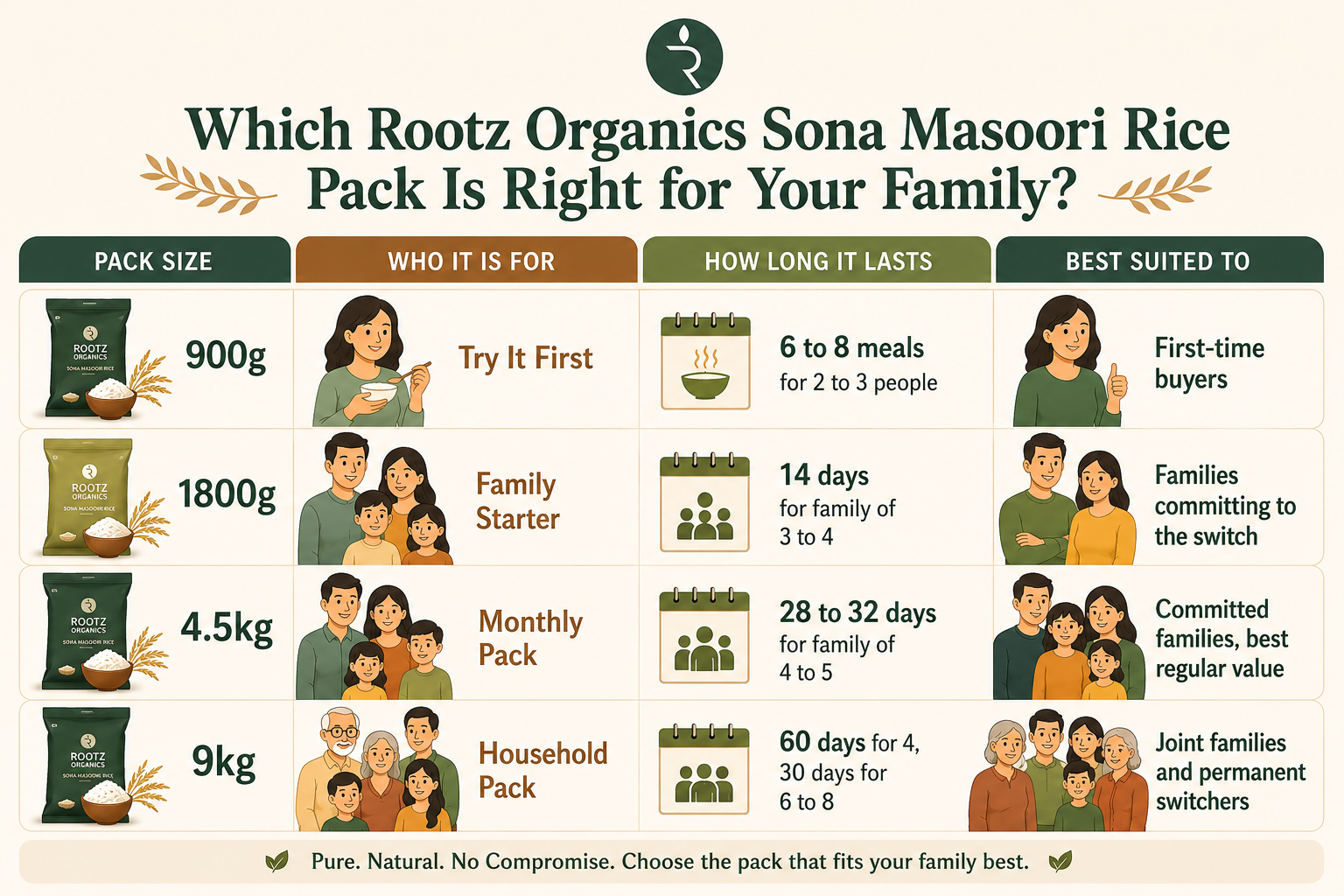
Same rice. Same certification. Same organic sourcing standard at every pack size. Choose based on how many people you are feeding and how frequently rice appears at your table.
900g: Try It First
For individuals, couples, or smaller households trying organic Sona Masoori for the first time. Approximately 6 to 8 meals for a family of two to three. Cook one pot of rice, one curd rice, one pongal. You will taste and feel the difference. Most families who cook with the 900g pack order the 1800g before it runs out, not because the pack is small, but because going back to conventional rice after tasting organic Sona Masoori stops feeling like an option.
Best for: First-time buyers, smaller households, individuals.
Order the 900g Pack: rootzorganics.in
1800g: The Right Start for a Family
Two weeks of rice for a family of three to four eating rice twice daily. Long enough to notice how the pongal tastes. How the curd rice feels different. How the idli batter ferments more reliably. How the daily meal tastes more like the way it used to taste before convenience and commercial sourcing changed everything quietly.
The 1800g is the pack where most families make the switch permanent.
Best for: Families of 3 to 4 making a genuine two-week commitment.
Order the 1800g Pack: rootzorganics.in
4.5kg: The Monthly Family Pack
One full month of organic Sona Masoori rice for a family of four eating rice twice daily. No mid-month reorder. No week where the organic pack runs out and you buy whatever is available at the nearest shop, which is almost certainly conventional.
The health benefit of eating organic rice is cumulative and daily. Reduced pesticide exposure at every meal, across every month, for every person at the table. That accumulation is the most important argument for committing to the monthly pack. More economical per kilogram than the smaller packs.
Best for: Families of 4 to 5 who have committed to organic Sona Masoori as their permanent daily rice.
Order the 4.5kg Pack: rootzorganics.in
9kg: For the Household That Has Decided
Two months of rice for a family of four, or a full month for a joint family of six to eight. The 9kg pack is for large households where rice consumption is high, the decision to switch to organic is permanent, and the per-kilogram cost matters.
Here is what the 9kg decision means across a year. A joint family of six eating conventional rice twice daily sits through over two thousand meals a year where pesticide residues and chemical polishing agents are present in the most consumed food on the table. Over a year of Rootz Organics Organic Sona Masoori, every one of those meals is clean. Every one of those bowls of curd rice, every pongal, every idli, made from rice that is exactly what it says it is. The 9kg pack is for the household that has done the maths.
Best for: Joint families of 6 to 8, or families of 4 wanting two months at the best per-kilogram value.
Order the 9kg Pack: rootzorganics.in
Ordering directly from rootzorganics.in gives you the freshest batch and supports the organic farming community across South India behind every pack.
What Families Notice After They Switch
The curd rice is the test.
Every South Indian family knows what good curd rice is supposed to taste like. It is specific. It is memory-deep. It is the flavour of the rice underneath the curd and the tempering that makes it what it is.
Families who switch to Rootz Organics Sona Masoori report immediately that the curd rice is different. More flavourful. More the way their mother made it or the way they remember it from a home that used to buy rice from a specific farmer who was known by name. The difference is the rice, not the recipe. Chemical polishing strips the natural flavour from the grain surface. Organic, naturally milled rice does not have that stripping. What you taste is the grain as it is.
The pongal is the second test. Sweet pongal made with organic Sona Masoori has a warmth and a fragrance during cooking that families describe as filling the kitchen differently. The rice's natural aroma, unmasked by chemical treatment, comes through in the ghee and the jaggery in a way that processed rice simply does not allow.
The idli batter ferments more consistently. This is the one that surprises families most. Fermentation is a microbial process, and pesticide residues in conventional rice can interfere with the bacteria responsible for fermentation. Organic rice, without those residues, produces a more reliable fermentation. The idlis are softer. The dosas are crispier. The batter behaves the way good batter is supposed to behave.
And the daily meal, the rice and sambar lunch that appears five or six times a week, simply feels lighter. Less heavy after eating. The lower starch content of Sona Masoori combined with the absence of chemical polishing produces rice that digests more comfortably and leaves less of the post-meal heaviness that most families have normalised as simply how rice feels.
Frequently Asked Questions
What makes Rootz Organics Sona Masoori different from the Sona Masoori I currently buy?
Two things. First, sourcing: certified organic paddy from over 200 verified farms, NPOP certified, zero pesticides, zero chemical fertilisers, zero GMOs. Conventional Sona Masoori is grown with significant pesticide use during paddy cultivation and storage. Second, processing: no chemical polishing. Commercial rice is routinely treated with glucose solution, talc, or other polishing agents to achieve the bright white appearance and shelf stability consumers expect. Rootz Organics rice is naturally milled without chemical surface treatment. The result is a grain that tastes of actual rice and cooks as Sona Masoori should cook.
Is Sona Masoori rice good for diabetes or blood sugar management?
Yes, relatively. Sona Masoori has a moderate glycaemic index of approximately 64, and its blood sugar impact is significantly reduced when eaten as part of a complete meal with protein or vegetables. The lower starch content compared to other white rice varieties means a slower digestion rate. Eaten as part of a South Indian meal with dal, sambar, rasam, or curd, the effective glucose response is meaningfully lower than rice eaten alone. Consult your doctor or dietitian for personalised advice if you are managing diabetes on medication.
Is organic rice genuinely worth the price difference over conventional rice?
Yes, and the argument is simpler than it seems. Rice is eaten in larger quantities and at higher frequency than almost any other food in an Indian household. The pesticide exposure from conventional rice is therefore not occasional. It is daily, consistent, and accumulative. The premium for organic rice, spread across the number of meals it covers, is smaller per meal than most families expect. And it eliminates the most frequent source of food-chain pesticide exposure in the household.
Why is Sona Masoori specifically better for everyday eating than Basmati?
Sona Masoori has fewer calories compared to Basmati, is easy to digest, and beneficial for weight management. Its lower starch content makes it lighter on the digestive system at the frequency of daily eating. Basmati is exceptional for biryani and pilaf, dishes where the long-grain texture and aroma are essential. For the daily meal, the curd rice, the pongal, the idli batter, Sona Masoori's texture, digestibility, and calorie profile make it the more appropriate choice.
Does organic Sona Masoori look different from commercial rice?
It may appear slightly less uniformly white because it has not been chemically polished to achieve commercial brightness. The natural colour of the grain, without glucose or talc treatment, is a clean white with natural variation. The aroma is more present, the characteristic mild sweetness of Sona Masoori is more detectable before and during cooking when the grain surface has not been chemically treated.
Is Rootz Organics Sona Masoori certified organic, not just labelled that way?
Yes. Third-party certified under NPOP, India's National Programme for Organic Production. Sourced from 200-plus verified organic farms. Zero pesticides, zero chemical fertilisers, zero GMOs. Every batch independently traceable from the paddy field to your pack. Not a self-declaration. A verified, audited standard.
Which pack size should I start with?
Start with the 1800g if you are feeding a family of three or four. It gives you two weeks of organic Sona Masoori across daily meals, which is enough to experience the curd rice, the pongal, the fermented batter, and the daily lunch in a way that makes the difference clear. Most families who complete the 1800g do not go back. If you are already committed, the 4.5kg covers a month and the 9kg is the right call for larger households.
How do I store Rootz Organics Sona Masoori rice?
Airtight container or sealed bag, cool and dry place, away from direct sunlight and moisture. Organic rice without chemical preservatives or anti-insect treatments is more susceptible to moisture and pest exposure than commercially treated rice. For large packs, divide into two or three airtight containers and keep only the container in current use accessible. Consume within 6 months of purchase for best freshness and flavour.
Health and happiness. Always.


