

Organic Sprouted Jowar Flour: You Switched to Jowar. Now Get Everything It Was Holding Back.
Available in 900g and 1800g | rootzorganics.in
You already made the smart choice.
You switched to jowar. You ditched the wheat bloat, the post-meal heaviness, the blood sugar climb. You started making bhakris, jowar rotis, jowar chilla, and your gut noticed the difference.
But here is what nobody told you when you made that switch.
Regular jowar flour, even the best stone-ground variety, contains phytic acid. And phytic acid has been quietly binding to the iron, the zinc, and the most powerful antioxidant compounds in your jowar before your body could absorb them.
You switched to one of the most nutritious grains in the world. You have been receiving a fraction of what it was always capable of giving.
Sprouted jowar flour is jowar with that fraction closed. The same grain. The same gluten-free, low-GI, antioxidant-rich profile you already trust. With the last barrier between you and its full nutritional power dismantled, from the inside, before the flour reaches your kitchen.
This is not a different flour. It is the complete version of the one you already believe in.
Order Rootz Organics Organic Sprouted Jowar Flour: rootzorganics.in
What Regular Jowar Was Keeping From You
Jowar is exceptional. It is completely gluten-free, a complex carbohydrate that gets absorbed slowly into the bloodstream, ideal for individuals with diabetes or those who are pre-diabetic, and remarkably high in phytochemicals known for their anti-inflammatory and antioxidant properties. This is not marketing. It is what science has consistently shown about sorghum for decades.
But jowar, like all whole grains, contains phytic acid in its outer bran layer. And phytic acid is the grain's natural mineral lock. It binds to iron, zinc, and magnesium before your digestive system can absorb them, and carries them out.
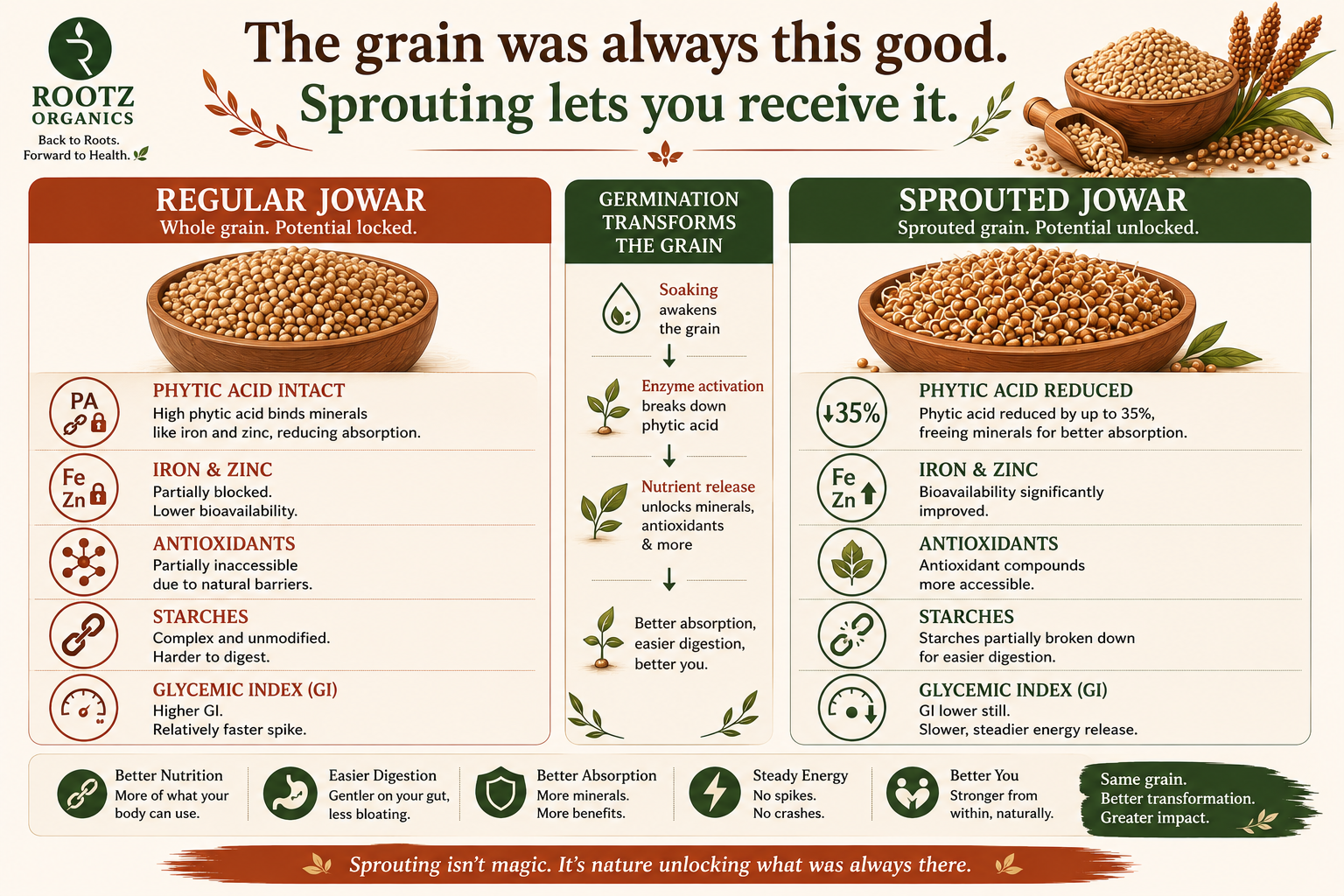
Research published in PubMed confirmed it precisely: germination of sorghum reduced phytate content by up to 35 percent, and in vitro bioavailability of iron and zinc were significantly improved as a result. The iron and zinc were always in the jowar. Phytic acid was deciding how much of them reached your bloodstream.
Sprouting is the process that unlocks this. When a jowar grain is soaked and allowed to germinate, it activates enzymes that break down phytic acid from the inside. The minerals are released. The antioxidant phenolic compounds become more bioavailable. The complex proteins and starches are partially pre-digested, making the flour significantly easier on the gut. And the glycaemic index drops further still, because germination partially breaks down the starches before the flour ever reaches your tawa.
Germination is an efficient method for grain modification that gives improved technological properties without chemical modification or genetic engineering. Nothing artificial. Nothing engineered. Just the grain being allowed to complete what nature intended.
What Sprouted Jowar Flour Delivers, The Full Picture
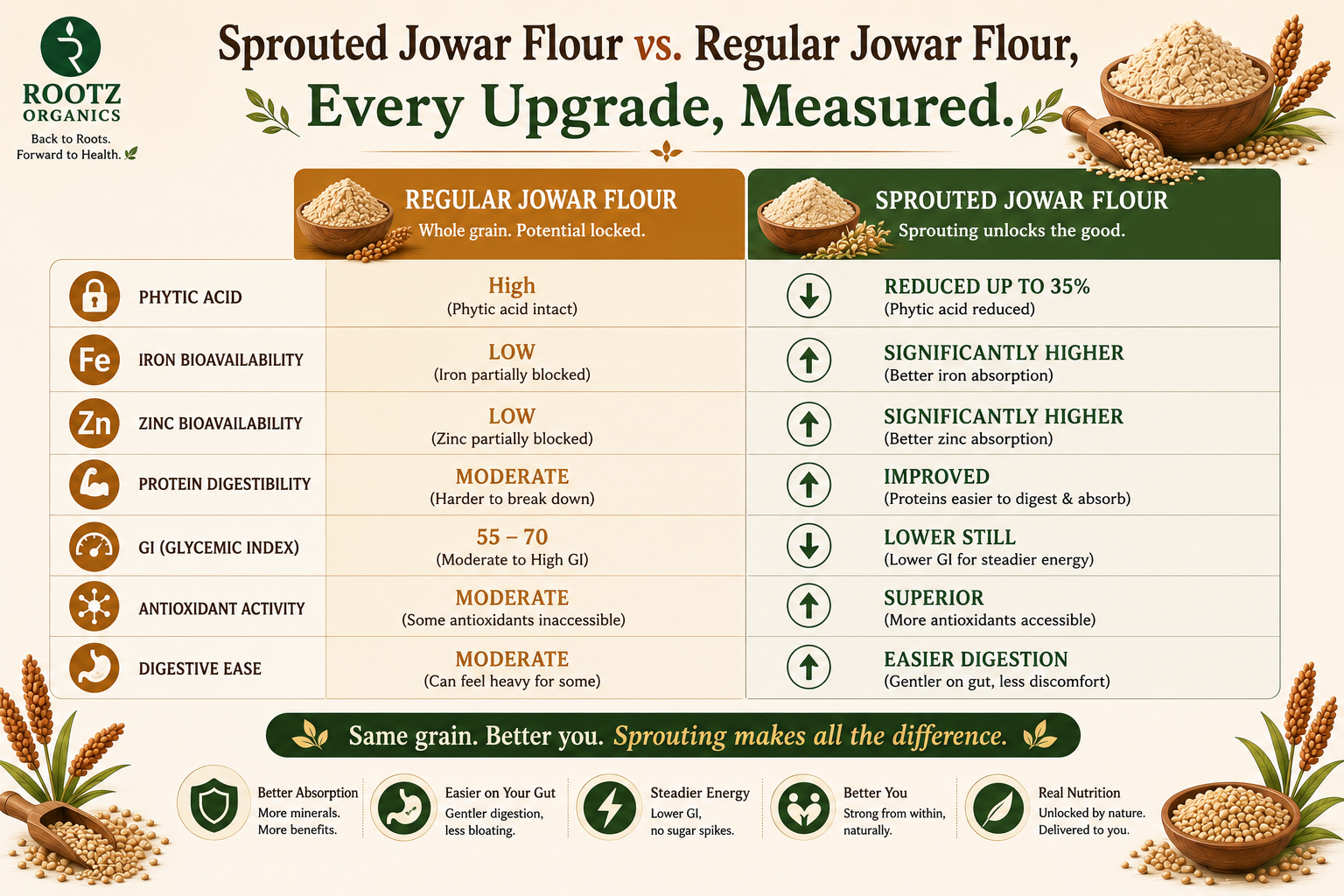
Gluten-free. Completely and naturally. Jowar flour is entirely gluten-free, boosting your health journey forward for all health-conscious people looking for a great flour substitute to avoid the unnecessary bloating caused by gluten. Sprouting does not change this. It enhances every other property while keeping the gluten-free integrity of the grain absolute.
Glycaemic Index: lower than regular jowar. Jowar already has a low GI. Sprouting reduces it further by partially breaking down complex starches before milling. For diabetics, pre-diabetics, and anyone managing insulin resistance, this is not a marginal gain. It is a measurably flatter post-meal glucose curve from the same bhakri your family has always made.
11g of protein and 8g of fibre per 100g, delivered with significantly higher bioavailability than unsprouted jowar because the sprouting process has partially pre-digested the proteins and reduced the anti-nutrients blocking mineral and nutrient absorption.
Iron and zinc, finally accessible. These are not nutrients most Indian families track consciously. But iron deficiency anaemia affects more than 50 percent of Indian women. Zinc deficiency is one of the most common and most under-diagnosed micronutrient gaps in Indian children. Both are present in jowar. Both are significantly more absorbable from sprouted jowar than from the unsprouted grain.
Antioxidants that fight more effectively. The sprouted sorghum flour extract showed better lipid-peroxidation-inhibition capacity compared to unsprouted sorghum. In plain terms: the antioxidants in sprouted jowar are more active at neutralising free radicals and reducing oxidative stress than the same antioxidants in regular jowar flour. For a grain already known for its anti-inflammatory properties, this is the upgrade that compounds every benefit it already had.
Easier on digestion. Complex proteins and starches partially broken down before milling means your digestive system does less work processing each roti. For families dealing with sluggish digestion, gut sensitivity, or anyone whose stomach simply works harder than it should, sprouted jowar flour removes a significant layer of that burden before the food reaches the kitchen.
The People Who Feel This Most
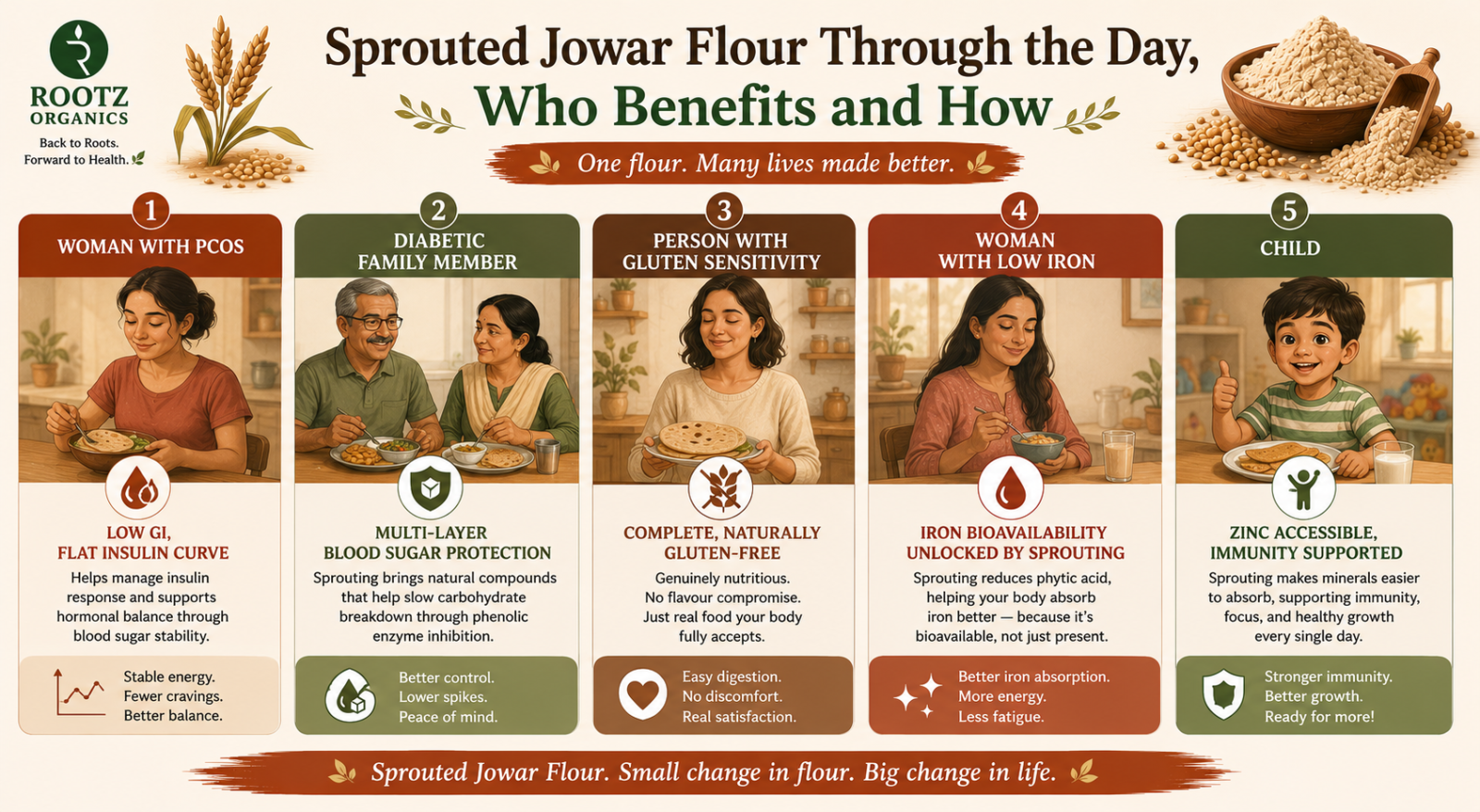
Women managing PCOS. This is the conversation the Indian health industry is not having loudly enough. PCOS affects 1 in 5 Indian women of reproductive age. At the root of PCOS is insulin resistance, the body producing too much insulin in response to blood sugar, which drives the hormonal cascade behind irregular cycles, weight gain, and fertility challenges. A low-GI, high-fibre flour that flattens the post-meal glucose curve at every meal is one of the most consistent dietary levers available for managing insulin resistance. Sprouted jowar does this better than regular jowar, which does it better than wheat. For women with PCOS eating rotis twice a day, every day, the flour choice is not a small variable. It is a daily hormonal input.
Anyone with Type 2 diabetes or pre-diabetes. Sprouted jowar millet flour is ideal for managing diabetes and sugar control diets. The combination of reduced phytic acid, partially broken-down starches, high fibre, and phenolic compounds that actively inhibit starch-digesting enzymes creates a multi-layered blood sugar protection mechanism that no refined or even regular whole grain flour can match.
People with gluten sensitivity who are tired of bland alternatives. Most gluten-free flours are nutritionally thin and texturally disappointing. Sprouted jowar is neither. It makes rotis and bhakris with genuine flavour, genuine nutrition, and a texture that does not require explanation or apology. It is not a compromise. It is the better choice.
Families where iron or zinc deficiency has been flagged. The doctor has told you to eat more iron-rich food. You are doing it. The missing conversation is whether the iron in your food is actually reaching the bloodstream. Phytic acid in unsprouted grains blocks a significant portion of it. Sprouting removes that block. Sprouted jowar flour is iron delivered, not just iron present.
Children and growing bodies. Zinc supports immunity, growth, and cognitive development during the years when nutrition most directly shapes outcomes. Sprouted jowar delivers zinc with a bioavailability that unsprouted jowar cannot match. In a form, roti, bhakri, dosa, that children eat without negotiation.
What Families Notice When They Switch From Regular Jowar to Sprouted
The rotis are softer.
This is the first thing most families say. Sprouting partially breaks down the complex proteins in jowar that can make unsprouted jowar flour dough stiff and difficult to roll. The dough from sprouted jowar is more pliable, the rotis roll with less effort, and the finished bhakri has a slightly lighter texture than the version they were making before.
The flavour is warmer and more nuanced. The germination process generates free sugars, natural, not added, that give sprouted jowar flour a gentle sweetness that regular jowar does not have. Families describe the bhakri as tasting more complete, more satisfying. Children who resisted jowar rotis before accept sprouted jowar rotis more readily.
The digestion is noticeably lighter. Families who made the switch from regular jowar to sprouted jowar, not from wheat, but from regular jowar, consistently report meals that sit more comfortably, a gut that settles faster, and an absence of the occasional heaviness that even a good whole grain can produce when its starches are fully intact.
The blood sugar response is measurably different for the members of the household who track it. Same meal. Same portion. Flatter curve. This is the sprouting working exactly as the science says it should.
Why Rootz Organics Sprouted Jowar Flour
The sprouted grain category has one problem: the word "sprouted" on a label tells you very little about whether the sprouting process was completed properly.
Minimum sprouting, just enough to qualify for the label, produces flour with almost none of the phytate reduction, protein digestibility improvement, or antioxidant enhancement that proper germination achieves. The duration, the temperature, the conditions, and the verification that the process completed: these are what separate genuine sprouted flour from flour that carries the word as a marketing term.
Rootz Organics organic sprouted jowar flour begins with certified organic sorghum sourced from over 200 verified farms across India. Zero pesticides. Zero chemical fertilisers. Zero GMOs. Third-party certified under NPOP, India's National Programme for Organic Production, independently audited with every batch traceable from farm to pack.
The grain is soaked and germinated under controlled conditions until the transformation completes: phytic acid reduced, enzymes activated, starches partially broken down, nutrients unlocked. Then stone-ground at low heat on traditional chakki so that every benefit the germination created arrives in your flour intact.
One ingredient. Organic sprouted jowar. Nothing added. Nothing removed.
The founder tests every product in her own kitchen first. Her family eats it before yours does. For a product where the quality of the sprouting process is invisible to the consumer, that personal accountability is not a brand story. It is the only guarantee that matters.
900g or 1800g: Which Pack Fits Your Kitchen
900g: The Right Place to Start
For smaller households, individuals, or anyone switching from regular jowar to sprouted jowar for the first time. Approximately 25 to 30 generous servings, enough for two to three weeks of daily jowar rotis for a small family or a month for an individual.
Make one bhakri with this flour. The dough will tell you immediately that this is different. The finished roti will confirm it. Most families who open the 900g pack order the 1800g before it runs out, not because the pack is small, but because once you eat sprouted jowar rotis consistently, the idea of going back to regular jowar flour stops making sense.
Best for: Individuals, smaller households, or first-time sprouted jowar buyers.
Order the 900g Pack: rootzorganics.in
1800g: The Household Commitment
For families of three to five who make jowar rotis regularly, the 1800g pack is a full month of sprouted jowar cooking with no reorder, no gap, and no week where you fall back on regular jowar or wheat flour because the pack ran out.
The benefits of sprouted jowar compound with consistency. The iron bioavailability improves meal by meal. The insulin response flattens across weeks for the family member managing blood sugar or PCOS. The gut that keeps getting lighter. These are not one-roti results. They are the accumulated effect of a flour that is working properly at every meal, every day, without interruption.
The 1800g pack is also more economical per roti than the 900g. One order. One month. The complete version of the grain you already believe in, working at full capacity.
Best for: Families of 3 to 5 who cook jowar rotis regularly and want uninterrupted benefit.
Order the 1800g Pack: rootzorganics.in
Ordering directly from rootzorganics.in gives you the freshest germinated and stone-ground batch and supports the organic farming community behind every pack.
How to Use Rootz Organics Sprouted Jowar Flour
Jowar bhakri: Add warm water gradually and knead to a soft dough. The sprouted flour is noticeably more pliable than regular jowar flour. Pat or roll to a medium thickness, cook on a hot tawa, and finish directly on the flame for the char that makes bhakri what it is. Serve with A2 cow ghee, which increases absorption of the fat-soluble antioxidants the flour carries.
Jowar roti: Thinner than bhakri, rolled like a regular roti. The sprouted dough handles well. Pairs with any dal, sabzi, or curd-based preparation.
Jowar dosa or cheela: Mix with water to a thin batter, add cumin, curry leaves, and coriander. Pour onto a hot tawa. A gluten-free, high-protein breakfast that takes four minutes and leaves the stomach lighter than any wheat-based alternative.
Jowar porridge: Mix flour with water or milk, cook on low heat, add jaggery or salt depending on preference. A traditional morning preparation that is particularly well-suited for children, the elderly, and anyone recovering from illness who needs gentle, nourishing food.
Frequently Asked Questions
What is the difference between sprouted jowar flour and regular jowar flour?
Both are made from sorghum. The difference is the germination step. Regular jowar flour is ground from unsprouted grain and retains phytic acid intact, which partially blocks the absorption of iron, zinc, and magnesium. Sprouted jowar flour is made from jowar grains soaked and germinated until phytic acid is reduced by up to 35 percent, significantly improving the bioavailability of iron and zinc. Sprouting also partially breaks down complex proteins and starches, improving digestibility and lowering the glycaemic index further. The antioxidant activity of the sprouted flour is also measurably superior. Same grain. Every nutritional advantage improved.
Is sprouted jowar flour good for PCOS?
Yes, and specifically so. PCOS is driven primarily by insulin resistance. A low-GI, high-fibre flour that produces a flat post-meal glucose curve at every meal reduces the insulin spikes that worsen PCOS hormonal imbalance. Sprouted jowar has a lower GI than regular jowar, which already has a lower GI than wheat. For women managing PCOS through diet, the flour used at every meal is one of the most consistent and impactful daily variables available. Consult your doctor or dietitian for personalised dietary advice.
Is it completely gluten-free?
Yes. Jowar is sorghum, a grain with no relationship to wheat, barley, or rye. It is completely and naturally gluten-free. Sprouting does not alter this. Rootz Organics processes sprouted jowar in a dedicated facility to protect its gluten-free integrity from cross-contamination.
Is sprouted jowar flour good for diabetics?
Yes. The combination of reduced phytic acid, partially pre-digested starches, high fibre at 8g per 100g, and phenolic compounds that inhibit starch-digesting enzymes creates multiple layers of blood sugar protection. The GI is lower than regular jowar flour, which is already low. Post-meal glucose curves are measurably flatter. Consult your doctor before dietary changes if you are on blood sugar medication.
Will my family accept jowar rotis and bhakris?
Sprouted jowar flour makes a more pliable dough and softer rotis than regular jowar flour, because the sprouting process partially breaks down the proteins that make unsprouted jowar stiff. The flavour has a gentle natural sweetness from the free sugars generated during germination. Most families who struggled with regular jowar flour find sprouted jowar significantly easier to cook with and more palatable to eat. Children who resisted jowar typically accept the sprouted version more readily.
How long do the 900g and 1800g packs last?
The 900g pack gives approximately 25 to 30 servings. For a small family eating jowar rotis at one meal daily, this covers two to three weeks. For an individual, closer to a month. The 1800g covers a family of three to four eating jowar rotis twice daily for approximately 3 to 4 weeks. Both packs should be stored in an airtight container, cool and dry place. Refrigerate during summer. Consume within 30 days of opening for best freshness.
Is Rootz Organics sprouted jowar flour genuinely certified organic?
Yes. Third-party certified under NPOP, India's National Programme for Organic Production. Sourced from 200-plus verified organic farms. Zero pesticides, zero chemical fertilisers, zero GMOs. Every batch independently traceable from farm to pack. The sprouting process is controlled and verified, not minimal or cosmetic.
Why choose sprouted over regular jowar if I have already switched from wheat?
Because switching from wheat to regular jowar was the right first move. Switching to sprouted jowar completes it. Regular jowar gives you gluten-free, low-GI, antioxidant-rich nutrition with phytic acid partially blocking the minerals. Sprouted jowar gives you all of that with the mineral barrier removed, protein digestibility improved, GI lowered further, and antioxidant activity enhanced. If you eat jowar every day, the difference between regular and sprouted compounds across every meal. Over a month, it is significant. Over a year, it is the difference between receiving most of what the grain offers and receiving all of it.
Health and Happiness. Always.


