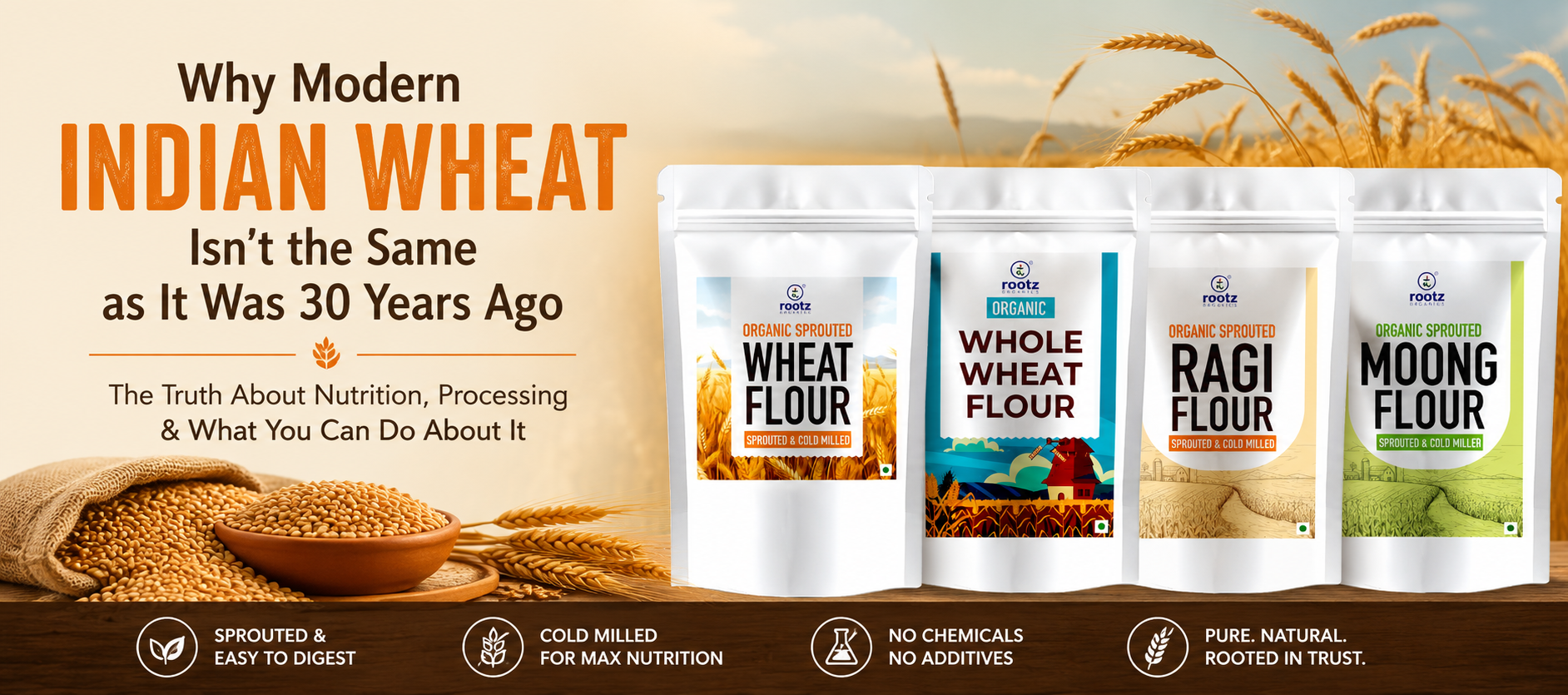
Why Modern Indian Wheat Isn't the Same as It Was 30 Years Ago
Ask any grandmother in rural Punjab or Madhya Pradesh, and she will tell you that today's roti simply does not taste, chew, or digest the way it once did. That's not nostalgia talking. The debate around Modern Wheat vs Traditional Wheat is backed by decades of agricultural data, nutrition research, and farming records. Wheat is India's second-largest staple crop, and the variety sown in most fields today is genetically and agronomically different from what was harvested three decades ago.
This shift didn't happen overnight, and it wasn't accidental. It was the outcome of deliberate breeding programs designed to solve a very real problem: feeding a growing population. But solving one problem created a new set of questions around nutrition, digestibility, and long-term health that Indian households are only beginning to ask.
What Is the Real Difference Between Modern Wheat and Traditional Wheat?
Modern wheat refers to short-stemmed, high-yield hybrid varieties developed after the 1960s Green Revolution, bred primarily for higher output per acre and disease resistance. Traditional wheat refers to older, tall-stemmed desi varieties such as Sharbati, Kathia, and Emmer (Khapli) that were grown across India before large-scale hybridisation, and that generally carry different gluten structures and mineral profiles.
How India's Wheat Varieties Changed After the Green Revolution
India's wheat transformation began in the mid-1960s, when the country faced severe food shortages and depended heavily on imported grain. Agricultural scientists introduced semi-dwarf wheat varieties developed with support from international breeding programs, and farmers adopted them at record speed because the results were immediate and dramatic.
The Shift to Dwarf, High-Yield Varieties
Pre-1960s Indian wheat plants were tall, with long stems that often collapsed under the weight of heavy grain heads, especially when fertiliser was applied generously. Farmers called this "lodging," and it could wipe out a large share of a season's harvest overnight after a single storm. The new dwarf varieties solved this problem by redirecting the plant's energy from stem growth into grain production, allowing fields to absorb far more fertiliser and irrigation without collapsing. Within a decade, wheat output in states like Punjab and Haryana multiplied several times over, turning India from a grain-importing nation dependent on foreign food aid into a self-sufficient one by the mid-1970s.
This transition also changed how wheat was grown at a structural level. Traditional wheat farming relied on mixed cropping, longer growing cycles, and minimal external inputs, with farmers saving seed from their own harvest year after year. Modern wheat farming, by contrast, depends on purchased hybrid seed, calibrated fertiliser schedules, and assured irrigation, which is why it took root fastest in irrigated regions like Punjab and slowest in rain-fed belts of central India, where many older cultivars survived simply because the new varieties didn't perform as well without canal water.
Why Yield Became the Priority Over Nutrition
Breeding programs of that era were built around one metric: tonnes per hectare. Nutritional density, mineral content, and digestibility were not part of the selection criteria, simply because the immediate national priority was avoiding famine. Over successive breeding cycles, this yield-first approach shaped nearly every popular commercial wheat variety grown in India today.
What Nutritional Changes Have Scientists Found in Modern Wheat?
Peer-reviewed agricultural studies comparing old and new wheat cultivars have recorded measurable declines in several minerals alongside changes in protein structure. These aren't marketing claims; they come from side-by-side cultivar trials conducted by agricultural universities and food science institutions over the last two decades.
Protein and Gluten Content Differences
Modern high-yield wheat varieties tend to carry a different balance of gluten-forming proteins compared to older landraces. Breeders selected for stronger, more elastic gluten because it makes commercial dough easier to machine-process and helps bread hold its shape in industrial bakeries. Traditional wheat varieties, in contrast, generally have a softer, less concentrated gluten structure, which is part of why many people report easier digestion with heritage grains like Khapli wheat.
Micronutrient Decline: Zinc, Iron, and Magnesium
Multiple cultivar-comparison studies have observed a "dilution effect," where a sharp rise in starch and grain yield is not matched by a proportional rise in mineral uptake from the soil. As a result, several modern wheat varieties show lower concentrations of zinc, iron, and magnesium per 100 grams compared to older cultivars grown under similar conditions. For a population where iron-deficiency anaemia already affects a large share of women and children, this decline is not a trivial detail.
Why Do More People React to Wheat Today Than 30 Years Ago?
Reported wheat sensitivity, bloating, and gluten intolerance have risen sharply across urban India over the past two decades, and researchers point to more than one contributing factor. Higher gluten concentration, faster industrial processing that skips traditional fermentation, and reduced dietary diversity all play a role.
Traditional Indian wheat preparation almost always involved a resting or fermentation step, whether it was a slow-proofed dough or naturally leavened bhakri batter. This process allowed enzymes and wild yeasts to partially break down gluten before the wheat was even cooked, easing digestion. Most commercial flour today skips this step entirely, going straight from mill to packet to kitchen. For households looking to reduce this load, rotating in gluten free flours for part of the week is a practical middle ground rather than an all-or-nothing switch.
Traditional Wheat Varieties Still Grown in India
Despite the dominance of commercial hybrid wheat, pockets of traditional cultivation have survived, largely through small farmer cooperatives and organic growers who never switched over.
- Sharbati Wheat – grown mainly in Madhya Pradesh's Sehore belt, known for its golden colour and naturally sweeter grain.
- Kathia Wheat – a hard, high-protein desi variety historically used for dalia and coarse flour.
- Emmer or Khapli Wheat – one of the oldest cultivated wheat species in the world, low in modern gluten strength and grown in parts of Maharashtra, Karnataka, and Gujarat.
These varieties yield less per acre, often 20 to 30 percent below dwarf hybrid wheat under the same conditions, which is precisely why large-scale commercial agriculture moved away from them. What they lose in volume, they generally make up for in resilience: many of these older cultivars tolerate drought stress and poor soil better than modern hybrids, since they were never bred to depend on heavy irrigation and fertiliser in the first place. For households prioritising nutrition density over shelf appeal, sourcing stone-ground organic wheat flour milled from these older cultivars is one of the more direct ways to close the nutritional gap.
How to Choose Better Wheat and Flour Today
Choosing wheat today is less about brand names and more about understanding what happened between the field and the flour mill. The comparison below breaks down the practical differences a shopper actually encounters.
Modern Wheat vs Traditional Wheat: A Quick Comparison
- Plant height and yield: Modern wheat is short-stemmed and high-yielding; traditional wheat is tall-stemmed with moderate yield.
- Gluten strength: Modern wheat has stronger, more elastic gluten suited to industrial baking; traditional wheat has softer gluten, generally easier to digest.
- Mineral density: Traditional cultivars tend to retain higher zinc, iron, and magnesium levels per serving.
- Processing: Traditional flour is usually stone-ground and minimally refined; modern commercial flour is often roller-milled and bleached.
- Farming scale: Modern wheat dominates large commercial farms; traditional wheat survives mainly through small and organic growers.
When reading a flour packet, look for the milling method, the variety name if listed, and whether the flour has been stone-ground rather than roller-milled, since roller-milling strips away the bran and germ where most minerals are concentrated. Buying organic flours online from sources that disclose the wheat variety and milling process removes much of this guesswork.
Beyond Wheat: Why Millets Like Ragi and Jowar Are Gaining Ground
Wheat fatigue has pushed many Indian households to rediscover millets that their own grandparents once relied on daily. Ragi (finger millet) is naturally gluten-free and carries notably higher calcium levels than wheat, making organic ragi flour a common substitute for children's and elders' diets. Jowar (sorghum) offers a similar gluten-free profile with a good fibre content, and organic jowar flour is increasingly used for rotis, dosas, and porridge in place of refined wheat flour. Rotating wheat with these grains a few days a week is a simple, low-effort way to broaden nutrient intake without giving up familiar Indian meals entirely.
Expert Insight: What Sourcing Grain Directly Teaches You
Working directly with small and organic wheat growers across India reveals a pattern that lab data alone doesn't fully capture: farmers who still grow older desi varieties describe them as more forgiving crops, requiring less irrigation and chemical input, but demanding more patience at harvest because the yield curve is slower and less predictable. This is the trade-off India made in the 1960s out of necessity, choosing speed and volume over slower, mineral-rich cultivars — and it is the same trade-off today's consumers are left weighing, crop by crop and packet by packet, when they decide how much of it they're willing to accept in their own kitchens.
In Short :-The story of Indian wheat over the last 30 years is really a story of trade-offs: the Green Revolution's dwarf, high-yield varieties solved a genuine food security crisis but reshaped the grain's gluten strength and mineral content along the way. Traditional cultivars like Sharbati, Kathia, and Khapli still exist, grown mostly by small and organic farmers who prioritise quality over volume. Understanding this difference lets Indian households make an informed choice rather than an automatic one every time they buy a bag of atta.
Frequently Asked Questions
Is modern wheat actually worse for health than traditional wheat?
Modern wheat is not inherently unsafe, but studies show it generally has stronger gluten and lower mineral density than older desi varieties. For most people it is well tolerated, though those with digestive sensitivity often do better with traditional or stone-ground alternatives.
Why has wheat intolerance increased in India over the last 30 years?
Higher gluten content in commercial hybrid wheat, faster industrial milling that skips traditional fermentation, and reduced grain diversity in daily diets are the main factors researchers link to rising wheat sensitivity across urban India.
What is Khapli or Emmer wheat, and is it better than regular wheat?
Khapli wheat is an ancient low-gluten wheat variety grown in parts of Maharashtra and Gujarat. It is generally easier to digest and retains more minerals than modern hybrid wheat, though it yields less per acre, which is why it remains a niche rather than mainstream crop.
Can I replace wheat flour completely with ragi or jowar flour?
Complete replacement is possible but not always practical, since ragi and jowar behave differently in dough and lack the elasticity wheat provides. Most nutritionists suggest rotating wheat with ragi or jowar flour a few days a week rather than eliminating wheat outright.
How can I tell if a wheat flour is closer to traditional or modern processing?
Check the packaging for the milling method and variety name. Stone-ground flour that lists a specific wheat cultivar, and retains visible bran flecks, is generally closer to traditional processing than fine, bleached, roller-milled flour with no variety disclosed.
Is organic wheat flour the same as traditional wheat flour?
Not always. Organic certification refers to farming practices free of synthetic chemicals, while "traditional" refers to the wheat variety itself. Organic wheat flour can still come from a modern hybrid variety, so checking both the farming method and the cultivar gives the most complete picture.
-
Healthy School Tiffin Ideas Using Millets and Sprouted Flours
July 22nd, 2026 -
 July 16th, 2026