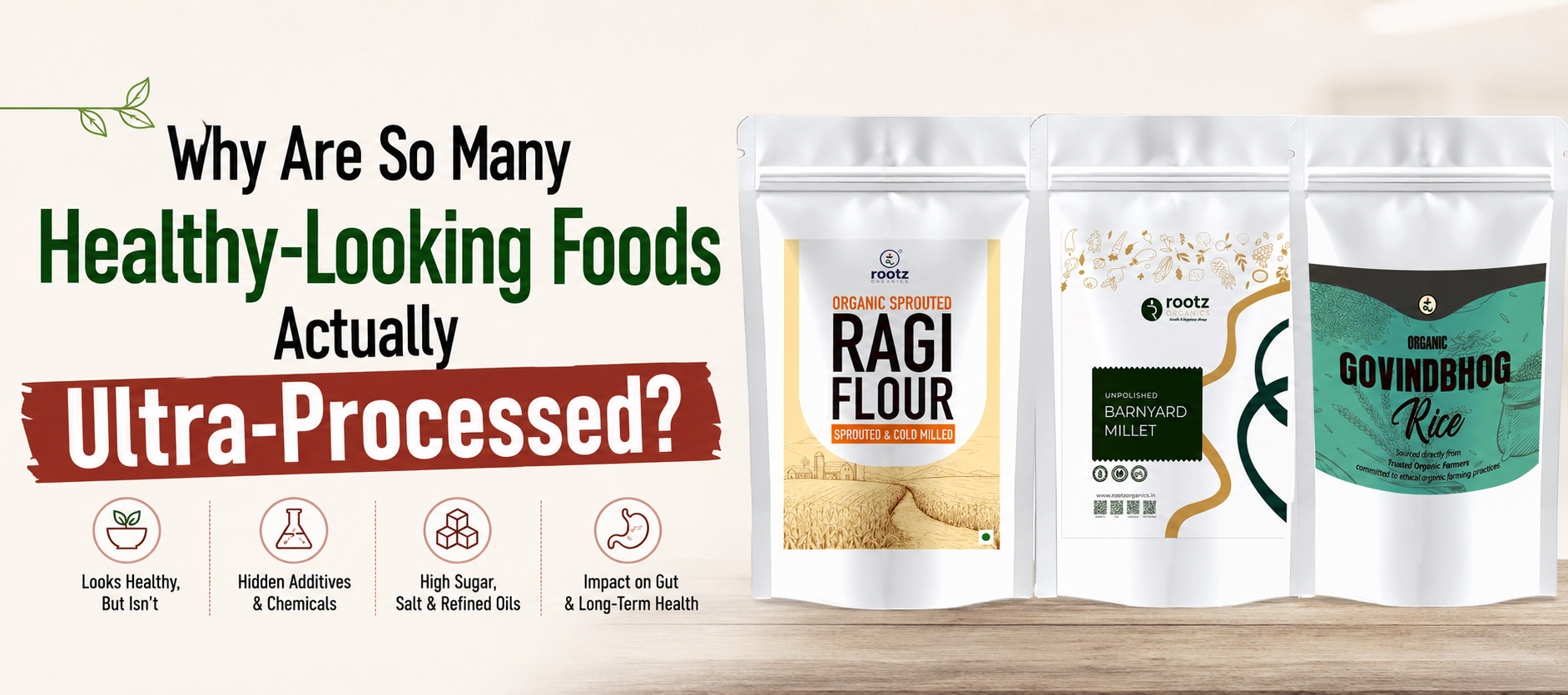
Why Are So Many Healthy-Looking Foods Actually Ultra-Processed
Walk down the "health food" aisle of any Indian supermarket and you will see the same words repeated on package after package: multigrain, protein-rich, no added sugar, natural flavour. Most shoppers assume these labels mean the product is close to real food. In many cases, it is not. A large share of what gets marketed as nutritious is, by scientific classification, ultra-processed food engineered for shelf life, flavour intensity, and repeat purchase rather than nourishment.
Ultra-processed food is an industrially formulated product made mostly from refined ingredients and additives — such as emulsifiers, flavour enhancers, and protein isolates — rather than from whole or minimally altered foods. It is built in a factory to a recipe, not cooked in a kitchen, and it is designed to be hyper-palatable, cheap to produce, and long-lasting on a shelf.
What Actually Separates Whole Food From Industrially Formulated Snacks?
The distinction comes from the NOVA food classification system, developed by researchers at the University of São Paulo and now widely referenced in nutrition science, including India's own dietary guidance. NOVA sorts food into four groups: unprocessed or minimally processed foods, processed culinary ingredients like oil or ghee, processed foods such as home-style pickles or canned vegetables, and heavily processed formulations built almost entirely from industrial ingredients.
What separates the last category from ordinary processed food is not the number of steps involved, but the ingredients themselves. If a product's ingredient list includes substances a home cook would never buy at a local kirana store — maltodextrin, hydrogenated oils, artificial colours, texturisers, or isolated protein concentrates — it almost always belongs to this most-processed group, regardless of how the front of the pack looks.
This is exactly why the category is so easy to miss. A jar of pickle, a packet of parboiled rice, or a slab of jaggery looks "processed" in the everyday sense of the word, yet sits nowhere near the industrial end of the spectrum described by NOVA. A pastel-coloured protein bar or a fruit-flavoured drink powder, on the other hand, can look wholesome on the shelf while being built almost entirely from fractionated ingredients assembled to imitate a food rather than being one.
The "Health Halo" Problem in Packaged Food Marketing
A health halo is created when one positive claim on a package convinces a shopper the entire product is virtuous. "High protein" printed on a chocolate-coated bar, or "made with oats" on a sugar-laden breakfast cereal, are classic examples. The claim is often true in isolation, but it distracts from a long list of stabilisers, refined starches, and added sugars sitting just below it.
This marketing pattern works because Indian consumers are, quite reasonably, trying to eat better. Rising awareness of diabetes and heart disease has pushed households toward anything that sounds functional or fortified. Brands respond by fortifying heavily processed snacks with vitamins or protein rather than reformulating them around whole ingredients, which keeps the product cheap to manufacture while letting it wear a health costume.
Everyday "Healthy" Foods That Are Often Industrially Formulated
Several categories sold across India carry a wellness reputation that does not always match their ingredient panel:
- Flavoured and "protein" yogurt — often built on thickeners, fruit-flavoured syrups, and stabilisers rather than fermented milk and real fruit.
- Muesli and granola bars — frequently bound with glucose syrup, palm oil, and inverted sugar, turning a grain-based snack into a confectionery item.
- Multigrain and brown bread — commonly made mostly from refined maida with caramel colour added to mimic the appearance of whole grain.
- Ready-to-eat protein or energy bars — built around soy protein isolate, sugar alcohols, and emulsifiers, with minimal resemblance to nuts, seeds, or dals.
- Plant-based milk alternatives — some are little more than water, sugar, gums, and a small percentage of the named plant, rather than a simple soaked-and-blended product.
- Instant or flavoured oats — plain oats are minimally processed, but flavoured sachets often add significant sugar, salt, and flavouring agents.
None of this means every packaged item is suspect. It means the health claim on the front of the box is marketing copy, not a nutrition summary — the ingredient list on the back tells the real story.
Children's snacks deserve particular attention. Fruit-shaped chews, flavoured rusks, and "immunity" candies aimed at kids often lean the hardest on health imagery precisely because parents are the most cautious shoppers in the store. A pouch decorated with cartoon fruit can still owe most of its content to glucose syrup and citric acid rather than the fruit pictured on the front.
How to Read a Food Label Like a Nutrition Scientist
Most shoppers spend under ten seconds looking at a food label, usually at the front. Flipping the pack over and reading the ingredient panel for even thirty extra seconds is the single most effective habit for avoiding a health-washed purchase. Reading labels quickly becomes intuitive once you know what to check, in this order:
- Count the ingredients. A short list of recognisable foods is a good early signal; a long list with numbered additives (INS codes) is a warning sign.
- Check where sugar hides. Sugar can appear under a dozen names — glucose syrup, maltose, fructose, invert sugar — often split across several entries so none appears first on the list.
- Look for isolates and concentrates. Ingredients like "soy protein isolate" or "whey protein concentrate" indicate the protein has been extracted and reconstituted, not simply included as a whole food.
- Notice emulsifiers and gums. Words like mono- and diglycerides, carboxymethyl cellulose, or carrageenan are structural additives used to fake the texture of a less processed product.
- Compare the claim to the composition. If "high fibre" is printed on a product where added fibre powder, not whole grain, supplies most of that fibre, the claim is technically true but nutritionally misleading.
What India's Updated Dietary Guidance Says About Packaged Convenience Food
The Indian Council of Medical Research and the National Institute of Nutrition revised the Dietary Guidelines for Indians in 2024, the first update in over a decade. The new guidance directs people to limit salt, fat, sugar, and ultra-processed foods while staying physically active and managing abdominal weight, and it places a noticeably stronger emphasis than before on reading ingredient labels and improving protein quality rather than relying on isolated protein products.
This shift reflects a documented change in how India eats. Packaged, ready-to-eat, and convenience foods have grown rapidly across urban and semi-urban India over the past decade, and public health researchers increasingly treat this shift as a contributor to rising obesity and lifestyle disease rates. The guidance is not anti-packaging — it is a call to distinguish between food that has simply been preserved or dried, and food that has been industrially reconstructed from fragments of ingredients.
Choosing Genuinely Clean Ingredients Over Health-Washed Packaging
The most reliable way to avoid heavily processed substitutes is to build a pantry around ingredients that need no health claim because their composition speaks for itself. Whole grains milled the traditional way, single-ingredient flours, and rice varieties processed only by cleaning, husking, or parboiling sit at the opposite end of the spectrum from a fortified snack bar.
Start With the Flour Sitting in Your Kitchen Right Now
Flour is the easiest place to begin, because most households use it daily without ever checking what has been added to it. A stone-ground organic wheat flour made from a single grain, with nothing added or extracted, gives a household the same everyday staple without the anti-caking agents or bleaching sometimes used in commercial atta.
Bring Back Millets in Their Least-Altered Form
Millets deserve the same scrutiny as wheat, especially now that they are being marketed heavily as a health trend. A clean organic ragi flour made from sprouted, stone-milled grain retains its natural calcium and fibre instead of having them replaced by synthetic fortification later in the process.
The same applies to jowar. A traditionally milled organic jowar flour keeps its natural fibre intact, which is precisely the quality that gets stripped out and then re-added as an isolated additive in many packaged "high-fibre" snacks.
Rethink the Rice Sitting in Your Pantry
Rice is another category where processing style quietly changes the nutritional profile. Choosing minimally milled, chemical-free options through a trusted source for organic rice online avoids the polishing agents and bleaching sometimes used on mass-market packaged rice.
Build the Habit Around a Source You Trust
Beyond any single ingredient, the bigger shift is where the weekly shopping list comes from. Buying staples through a dependable online organic grocery makes it easier to default to whole-ingredient basics rather than reach for a convenience product out of habit.
Categories curated specifically around clean-label criteria, such as a dedicated section for organic food products online, can also shortcut the label-reading process for shoppers who want assurance built into the sourcing rather than checked item by item.
The same logic extends to snacking. A millet-based cookie made with jaggery and a single flour, or a handful of roasted seeds, delivers the crunch and convenience people look for in a packaged bar without needing gums, isolates, or artificial flavour to hold it together. Convenience and clean ingredients are not opposites; they are simply harder to find together on a crowded supermarket shelf than a well-curated grocery source makes them.
A Practical Way to Think About It
Rather than sorting food into "good" and "bad," it helps to think in terms of distance from the original ingredient. A boiled potato, a dal cooked at home, or stone-ground flour sit close to their source. A flavoured protein chip or a fruit-flavoured drink mix sit much further away, even when the packaging borrows the visual language of wellness — green colour schemes, leaf icons, and words like "natural" that carry no regulated meaning in India.
This distance-based test is more reliable than any single claim on a package. It also travels well: it works whether you are standing in a supermarket aisle, scrolling a grocery app, or reading a nutrition label sent to you by a friend. Over time, applying it consistently to weekly grocery shopping does more for a household's health than any single "superfood" purchase, because it changes the baseline composition of what fills the pantry rather than adding one virtuous item to a cart already full of industrially formulated snacks.
In short, a food does not become healthy simply because its packaging says so. Genuine nutritional quality is decided by the ingredient list, not the marketing copy, and Indian households can protect themselves simply by checking what is actually inside a product before trusting what is printed outside it.
Frequently Asked Questions
What is the easiest way to identify an ultra-processed food?
Check the ingredient list first. If it contains substances you would not keep in a home kitchen — such as emulsifiers, flavour enhancers, isolated proteins, or numbered additives — the product is very likely heavily processed, regardless of what the front label claims.
Are all packaged foods considered ultra-processed?
No. Packaging alone does not determine processing level. A bag of stone-ground flour or cleaned, parboiled rice is minimally processed. What matters is whether ingredients have been industrially altered, isolated, or supplemented with additives not typically used in home cooking.
Why do unhealthy snacks often look healthy in India?
Brands use health halo marketing — a single strong claim like "high protein" or "no maida" — to create an overall impression of wellness. This distracts shoppers from a longer list of sugars, refined starches, and stabilisers listed elsewhere on the pack.
Does India's 2024 dietary guidance recommend avoiding all processed food?
No. The updated Dietary Guidelines for Indians specifically target heavily processed foods high in salt, sugar, and fat, alongside advice on reading labels carefully. Minimally processed staples like whole grains, pulses, and dairy remain part of a healthy diet.
What is a simple swap for packaged snacks at home?
Replace flavoured bars or instant mixes with single-ingredient staples such as stone-ground flours, whole millets, or naturally processed rice, and prepare simple recipes at home where you control every ingredient that goes in.
-
Why More Doctors Are Recommending Traditional Indian Foods Again
July 24th, 2026 -
Healthy School Tiffin Ideas Using Millets and Sprouted Flours
July 22nd, 2026 -
Why Modern Indian Wheat Isn't the Same as It Was 30 Years Ago
July 16th, 2026 -
 July 16th, 2026