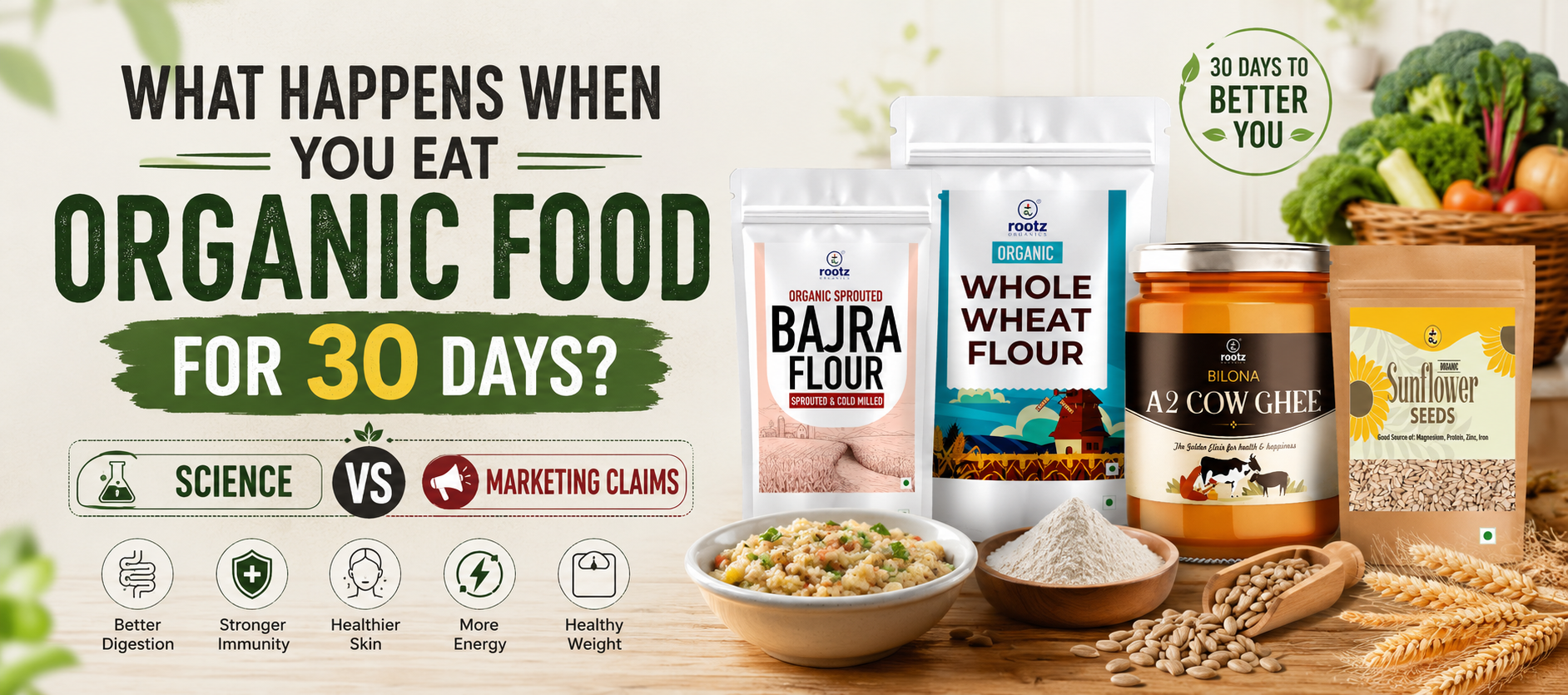
What Happens When You Eat Organic Food for 30 Days? Science vs Marketing Claims
Walk into any grocery store today and you'll see the word "organic" printed across everything from biscuits to bottled water. With so much marketing noise, it's worth asking a genuinely useful question: what actually happens inside your body when you commit to eating organic for a full month? This article separates verified research from promotional claims, looking closely at the real, evidence-backed benefits of eating organic food over a sustained 30-day period.
Rather than relying on vague wellness buzzwords, we'll walk through what peer-reviewed studies have found, week by week, and how this translates into practical choices for Indian households navigating a market full of organic claims.
Why a 30-Day Timeframe Matters for Measuring Change
Nutritional and toxicological research consistently uses 30-day windows because this is roughly the time needed for measurable biological changes to register, whether that's a shift in pesticide metabolite levels, gut bacteria composition, or nutrient status. Shorter trials often show inconclusive results, while this timeframe allows the body's systems to adjust to a meaningfully different dietary pattern.
Week One: What Actually Changes First
Pesticide Residue Levels Begin Dropping Quickly
One of the most well-documented findings comes from a 2019 study published in Environmental Research, which tracked families switching to an entirely organic diet. Researchers found that urinary pesticide metabolite levels dropped by an average of over 60% within just six days. This is one of the fastest, most measurable changes linked to dietary switching, and it directly addresses one of the most common marketing claims, this time with solid data behind it.
Digestive Patterns Start Shifting
Many people report early changes in digestion during the first week, often linked to the absence of artificial preservatives, emulsifiers, and synthetic additives commonly found in conventionally processed foods. While individual experiences vary, this aligns with emerging research on how certain food additives can disrupt gut lining integrity.
Week Two: Energy, Inflammation, and Early Metabolic Signals
Reduced Exposure to Endocrine-Disrupting Chemicals
Certain pesticides used in conventional farming, including organophosphates, have been studied for their potential endocrine-disrupting effects. Lower exposure during an organic eating period may support more stable hormonal signalling, though researchers note that more long-term human studies are needed to fully quantify these effects.
Antioxidant Intake May Increase
A widely cited 2014 meta-analysis published in the British Journal of Nutrition, analysing over 343 studies, found that organic crops had significantly higher concentrations of antioxidants, including polyphenols, compared to conventional crops. Antioxidants play a measurable role in reducing oxidative stress, a known contributor to chronic inflammation.
Week Three: Where Marketing Claims Often Overstate the Science
This is where it's important to separate fact from promotional language. Many organic brands claim dramatic weight loss or "detox" effects within weeks, claims that current scientific literature does not strongly support. What research does show is more nuanced: people eating organic diets often naturally consume fewer ultra-processed foods, which indirectly supports better metabolic markers, rather than the organic label itself causing rapid transformation.
Genuine, evidence-based benefits of eating organic food tend to be gradual and cumulative rather than dramatic, a distinction honest brands should communicate clearly rather than overselling.
Week Four: Longer-Term Patterns Worth Noting
Gut Microbiome Diversity
Preliminary research suggests that diets higher in fibre-rich, minimally processed organic produce and grains support greater gut bacterial diversity, a marker increasingly linked to immune resilience and metabolic health. This effect is more closely tied to overall dietary fibre and diversity of plant foods than to the organic label alone.
Reduced Cumulative Chemical Load
By the end of a 30-day period, cumulative exposure to synthetic pesticide residues is meaningfully lower for those eating certified organic. While occasional exposure from conventional produce is generally considered low-risk by regulatory bodies, reducing cumulative long-term exposure is a reasonable, evidence-supported goal, particularly for children and pregnant individuals.
Separating Genuine Science From Common Marketing Tactics
Several claims circulate widely in organic food marketing that deserve scrutiny. Claims of guaranteed weight loss within days are not supported by controlled studies. Claims that organic food contains dramatically more vitamins are only partially accurate, with differences being modest and varying by crop. Claims that all "natural" or "chemical-free" labelled products are equivalent to certified organic are misleading, since certification involves verified, regulated standards, while terms like "natural" often carry no legal definition in India.
This is precisely why certification matters. Products certified under NPOP and PGS-India standards undergo verified, traceable farming practice audits, distinguishing genuinely organic sourcing from products that simply use organic-adjacent language without regulatory backing.
How to Structure a Realistic 30-Day Organic Trial in India
Start With High-Impact Daily Staples
Rather than replacing your entire kitchen overnight, prioritise the items consumed most frequently. Switching to organic flours online for daily roti and baking is one of the highest-impact changes, since flour-based staples are consumed almost daily in most Indian households.
Diversify Your Grain Sources
Incorporating unpolished millets alongside rice and wheat introduces greater fibre diversity and nutrient density, supporting the gut microbiome benefits discussed earlier in this trial framework.
Prioritise Fresh Produce With Higher Pesticide Exposure Risk
Certain vegetables, particularly leafy greens and those consumed with their skin, tend to carry higher pesticide residue in conventional farming. For households in the capital region, choosing organic vegetables online delhi ensures both freshness and verified, residue-free sourcing for these higher-risk categories.
Rotate Millet Varieties for Broader Nutritional Coverage
Different millet varieties, such as ragi, jowar, and bajra, offer distinct micronutrient profiles. Sourcing a consistent supply of organic millets online makes it easier to rotate varieties throughout your 30-day trial rather than relying on a single grain.
Simplify Sourcing Through a Single Trusted Channel
One of the biggest barriers to a consistent organic trial is sourcing convenience. Building your monthly pantry through a reliable online organic grocery removes the friction of visiting multiple stores and ensures consistent certification standards across categories.
Cover the Full Spectrum, Not Just Produce
A genuine 30-day trial extends beyond fruits and vegetables to pantry staples, snacks, and daily essentials. Exploring a wider range of organic food products online helps ensure that processed and packaged items consumed during the month also meet clean-label standards, rather than undermining the trial through hidden additives elsewhere in the diet.
What a Realistic Outcome Looks Like After 30 Days
Based on available research, a realistic, evidence-grounded outcome after 30 days of consistent organic eating includes measurably lower pesticide residue exposure, modestly improved antioxidant intake, potential improvements in digestive regularity linked to reduced additive consumption, and early signals of improved gut bacterial diversity, particularly when paired with higher fibre intake from whole grains and millets.
What it does not reliably include, despite common marketing claims, is dramatic weight loss, instant detoxification, or guaranteed disease reversal within a single month. Genuine wellness outcomes from organic eating are part of a longer-term pattern, not a 30-day miracle.
Making Organic Eating a Sustainable Long-Term Habit
The most meaningful benefits of eating organic food compound over months and years, not days. Treating a 30-day trial as a starting point rather than a finish line allows the body's systems, from gut bacteria to cumulative chemical exposure, time to genuinely adjust. For Indian households balancing tradition with modern wellness science, this means returning to whole, minimally processed foods, supported by verified certification, rather than chasing quick-fix promises found in marketing copy.
Ultimately, the science supports organic eating as a sound, evidence-backed long-term choice, just not for the dramatic, overnight reasons often advertised.
Frequently Asked Questions
Is there scientific proof that organic food is healthier?
Multiple peer-reviewed studies show organic produce generally contains lower pesticide residue levels and, in several cases, higher antioxidant content compared to conventionally grown produce. However, research on long-term health outcomes is still developing, and results vary depending on the specific food and study design.
How long does it take to see results from eating organic food?
Studies measuring pesticide metabolites in urine have shown significant reductions within just five to seven days of switching to an organic diet. Digestive and energy-related changes are typically reported within two to four weeks of consistent dietary change.
Does organic food actually taste different?
Many people report noticeable taste differences, particularly in organic vegetables and fruits, often attributing this to slower growth cycles, seasonal harvesting, and the absence of chemical ripening agents, though taste perception is also subjective and influenced by freshness.
Is organic food just a marketing trend in India?
While marketing around organic food has grown significantly, the underlying agricultural practices, including NPOP and PGS-India certification standards, are regulated and verifiable, distinguishing genuinely certified organic products from those simply labelled as natural or chemical-free without certification.
What is the easiest way to start a 30-day organic eating trial?
Begin by replacing high-pesticide-residue items like leafy vegetables, fruits with edible skins, and daily staples such as flour and grains with certified organic versions, rather than overhauling your entire pantry at once.
-
 August 25th, 2026
 -

The Science Behind Soaking, Sprouting, Fermenting and Grinding
August 24th, 2026 -
 August 24th, 2026
 -
 August 20th, 2026