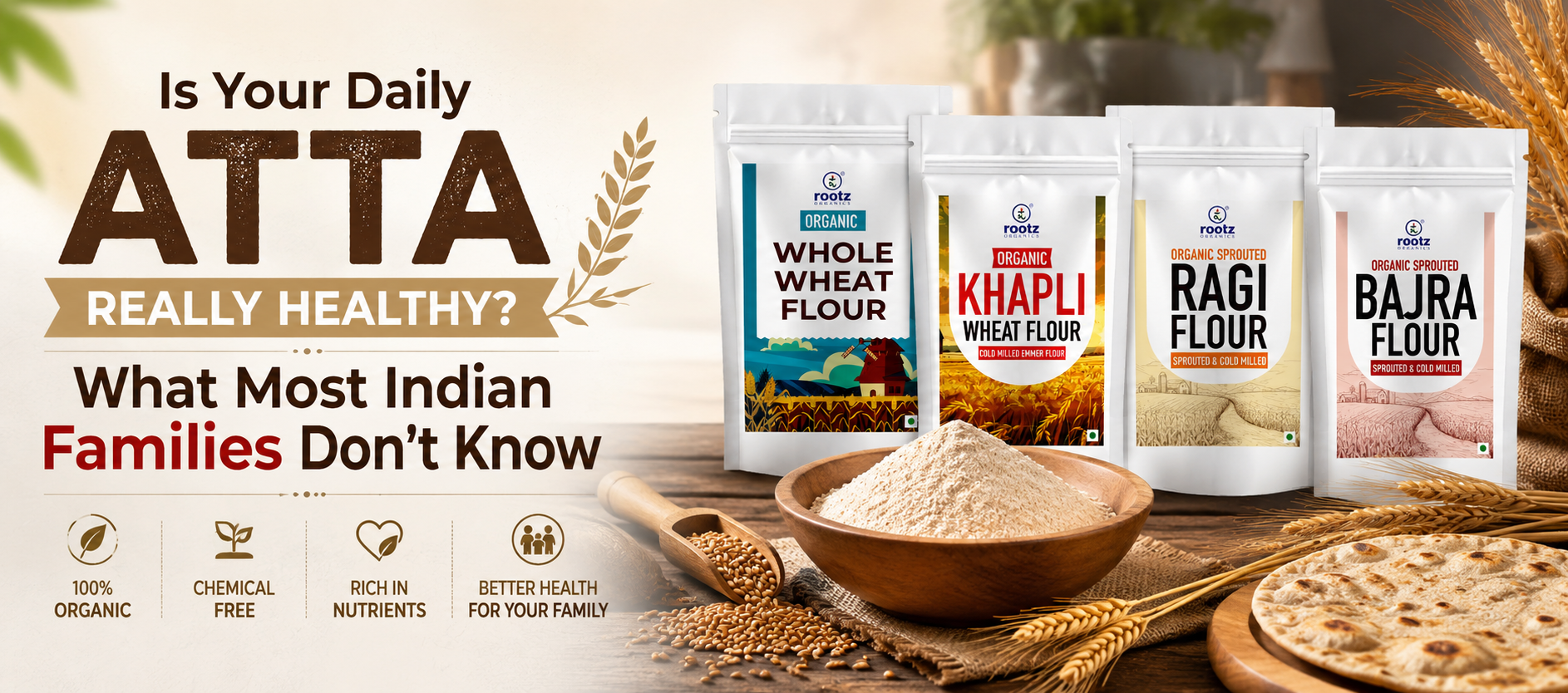
Is Your Daily Atta Really Healthy? What Most Indian Families Don't Know
Roti is the one food almost every Indian household eats without question. It doesn't get photographed for Instagram, nobody Googles its ingredients before buying it, and it has been part of family meals for generations, passed down through mothers and grandmothers who trusted whatever atta was available at the local kirana store. That familiarity is exactly why most of us have never stopped to ask a simple question: is the atta sitting in your kitchen actually doing your body any good?
The honest answer, for the vast majority of packaged atta sold in India today, is more complicated than the bright "100% wheat" claim on the packaging suggests. Between aggressive farming practices, industrial milling shortcuts, and marketing language designed to reassure rather than inform, the flour in your kitchen may be very different from what your grandparents once ground at the local chakki. This article looks at what's really inside your daily flour, why it matters more than most families realise, and how to make a genuinely informed choice the next time you restock your kitchen.
Why Your Roti Might Not Be as Wholesome as You Think
Wheat farming in India has changed dramatically over the past five decades. Since the Green Revolution, Indian agriculture has shifted heavily toward hybrid wheat varieties selected for higher yield, longer shelf life, and easier large-scale processing — not for nutrient density or digestibility. These hybrid strains tend to have a harder, more elastic gluten structure than older traditional wheat varieties, which makes industrial milling and dough handling easier but can make the flour harder on digestion for some people.
Layered on top of this is the issue of agrochemical residue. Independent testing of leading packaged atta brands in India has repeatedly detected pesticide residue, and wheat is also commonly treated with glyphosate-based herbicides during cultivation, sometimes even used as a pre-harvest desiccant to speed up drying. These residues do not reliably disappear during milling, which means they can persist all the way into the flour your family eats every single day, multiple times a day, for years.
The "Multigrain" and "Fortified" Labels That Confuse Shoppers
Walk down any supermarket aisle and you'll see "multigrain atta," "diabetic-friendly atta," and "fortified atta" competing for attention. These labels sound like upgrades, but they deserve a closer look.
Most commercial multigrain attas are blended at the factory using whatever grains are cheapest that season, in proportions the brand doesn't always disclose clearly on the pack. A genuinely beneficial multigrain mix made fresh with seasonal grains like bajra, jowar, and chana is a very different product from a shelf-stable industrial blend. Similarly, "fortified" atta typically means synthetic vitamins and minerals have been added back in after refining stripped them out in the first place — which solves a problem the milling process itself created, rather than avoiding it.
Stone-Ground vs Roller-Milled: Why the Process Matters as Much as the Grain
Even when the wheat itself is good quality, how it's milled significantly affects what ends up in your dough. Traditional chakki (stone-ground) milling grinds the entire wheat kernel — bran, germ, and endosperm together — at a slower speed and lower temperature. This preserves more of the natural fibre, B-vitamins, and minerals that are sensitive to heat.
Industrial roller mills, by contrast, often separate and selectively recombine parts of the grain at much higher speeds. While this produces a finer, more uniform flour with a longer shelf life, it also generates more heat and mechanical stress, which degrades some of the very nutrients that made whole wheat worth choosing over refined flour in the first place. If you've ever wondered why homemade-style atta from a local chakki tastes and behaves differently from a packaged brand, this difference in process is the primary reason.
What Makes an Atta Genuinely "Organic" — and Why That Matters
The word "organic" on a flour packet should mean the wheat was grown without synthetic pesticides, chemical fertilisers, or genetically modified seeds, and that this has been verified through India's two recognised certification systems — NPOP (National Programme for Organic Production) or PGS-India. Without one of these marks alongside a valid FSSAI license number, an "organic" claim on atta is not independently verified.
This is the real distinction worth paying attention to when you're evaluating the best organic atta for your kitchen. Organic certification addresses the chemical input side of the equation — confirming the grain was grown clean — while stone-grinding addresses the processing side, preserving the nutrition that's already there. The two are complementary, and the strongest choice for a household combines both rather than relying on just one.
How to Choose a Genuinely Healthy Atta for Your Family
Choosing well doesn't require becoming a food scientist. A few practical checks go a long way.
Check the Certification, Not Just the Word "Organic"
Look specifically for the NPOP or PGS-India mark, along with an FSSAI license number you can verify. Packaging that uses "organic," "natural," and "pure" interchangeably without any certification mark is using marketing language, not a verified claim.
Look for the Milling Method on the Label
Brands confident in their process will clearly state "stone-ground" or "chakki-ground" on the packaging. If this information is missing, it's reasonable to assume the flour went through standard high-speed roller milling.
Check the Ingredient List on "Multigrain" Variants
A trustworthy multigrain atta will list every grain it contains and roughly in what proportion. Vague blends with no breakdown are harder to evaluate honestly.
Prioritise Freshness Over Long Shelf Life
Whole wheat flour naturally has a shorter shelf life than refined flour because the oils in the bran and germ are still present and can turn rancid over time. A genuinely fresh organic wheat flour should be milled in small batches rather than stockpiled for months before reaching your kitchen.
Beyond Wheat: When a Different Flour Might Serve You Better
For many Indian households, the better question isn't just "which wheat atta should I buy" but "should every roti even be made from wheat." Depending on your family's specific health goals, exploring alternatives can be genuinely worthwhile.
Sprouted Flours for Easier Digestion
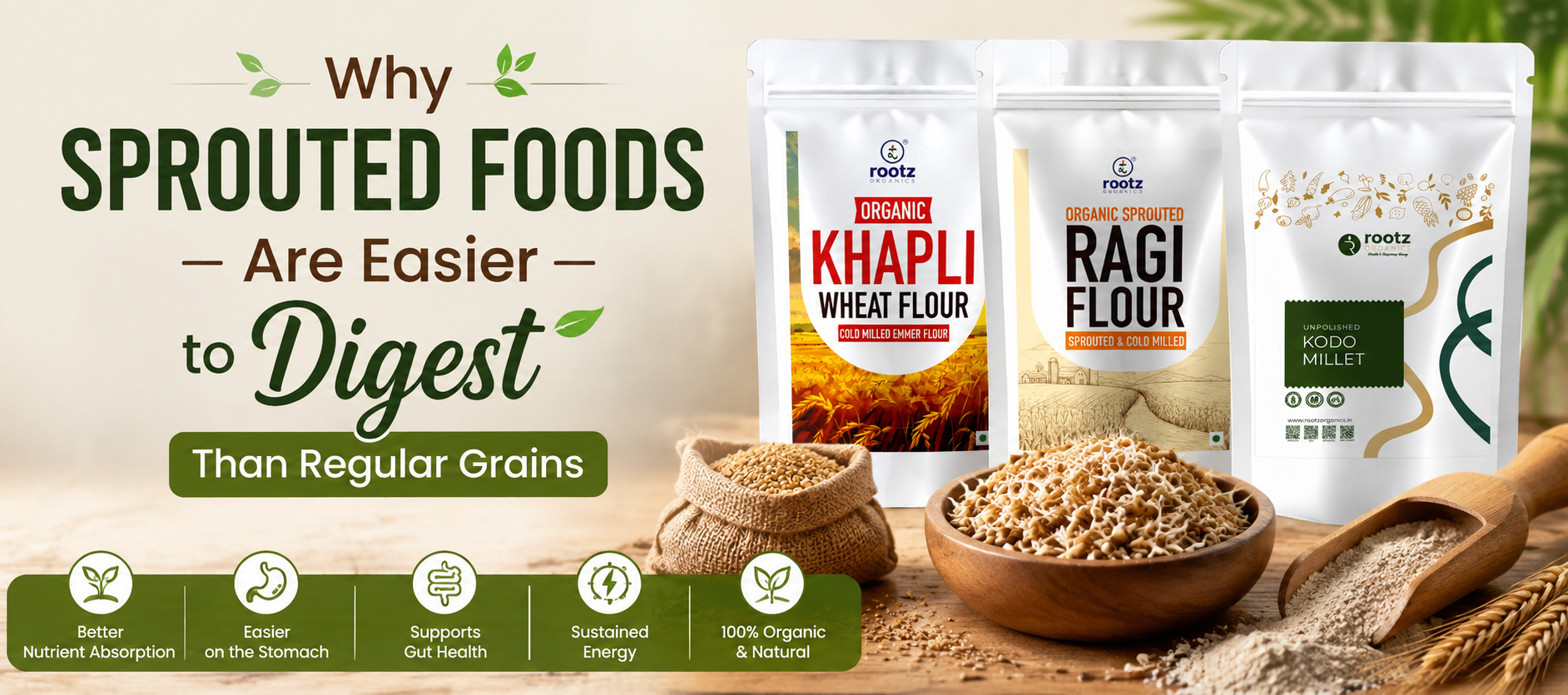
Sprouting wheat or other grains before milling activates enzymes that break down some of the starches and anti-nutrients naturally present in raw grain, which many people find easier on digestion. An organic sprouted flour retains the familiar taste of wheat-based rotis while offering a gentler digestive profile, particularly useful for those who experience bloating after regular atta.
Ragi for Bone Health and Calcium
Finger millet, known as ragi, has long been a staple in South Indian households and is naturally rich in calcium and iron. Rotating in organic ragi flour a few times a week is a simple way to diversify your family's grain intake while supporting bone health, especially for growing children and older adults.
Jowar for a Lower Glycaemic Load
Sorghum, called jowar in most of India, is naturally gluten-free and digests more slowly than refined wheat, making it a popular choice for those watching blood sugar levels. Organic jowar flour works well for rotis and bhakris and is a practical entry point for families looking to reduce their dependence on wheat without giving up flatbreads entirely.
Gluten-Free Options for Sensitive Systems
For households managing genuine gluten sensitivity or coeliac disease, a dedicated range of gluten free flours made from millets and other naturally gluten-free grains removes the guesswork entirely, without sacrificing the experience of a warm, fresh roti at the table.
Building a Smarter Flour Routine, Not Just a Single Swap
The most sustainable approach isn't necessarily replacing wheat atta entirely overnight — it's building a rotation. Many nutrition-conscious Indian households now keep two or three flours in their kitchen rather than relying on a single sack of wheat atta for every meal. A well-stocked pantry of organic flours online makes this kind of rotation far easier to maintain, since you can order smaller, fresher batches across multiple grains instead of bulk-buying one type that sits on the shelf for months.
This approach also naturally diversifies your family's micronutrient intake. Wheat, ragi, jowar, and bajra each bring a different nutritional strength to the table — wheat offers steady energy and B-vitamins, ragi brings calcium, jowar supports blood sugar management, and bajra adds iron and warmth-generating properties valued in Ayurvedic tradition. Rotating between them, rather than depending on one grain exclusively, is a more balanced long-term strategy than searching for one "perfect" flour.
There's also a practical, household-economics argument for this kind of rotation. Buying one large sack of wheat atta every month often means the last few kilos sit around for weeks before use, slowly losing freshness as the natural oils in the bran begin to oxidise. Splitting your monthly flour budget across two or three smaller, fresher packs — one of wheat, one of a millet like jowar or ragi, perhaps a sprouted variant for the days you want something gentler on digestion — tends to result in fresher flour reaching your kitchen overall, simply because nothing sits unused for long.
A Simple Checklist Before Your Next Atta Purchase
Before you restock your kitchen shelf, run through this quick sequence:
- Check for NPOP or PGS-India certification, not just the word "organic" on the front.
- Confirm the milling method — look for "stone-ground" or "chakki-ground" on the label.
- If buying multigrain, check that every grain and its proportion is listed.
- Favour smaller, fresher batches over large packs with long shelf lives.
- Consider rotating in at least one alternative grain — ragi, jowar, or a sprouted variant — alongside your regular wheat atta.
Conclusion: A Small Daily Choice With a Large Cumulative Effect
Atta is not a food you eat occasionally — for most Indian families, it's on the table at nearly every meal, every day, for an entire lifetime. That frequency is exactly what makes the quality of your flour worth examining closely, even though it's the most unglamorous item in your shopping basket. A pesticide residue or a nutrient lost to high-heat milling might sound negligible in a single roti, but multiplied across thousands of meals over decades, these small differences add up to a meaningfully different cumulative exposure for you and your family.
You don't need to overhaul your kitchen overnight. Start by checking the certification and milling method on the bag you already buy, then consider introducing one rotational grain alongside it. Small, informed adjustments to something you eat this often compound into a meaningfully healthier pantry over time — and that is a far more reliable strategy than chasing whichever flour happens to be trending this season.
What makes one atta better than another?
The two biggest factors are how the wheat was grown and how it was milled. Wheat grown without synthetic pesticides and chemical fertilisers, verified through NPOP or PGS-India certification, avoids the chemical residue commonly found in conventional flour. Stone-ground (chakki) milling additionally preserves more of the natural fibre, B-vitamins, and minerals compared to high-speed industrial roller milling.
Is multigrain atta automatically healthier than regular wheat atta?
Not necessarily. Many commercial multigrain attas are factory blends using whatever grains are cheapest at the time, without a clear breakdown of proportions on the label. A genuinely beneficial multigrain mix should list each grain and its approximate share clearly, so you can evaluate whether it actually adds nutritional value over single-grain wheat atta.
Does organic atta contain less pesticide residue than regular atta?
Yes. Certified organic wheat is grown without synthetic pesticides or herbicides, so genuinely certified organic atta typically tests at undetectable levels for these residues, whereas independent testing has found pesticide and herbicide traces across several conventional commercial atta brands in India.
What is the best organic atta for someone with mild gluten sensitivity?
For mild sensitivity, an organic sprouted wheat flour can be easier to digest since sprouting breaks down some of the starches and anti-nutrients present in raw grain. For more significant gluten sensitivity or coeliac disease, naturally gluten-free options like organic jowar or ragi flour are a safer choice than any wheat-based atta, sprouted or otherwise.
How can I tell if my atta is stone-ground or roller-milled?
Check the packaging for explicit terms like "stone-ground" or "chakki-ground." Brands using this traditional process tend to highlight it clearly because it is a meaningful quality marker. If the label makes no mention of milling method at all, it is reasonable to assume the flour was processed using standard high-speed roller mills.
-
 August 6th, 2026
 -
 August 6th, 2026