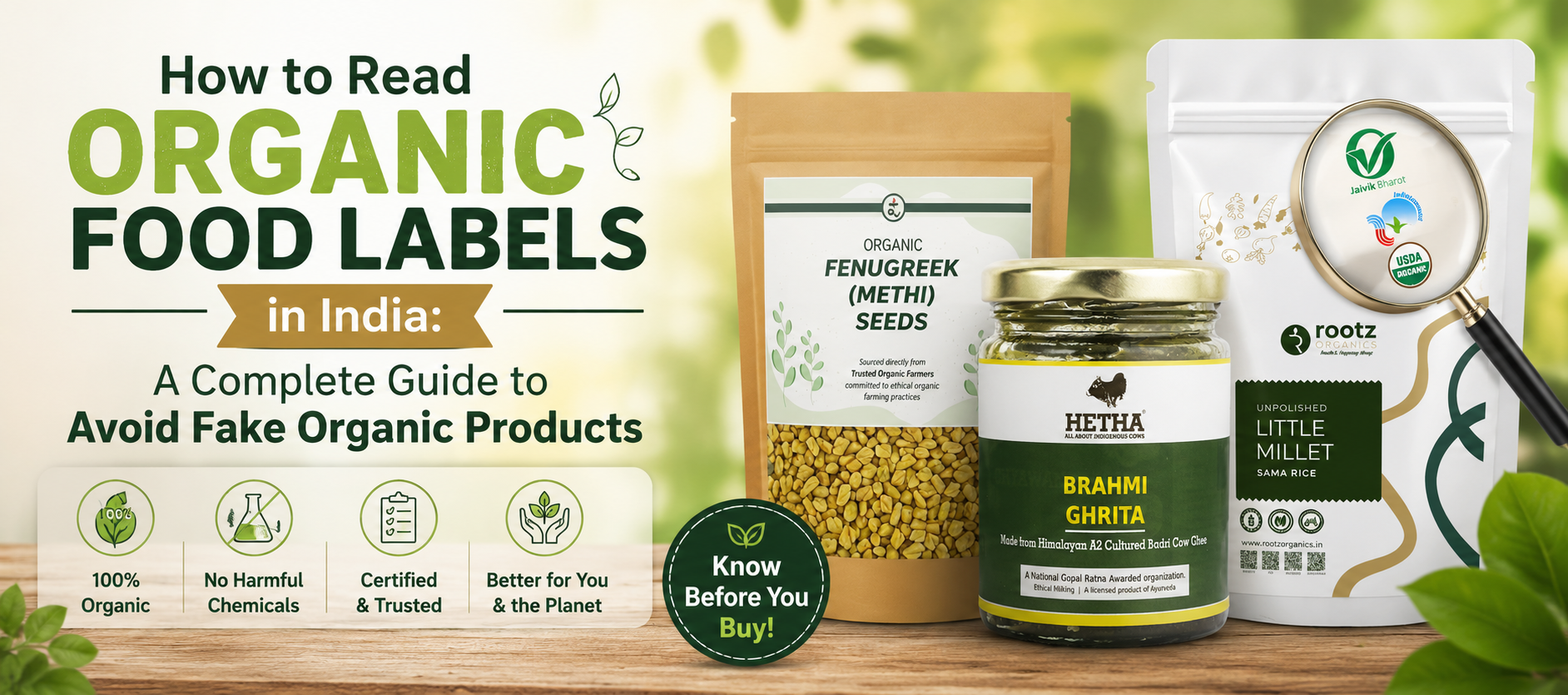
How to Read Organic Food Labels in India: A Complete Guide to Avoid Fake Organic Products
Quick Answer: A genuine organic product in India must carry the green Jaivik Bharat logo along with either an India Organic (NPOP) mark or a PGS-India mark, plus a valid FSSAI license number. Knowing how to identify organic food in India comes down to checking these three things on the pack — words like "natural," "farm-fresh," or "chemical-free" carry no legal meaning and are not proof of certification.
Walk into any supermarket aisle in Delhi, Mumbai, or Bengaluru and you'll see dozens of packets shouting "organic" in bold green letters. Online, every third product on a grocery app seems to carry some version of a leaf icon or a "100% natural" badge. The uncomfortable truth is that most Indian shoppers have no idea which labels mean something and which are simply clever packaging.
This confusion isn't accidental. As demand for clean-label food has grown across urban and semi-urban India, so has the temptation for brands to use the word "organic" without going through certification. The result is a marketplace where genuinely certified produce sits beside look-alike labels designed to mislead. This guide breaks down exactly what to look for, what to ignore, and how to verify a claim before it reaches your cart.
Why Organic Label Confusion Is So Common in India
Unlike countries with a single, decades-old organic seal every consumer recognises on sight, India's certification ecosystem is relatively young and involves more than one valid system. This isn't a flaw in the regulation — it's simply unfamiliar territory for most households. The FSSAI only introduced a unified consumer-facing logo in December 2017, which explains why many shoppers still go by gut feel rather than verified facts.
Brands have noticed this gap. Packaging language has evolved to sound reassuring — "farm sourced," "naturally grown," "chemical-conscious" — without ever making a certified claim. None of these phrases are regulated. A product can legally use every one of them while still being grown with synthetic pesticides and chemical fertiliser. That is precisely why how to identify organic food in India has become one of the most searched concerns among health-conscious buyers today.
The Three Marks That Actually Carry Legal Weight
Before you evaluate anything else on a package, train your eye to look for these three specific indicators. Under the Food Safety and Standards (Organic Foods) Regulations, 2017, these are the only marks that legally certify a product as organic in India.
The Jaivik Bharat Logo
This is the umbrella identity mark issued by the FSSAI — a green circular logo featuring a leaf and a tick mark, with "Jaivik Bharat" printed beneath it. Any business selling packaged organic food in Indian retail, online or offline, is required to carry this logo if their product is genuinely certified. If a packet calls itself organic but this logo is missing entirely, treat that as your first red flag.
The India Organic Mark (NPOP Certification)
Products certified under the National Programme for Organic Production, overseen by APEDA under the Ministry of Commerce, carry the India Organic mark. NPOP involves third-party accredited bodies that conduct farm audits, soil testing, and supply chain checks — the more rigorous of the two domestic routes, typically used by brands that also export.
The PGS-India Mark
The Participatory Guarantee System is a community-based model managed by the Ministry of Agriculture, designed to make certification accessible for small and marginal farmers. Under PGS-India, farmer groups verify each other's practices through structured peer review, validated regionally. It is widely used for domestic vegetables, pulses, and grains, and carries equal legal standing to NPOP within India.
Both systems operate independently — a product certified under one cannot be relabelled under the other. NPOP-certified goods can be sold domestically and exported, while PGS-India goods are for domestic trade only.
What the 95% Rule Actually Means for Your Purchase
Here's a detail most shoppers never learn: under Indian organic standards, a single-ingredient product must be wholly organic to use the term, while a multi-ingredient product must contain at least 95% certified organic ingredients to be legally labelled "organic." This matters for processed foods — a packet of organic cookies, for instance, could technically use the label while still containing a small percentage of non-organic additives. Reading the ingredient list alongside the certification mark, rather than relying on the front-of-pack claim alone, gives you the fuller picture.
Common Greenwashing Phrases That Mean Nothing Legally
Marketing teams are skilled at choosing words that sound like a certified claim without making one. Treat these phrases with skepticism unless backed by an actual certification mark:
- "Natural" or "100% Natural" — has no regulatory definition and can appear on products containing pesticide residue.
- "Farm Fresh" or "Farm Sourced" — describes origin, not farming method, and says nothing about chemical use.
- "Chemical-Free" — an unverifiable, self-declared claim with no testing requirement behind it.
- "Pesticide-Free" — unless paired with lab residue results or a certification number, this is simply a brand promise.
- "Eco-Friendly" or "Sustainable" — vague sustainability language flagged in India's CCPA 2024 guidelines on greenwashing, which require environmental claims to be backed by verifiable evidence.
None of this means every brand using such language is acting in bad faith. But the responsibility sits with you, the buyer, to look past the adjective and check for the actual certification mark before paying a premium price.
How to Verify an Organic Claim Before You Buy
Spotting a logo on a package is only step one. The more reliable step — and one almost no Indian shopper actually uses — is direct verification.
Use the Indian Organic Integrity Database
FSSAI, jointly with APEDA and PGS-India, maintains a public, searchable portal called the Indian Organic Integrity Database, accessible through the official Jaivik Bharat website. You can search by the name of the food business operator or the product itself to confirm whether a certification is current and which certifying body issued it. If a brand's name doesn't appear in this database despite claiming certification, that claim is unverified.
Check for a License or Registration Number
Genuine certified products display a certification or FSSAI license number linked to an accredited certifying agency, along with batch numbers and packaging dates for traceability. A label that makes bold organic claims but carries no number you can cross-reference offers you nothing to verify.
Look for Sourcing Transparency
Brands confident in their certification tend to be transparent — sharing which farms or farmer collectives they source from and where certification documents can be viewed. When you shop a wide range of organic food products online, this kind of openness should be visible without you having to dig for it.
Category-Specific Label Checks Every Indian Shopper Should Know
Different product categories carry their own nuances when verifying organic claims.
Flours and Grains
For atta and grain flours, check that the certification mark applies to the milling process, not just the raw grain. Stone-ground and sprouted variants should specify their processing method on the pack. When sourcing organic flours online, look for batch-level traceability, since flour is a daily staple where even small contamination has a cumulative effect on a household's chemical exposure.
Ghee and Dairy
Organic claims on ghee should specify both the certification of the milk source and the processing method. Traditional bilona-method ghee from native desi cow breeds is often marketed under the A2 designation, but "A2" itself describes a protein type, not an organic certification — the two claims are separate and both should be documented. A genuine organic A2 ghee should state its certification body alongside the A2 sourcing detail, not substitute one claim for the other.
Millets and Ancient Grains
Millets such as ragi, jowar, and bajra have become trendy health foods in India, which also makes them a frequent target for mislabelling. Since millets are typically grown by smaller farmer groups, PGS-India certification is more common here than NPOP. When exploring organic millets online, check that the PGS-India certificate is specific to the farmer group supplying that batch, rather than a generic claim applied across an entire product line.
Cooking Oils
Oil labelling carries its own confusion, since "cold-pressed" and "organic" are separate claims. Cold-pressed describes the extraction method — oil extracted without heat or chemical solvents — while organic refers to how the source crop was grown. A product can be cold-pressed without being organic, and vice versa. When shopping cold pressed oils online, check that both claims are independently substantiated rather than assuming one implies the other.
Physical Cues That Can Support — But Never Replace — Certification
Some traditional indicators offer supporting evidence, though none should be treated as proof alone. Organic vegetables and fruits often show natural variation in shape and colour, since they aren't waxed or treated with ripening agents. Organic grains and pulses may have shorter shelf life and less uniform appearance, since nothing has been added to extend stability. Stronger natural fragrance in spices and herbs can also signal higher nutrient concentration. These cues are useful context, but only the documented marks above carry legal weight.
A Simple Checklist for Your Next Purchase
Before you check out — online or in-store — run through this sequence:
- Look for the green Jaivik Bharat logo on the front or back of the pack.
- Confirm whether it carries the India Organic (NPOP) mark or the PGS-India mark alongside it.
- Check for an FSSAI license number and certifying agency details.
- Read the ingredient list to see if a multi-ingredient product meets the 95% organic threshold.
- If in doubt, search the brand or product name on the Indian Organic Integrity Database before adding it to your cart.
This five-step habit takes less than a minute once you know what to look for, and it removes the guesswork from organic shopping for good.
Building a Trustworthy Organic Pantry
Once certification checking becomes second nature, the next step is choosing where you shop from. A trustworthy source for organic food online makes its NPOP and PGS-India certification details easy to find, rather than burying them in fine print. Look for sellers upfront about which farms they work with, how products are processed, and where you can independently verify certification — that transparency is itself one of the strongest signals of authenticity.
Conclusion: Knowledge Is Your Best Protection
India's organic food market is growing rapidly, bringing real benefits — fresher produce, cleaner staples, and more choices for health-conscious families. But it has also created room for labels that promise more than they deliver. Protecting yourself doesn't require expert knowledge or lab testing. It simply requires knowing three marks, ignoring a handful of meaningless buzzwords, and using one free government database when you're unsure.
Once this becomes habit, you stop being swayed by clever packaging and start making decisions based on verified fact — the most powerful tool any Indian shopper has for building a genuinely clean, organic kitchen.
How can I identify organic food in India before buying it?
Check the package for the green Jaivik Bharat logo issued by FSSAI, along with either the India Organic (NPOP) mark or the PGS-India mark. The product should also display a valid FSSAI license number. If a product claims to be organic but has none of these three marks, the claim is unverified, regardless of how the packaging is worded.
What is the difference between NPOP and PGS-India certification?
NPOP (National Programme for Organic Production) is overseen by APEDA and involves third-party accredited audits, making it suitable for both domestic sale and export. PGS-India is a community-based, peer-verified system managed by the Ministry of Agriculture, designed for small farmers and intended for domestic trade only. Both carry equal legal standing within India, but a product certified under one system cannot be labelled under the other.
Does the word "natural" on a food label mean it is organic?
No. Terms like "natural," "farm-fresh," and "chemical-free" have no legal definition under Indian food regulations and can be printed on packaging without any certification or testing. Only products carrying the Jaivik Bharat logo with an NPOP or PGS-India mark are legally recognised as organic in India.
How can I verify if a brand's organic certification is genuine?
Search the brand or product name on the Indian Organic Integrity Database, a public portal jointly maintained by FSSAI, APEDA, and PGS-India. This database confirms whether a certification is current, which body issued it, and which specific products are covered, letting you verify a claim in under a minute.
Can a product be labelled organic if it contains some non-organic ingredients?
Yes, but only within strict limits. Under Indian organic standards, a single-ingredient product must be fully organic to use the label, while a multi-ingredient product must contain at least 95% certified organic ingredients. Checking the ingredient list alongside the certification mark gives a more accurate picture than the front-of-pack claim alone.
-
 August 6th, 2026
 -
 August 6th, 2026