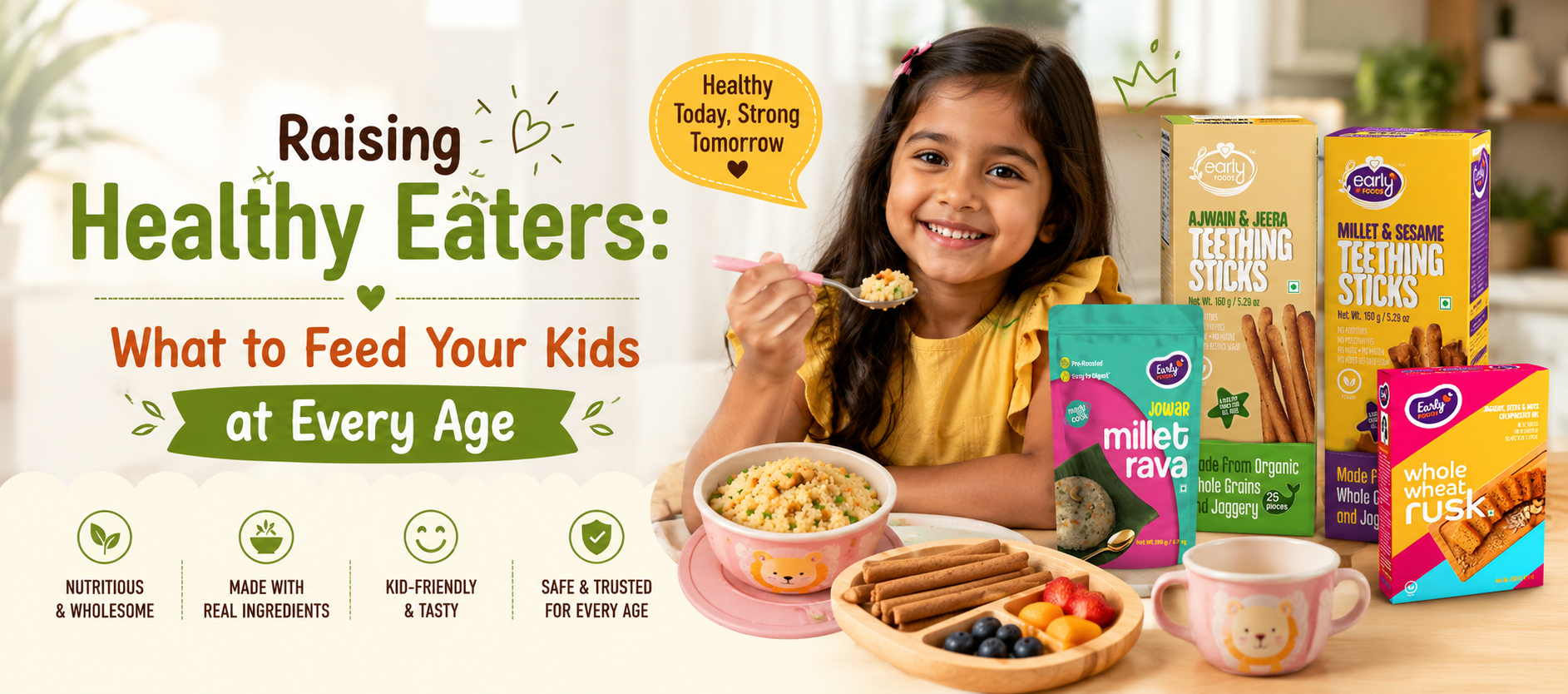
Raising Healthy Eaters: What to Feed Your Kids at Every Age
As a parent in India, you already know this feeling: you've cooked a wholesome meal, and your child has pushed it aside in favour of a packaged biscuit. Building great eating habits isn't about perfection — it's about consistency, variety, and choosing the right foods at the right stage of your child's growth.
Every parent wants their child to grow up strong, focused, and full of energy. But with supermarket shelves overflowing with "healthy" labels that often hide sugar and preservatives, and with conflicting advice from every direction, making the right nutritional choices can feel overwhelming.
This guide cuts through the noise. Below, you'll find age-wise, practical, and genuinely healthy food for kids — rooted in Indian dietary wisdom, backed by nutrition science, and aligned with what growing bodies actually need at each stage of development.
Why Age-Appropriate Nutrition Matters More Than You Think
Children's nutritional needs are not a scaled-down version of adult requirements. A toddler's gut, brain, and bone structure are all developing simultaneously, and each life stage demands a distinct nutritional focus.
According to India's ICMR-NIN dietary guidelines, inadequate intake of key micronutrients — calcium, iron, zinc, and vitamin B12 — is one of the most common problems affecting Indian school-age children. The solution, however, is not expensive supplements. It is a consistently varied, whole-food diet built from ingredients that Indian kitchens have always had.
Age Group | Primary Nutritional Focus | Key Indian Foods |
0–6 Months | Exclusive breast milk / formula | Breast milk (complete nutrition) |
6–12 Months | Iron, zinc, first proteins, DHA | Moong dal, sweet potato, ragi porridge |
1–3 Years | Calcium, protein, healthy fats | Ghee, paneer, ragi, banana |
3–6 Years | Iron, fibre, brain nutrients | Jowar, dal, green vegetables, nuts |
6–12 Years | Complex carbs, protein, calcium | Millets, rajma, curd, eggs/paneer |
12–18 Years | Calcium, omega-3, iron (girls), zinc | Sesame, walnuts, leafy greens, whole wheat |
Stage-by-Stage Guide: What Your Child Needs and When
The First Six Months: Breast Milk Is Complete Nutrition
For the first six months of life, breast milk (or iron-fortified infant formula) provides everything your baby needs — no water, no juice, no solids. This is supported by the World Health Organization, the Indian Academy of Paediatrics, and every credible nutritional authority globally.
Breast milk naturally adapts in composition as your baby grows. It is rich in antibodies, healthy fats for brain development, and lactose for energy. If breastfeeding is not possible, speak to your paediatrician about the right formula.
Parent Tip: Avoid the urge to introduce water or solids before 6 months. Even water can displace calorie-dense breast milk and potentially cause a sodium imbalance in very young infants.
First Foods for Babies: Building the Foundation
At around 6 months, your baby is ready to explore complementary foods alongside breast milk. This is a formative period — the textures, tastes, and nutrients introduced now shape gut health and food preferences for years to come.
Safe First Foods for Indian Babies
- Ragi porridge (plain)
- Mashed banana
- Moong dal water
- Soft-cooked sweet potato
- Apple puree
- Rice congee
- Pureed carrot
Ragi (finger millet) is especially well-suited as one of the first grains for Indian babies. It is naturally high in calcium, supports early bone development, and is easy to digest when cooked to a thin porridge consistency. Parents who use organic ragi flour from a trusted clean-label brand can be confident there are no pesticide residues or adulterants in their baby's first meals.
What to Introduce Gradually (After 8 Months)
- Mashed paneer
- Curd (unsweetened)
- Soft-cooked eggs (well done)
- Soft khichdi with ghee
- Mashed legumes
Key Rule: Introduce one new food every 3 days. This allows you to identify any allergic reactions early. Never add salt, sugar, or honey to food for babies under 12 months.
Toddler Nutrition: Energy, Exploration, and Good Fats
Toddlers are in a phase of explosive growth and brain development. Between the ages of 1 and 3, children develop eating habits that can last a lifetime. This is also the age when most Indian parents start to encounter fussy eating — a completely normal developmental stage.
The key principle for this age group is nutrient density over volume. Toddlers have small stomachs but big nutritional needs. Every bite should count.
Nutritional Priorities at This Stage
- Healthy fats for brain development: Pure ghee, coconut, avocado, and ground nuts (powder form) are excellent. Never eliminate fats from a toddler's diet.
- Calcium for bone growth: Cow's milk (up to 400–500 ml daily), curd, paneer, and ragi-based dishes.
- Iron to prevent anaemia: Fortified cereals, dark green leafy vegetables, and legumes paired with a vitamin C source for better absorption.
- Complex carbohydrates for sustained energy: Whole wheat rotis, oats, jowar, and bajra are far superior to refined flour products.
Sample Toddler Meal Ideas
- Ragi-banana porridge
- Soft dal khichdi with ghee
- Vegetable upma
- Paneer paratha (soft)
- Idli with coconut chutney
- Fruit custard (no sugar)
Important: Keep mealtimes calm, structured, and pressure-free. Forcing toddlers to "finish the plate" often creates long-term food aversions. Offer small portions frequently instead.
Preschool Years: Building Food Variety and Immunity
Children between 3 and 6 are becoming more independent eaters. Their immunity is still developing, which makes food quality — not just quantity — critically important. This is also an ideal age to introduce a wide variety of flavours and textures, setting the stage for an adventurous palate.
One powerful category of foods at this stage is millets. These ancient grains — jowar (sorghum), bajra, foxtail millet, and little millet — were a staple of the Indian diet for centuries before being displaced by refined wheat and rice. Today, nutritionists and paediatricians alike are recommending their return. If you haven't already explored organic millets online, this is the age to start incorporating them into your child's diet.
Why Millets Work So Well for Young Children
Jowar is notably high in protein and iron. Bajra supports bone development and provides magnesium. Ragi remains the king of calcium among grains. Unlike refined flour, these grains retain their fibre, which supports a healthy gut microbiome — now understood to be central to overall immunity and even mood regulation in children.
Quick Millet-Based Snack Ideas for 3–6 Year Olds
- Jowar (sorghum) rotis with dal
- Bajra khichdi
- Ragi mudde
- Foxtail millet upma
- Millet-vegetable cutlets (baked)
School-Age Children: Fuelling Learning, Growth, and Energy
Once children start school, their nutritional needs shift considerably. They need sustained energy for long hours, good concentration for academic work, and adequate protein for rapid muscle development. This is also the age when poor eating habits — driven by peer pressure, tiffin box trends, and aggressive junk food marketing — are most likely to take root.
The healthiest food pattern for this age group is built on whole grains, plant proteins, dairy, and seasonal produce. Convenient and portable foods can still be nutritious — the secret is in the ingredients.
What a Healthy School Tiffin Looks Like
A well-balanced tiffin should include a whole grain base (whole wheat or millet roti/paratha), a protein component (paneer, dal, egg, or sprouts), and a seasonal fruit or vegetable. Replacing white bread sandwiches with whole wheat preparations is one simple change that significantly improves fibre and micronutrient intake. Choosing products made with organic wheat flour that is stone-ground and unrefined offers superior nutrition compared to commercial refined flour.
Brain Foods for School Performance
- Walnuts & almonds
- Eggs
- Pumpkin seeds
- Blueberries
- Curd / paneer
- Dry fruit laddoo
Did You Know? Research confirms that children who eat a proper breakfast perform significantly better in concentration-based tasks during school hours. Skip the sugary "health drinks" — a bowl of millet porridge or an egg-based breakfast provides far more sustained energy.
Teenage Nutrition: Growth Spurts, Hormones, and Food Choices
Adolescence is the second most rapid period of growth after infancy. Teenagers experience significant bone development, hormonal changes, and increased muscle mass — all of which demand higher caloric and nutrient intake. At the same time, teenagers are increasingly making their own food decisions, which may not always align with nutritional best practices.
Critical Nutrients for Teenagers
- Calcium and Vitamin D: Peak bone mass is built during the teenage years. Dairy, ragi, sesame seeds, and sunlight exposure are essential.
- Iron (especially for girls): Adolescent girls are at elevated risk of iron-deficiency anaemia due to menstruation. Green leafy vegetables, jaggery, and legumes are key sources.
- Omega-3 fatty acids: Walnuts, flaxseeds, and fatty fish support brain health, mood regulation, and concentration — critical for board exam years.
- Zinc: Supports growth, immune function, and skin health. Found in pumpkin seeds, sesame, legumes, and dairy.
For Parents of Teenagers: Instead of imposing strict food rules, focus on keeping nutritious options accessible at home. Stock the kitchen with whole grain snacks, fresh fruit, nuts, and homemade energy bars. Teenagers who see healthy food as normal — not a punishment — are far more likely to maintain those habits into adulthood.
The Role of Organic and Additive-Free Foods in Children's Diets
A question many Indian parents are now asking is: Does it actually matter whether I buy organic? The short answer is — yes, especially for children, and especially during the first few years of life.
Children's bodies are more vulnerable to the effects of synthetic pesticides, artificial food dyes, preservatives, and chemical additives because their organs are still developing and their per-body-weight exposure to these compounds is proportionally higher than that of adults.
This is particularly relevant when it comes to organic baby food. The earliest months of complementary feeding set the foundation for digestive health and immune system development. Choosing clean-label, chemical-free options for your baby's first grains, purees, and cereals is a genuinely meaningful investment. Parents who prioritise organic products online — from organic food products online platforms — can access a wide variety of clean-label staples without sacrificing convenience.
What "Clean Label" Actually Means for Indian Parents
A clean-label product is one where every ingredient is recognisable, pronounceable, and functional. For Indian children, this translates to: stone-ground flours without bleaching agents, millets without added flavourings, and dried fruits without sulphur dioxide. It does not need to be expensive or complicated — it starts with reading ingredient lists and choosing products with three ingredients or fewer when possible.
Foods to Avoid and Why — A Parent's Reference
Knowing what to feed your child is half the equation. Equally important is understanding which commonly marketed "children's foods" are nutritionally problematic.
- Packaged "health drinks" and flavoured milk powders: Most contain more sugar per serving than a soft drink, offering minimal nutritional benefit beyond what plain milk already provides.
- Processed breakfast cereals with cartoon packaging: Typically high in refined sugar, low in fibre, and stripped of the vitamins naturally present in whole grains.
- Instant noodles and frozen snacks: High in sodium, saturated fat, and monosodium glutamate — particularly problematic for young children whose kidneys are still maturing.
- Packaged biscuits and cookies marketed as "whole grain": The addition of token amounts of oats or wheat bran does not offset refined flour and hydrogenated vegetable oils.
- Fruit juices (even "100% natural"): Juicing removes dietary fibre and concentrates sugar. A whole apple offers far more nutritional value than a glass of apple juice.
- Highly salted snacks and namkeens: Excessive sodium intake in children is associated with developing a preference for salty foods and increased cardiovascular risk later in life.
Practical Strategies to Get Children to Eat Healthily
Even the best nutritional knowledge is useless if your child refuses to eat. Here are evidence-backed approaches that genuinely work in Indian households:
Blend, Don't Battle
Finely grate or blend vegetables such as spinach, bottle gourd, carrots, and beetroot into dal, parathas, or idli batter. Children who wouldn't touch a bowl of palak will happily eat green-tinged parathas when the texture and flavour are balanced correctly.
Involve Children in Food Preparation
Research consistently shows that children who participate in cooking — even simple tasks like washing vegetables or stirring batter — are significantly more likely to try and enjoy the foods they helped prepare. Let your 4-year-old mix the ragi porridge. Let your 8-year-old help roll the jowar roti.
The "Division of Responsibility" Principle
Nutrition therapist Ellyn Satter's widely-adopted framework is clear: the parent decides what is served and when; the child decides how much they eat. Forcing children to "finish everything" or clean their plate overrides natural hunger and fullness cues, which can lead to disordered eating patterns in adulthood.
Repeat Without Pressure
Research indicates it can take 8 to 10 neutral exposures before a child accepts a new food. Offer new foods alongside familiar favourites. Never make the new food the centre of conflict. Simply place it on the plate, describe it briefly, and move on. Over time, curiosity wins.
Make the Healthy Choice the Easy Choice
Keep a fruit bowl visible. Store cut vegetables in a clear container at eye level in the fridge. Replace packaged biscuit tins with a jar of homemade dry fruit laddoos or roasted makhana. Children eat what they encounter — environment design is more powerful than willpower at any age.
Building a Healthy Weekly Meal Framework for Indian Kids
Rather than prescribing a rigid day-by-day meal plan, the most sustainable approach is a flexible framework based on food group rotation. Here is a practical template for Indian families:
Meal | Daily Anchor Food | Rotate Weekly |
Breakfast | Whole grain base (oats, ragi, millet, wheat) | Poha, upma, idli, paratha, porridge |
Mid-Morning | Fresh seasonal fruit | Banana, guava, papaya, apple, mango |
Lunch | Dal/legume + whole grain + vegetable | Khichdi, dal-chawal, millet roti+sabzi |
Evening Snack | Protein-rich, low-sugar option | Sprouts, paneer cubes, laddoo, makhana |
Dinner | Light, easily digestible whole food | Soft dal, vegetable soup, curd rice |
This framework ensures children receive complex carbohydrates, plant and dairy proteins, dietary fibre, and essential vitamins across every day without requiring parents to memorise detailed meal plans.
The Return to Traditional Indian Grains: Why Jowar and Other Millets Deserve a Place at Your Table
One of the most significant nutritional gaps in modern Indian children's diets is the near-complete absence of millets. Jowar (sorghum), once a daily staple across Maharashtra, Karnataka, Rajasthan, and Andhra Pradesh, has largely been displaced by refined wheat products. This is a nutritional step backwards.
Jowar flour, for instance, is naturally gluten-free and rich in dietary fibre, iron, and B vitamins. For children with wheat sensitivities or those who simply need a more diverse grain intake, organic jowar flour offers a practical, family-friendly alternative that integrates easily into everyday rotis, bhakris, and dosas.
The broader category of millets — foxtail, barnyard, kodo, and little millet — each brings its own micronutrient profile. Including two to three varieties in a child's weekly diet ensures a level of nutritional diversity that single-grain diets simply cannot match.
Final Thoughts: Raising a Healthy Eater Is a Long Game
No single meal, superfood, or supplement determines your child's health. What matters is the cumulative pattern — the daily choices made over months and years that shape a child's relationship with food, their gut microbiome, their bone density, and their long-term immunity.
The good news for Indian parents is that our culinary heritage is extraordinarily well-equipped to nourish children at every stage. Dal, ragi, jowar, paneer, ghee, seasonal vegetables, and hand-pounded spices — these are not "superfoods" in the marketing sense. They are simply whole, honest foods that have sustained generations. The challenge today is protecting them from displacement by ultra-processed alternatives.
Feed your children real food, as close to its natural form as possible. Choose clean-label, additive-free ingredients when you can. And remember: a child who sees their parents eating well and enjoying food is already receiving the most powerful nutritional education possible.
Frequently Asked Questions
What are the best foods for a 6-month-old baby starting solids in India?
For a 6-month-old beginning complementary feeding, start with single-ingredient, easily digestible foods such as mashed banana, cooked and pureed sweet potato, apple puree, soft rice congee, and thin ragi porridge. Introduce one new food every 3 days to monitor for allergies. Always continue breast milk or formula alongside solids during this stage. Avoid salt, sugar, and honey entirely for babies under 12 months.
Is ragi (finger millet) safe and beneficial for toddlers?
Yes, ragi is one of the most nutritionally valuable grains for toddlers and is widely used as a first food across South India. It is naturally rich in calcium — essential for developing bones and teeth — and also contains iron, amino acids, and dietary fibre. Thin ragi porridge is ideal from 6 months onwards. As children grow, ragi can be incorporated into pancakes, rotis, and baked goods. Always use unadulterated, additive-free ragi flour for infants and toddlers.
How do I encourage my picky school-aged child to eat vegetables?
The most effective approaches combine gentle exposure with strategy. Blend vegetables into familiar foods — spinach into paratha dough, carrots into dal, or beetroot into dosas. Involve your child in cooking so they develop ownership over the meal. Offer new foods without pressure alongside favourite dishes, and expect to serve the same vegetable 8 to 10 times before it's accepted. Avoid using food as a reward or punishment, as this creates a complicated relationship with eating.
Which grains are most nutritious for growing children?
Whole grains significantly outperform refined alternatives for children's nutrition. Ragi is exceptional for calcium; jowar (sorghum) is high in protein and iron; bajra supports bone health with magnesium and phosphorus; and oats provide soluble fibre that supports gut health and stable energy levels. Unrefined whole wheat is far superior to maida (refined flour). Rotating two to three whole grain varieties across the week ensures nutritional diversity that a single-grain diet cannot provide.
When is the right time to start organic food for my baby?
You can begin with organic options from the very first day of complementary feeding — typically around 6 months. Because infants' digestive and detoxification systems are still maturing, reducing their exposure to synthetic pesticide residues and chemical additives is particularly beneficial during this period. Organic single-grain cereals, organic fruit purees, and organic vegetable porridges are excellent starting points. As your child grows, transitioning your staple grains and flours to clean-label, organic variants is a practical and impactful step.
-
 August 6th, 2026
 -
 August 6th, 2026