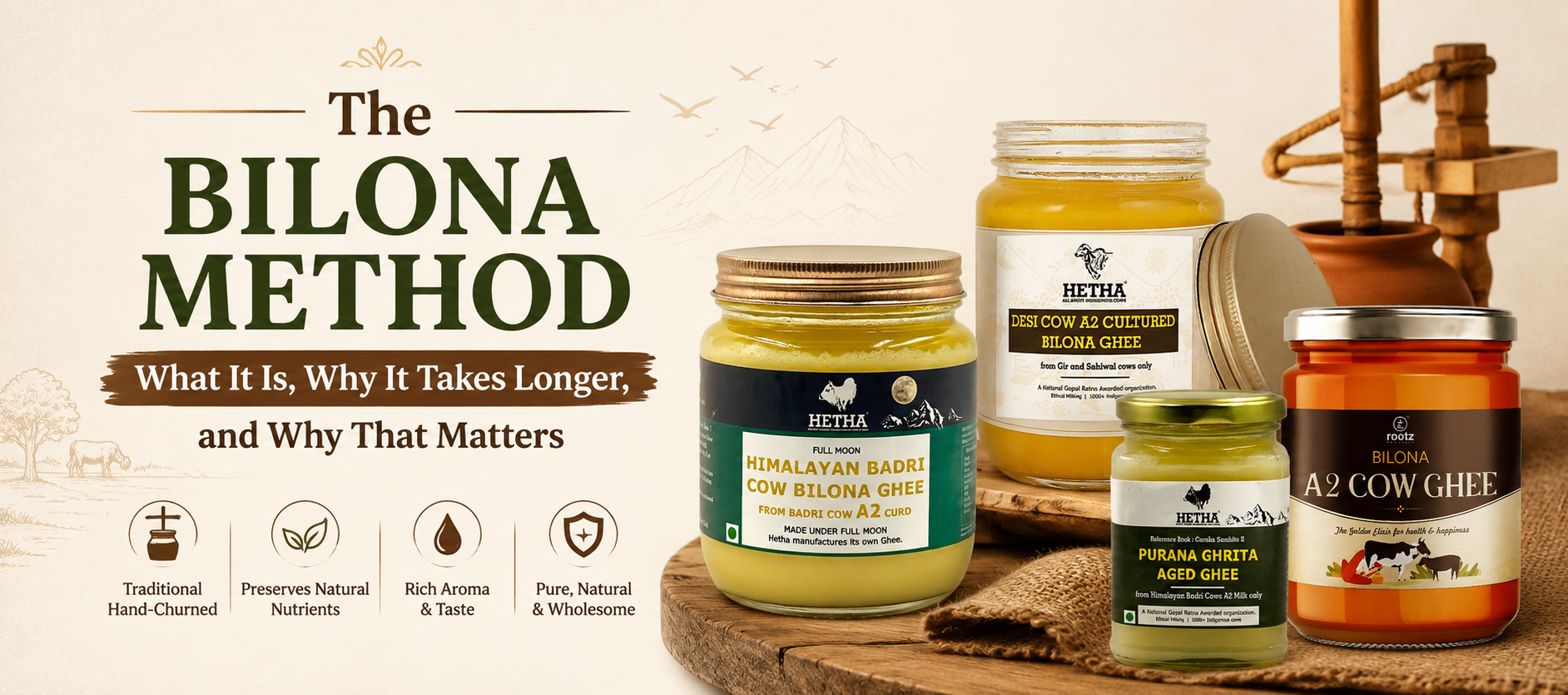
The Bilona Method — What It Is, Why It Takes Longer, and Why That Matters
Quick Answer: What is the Bilona Method?
The bilona method is an ancient Vedic technique for making ghee in which full-fat cow milk is boiled, fermented overnight into curd, and then hand-churned using a traditional wooden beater called a bilona or mathani to extract butter. This butter is then slowly clarified over a low flame into pure, golden ghee.
The entire process is free of machines, preservatives, or industrial shortcuts — and takes considerably longer than modern commercial production — but preserves nutrients, flavour, and Ayurvedic integrity that factory-made ghee cannot offer.
Where Does the Word "Bilona" Come From?
The word bilona (also spelled vilona or bilona) is derived directly from the name of the traditional wooden churner used in Indian households for centuries. This tool, also known as a mathani, is crafted from specific Ayurvedic woods such as neem, sandalwood, teak, pipal, or babool.
The churner works by spinning curd in alternating clockwise and counterclockwise directions, gently extracting butter from fermented milk solids without generating excess heat that could damage nutrients.
In ancient Indian households, this method was not a choice — it was simply the only way ghee was made. Grandmothers across India would spend their mornings churning curd, and the rhythmic sound of the mathani in an earthen pot was as familiar as the aroma of fresh rotis on a hot tawa.
Today, this traditional practice has largely been replaced by industrial methods that prioritise speed and large-scale production. However, a quiet yet meaningful revival of the bilona method is underway, as more people rediscover its nutritional, cultural, and Ayurvedic significance.
The Complete Bilona Ghee Making Process — Step by Step
The bilona ghee making process is not a single act but a careful sequence of five interdependent stages. Each step builds on the previous one, and skipping or rushing any of them changes the final product in measurable ways. Here is how authentic bilona ghee is made:
1. Milk Procurement & Boiling
It all begins with sourcing high-quality whole milk — ideally from indigenous Indian cow breeds such as Gir, Sahiwal, or Tharparkar. The milk is boiled slowly, often over firewood, to eliminate harmful bacteria and to slightly concentrate the milk solids. This boiling step is longer and gentler than what is done in commercial dairies. Importantly, the cream is not separated at this stage — the full-fat milk goes forward to the next step intact.
2. Curdling & Overnight Fermentation
Once cooled to lukewarm temperature (around 40°C), a small spoonful of curd — called jamavan — is added to the milk as a natural starter culture. The milk is then kept in an earthen pot overnight (typically 8–12 hours, or longer in cooler climates) to ferment into thick curd. This fermentation stage is perhaps the most critical differentiator of bilona ghee. It partially breaks down lactose and casein, making the ghee easier to digest. It also introduces complex flavour molecules — lactones and ketones — that are responsible for bilona ghee's characteristic depth of aroma and taste.
3. Hand-Churning with the Bilona
The next morning, the set curd is transferred to the churning vessel. The wooden bilona — suspended by a rope — is rotated rhythmically back and forth, coaxing the fat globules in the curd to aggregate and separate from the liquid (buttermilk). This process typically takes 45 to 90 minutes per batch and is done by hand or with a manually operated wooden beater. The slow, low-heat nature of this churning is deliberate: high-speed machine churning generates frictional heat that can oxidise and degrade heat-sensitive vitamins and fatty acids.
4. Separation of Butter (Makkhan)
After sufficient churning, white butter — called makkhan or loni — begins to float to the surface of the buttermilk. This fresh, unprocessed butter is carefully scooped out and collected. The remaining buttermilk (chaas) is a nutritious, probiotic-rich by-product that is often consumed as a cooling drink. This butter is the raw material for ghee — and because it comes from fermented curd rather than fresh cream, it carries a distinctly richer nutritional and flavour profile.
5. Slow Clarification Over Low Flame
The collected makkhan is placed in a thick-bottomed vessel — traditionally a clay or iron pot — and heated gently over a low flame. As the butter warms, the water content evaporates and the milk solids slowly settle at the bottom, turning golden brown. The fat rises to the top, clarifying into pure ghee. This simmering step takes anywhere from 45 minutes to over an hour, depending on batch size. The entire kitchen fills with the unmistakable nutty, caramelised aroma that genuine bilona ghee is famous for. The liquid gold is then strained and stored in glass jars — no additives, no preservatives, no stabilisers.
Why This Process Takes So Much Longer Than Industrial Methods
25–30 L Milk needed to yield 1 litre of bilona ghee
8–12 hrs Overnight fermentation time for curd
3–4 days Total time from raw milk to finished ghee
80–85% Fat recovery rate (vs 90–95% in commercial methods)
Commercial ghee production is engineered around one priority: efficiency. Cream is separated from milk using high-speed centrifuges, converted into creamery butter, and then clarified at high temperatures in large industrial kettles — all within a matter of hours. There is no fermentation step, no wooden churner, and no slow flame. The result is consistent and cost-effective, but it comes at a nutritional and sensory cost.
The bilona method, by contrast, is slow by deliberate design. Fermentation cannot be rushed without compromising the probiotic activity and flavour development that define the product. Hand-churning cannot be accelerated without generating frictional heat that degrades delicate vitamins. Low-heat clarification cannot be sped up without burning the milk solids and losing the characteristic nutty aroma.
Every extra hour in the bilona process contributes to flavour development, nutrient preservation, and Ayurvedic integrity — not inefficiency.
This is also why bilona ghee costs significantly more than commercial ghee. It can take up to 30 litres of milk to produce a single litre of finished ghee, with lower fat recovery rates (80–85%) compared to industrial methods (90–95%). Add to that the labour of hand-churning and small-batch care, and the economics of bilona ghee become clear: the premium is not markup — it is cost.
Bilona vs. Commercial Ghee — A Side-by-Side Look
Here is a clear comparison of how bilona-method ghee differs from commercially produced ghee across the parameters that matter most to health-conscious consumers in India:
Parameter | Bilona Ghee | Commercial Ghee |
Starting Material | Whole fermented curd | Cream separated from milk |
Fermentation Step | ✓ Yes — overnight, natural culture | ✗ No |
Churning Method | Manual, wooden churner (low heat) | High-speed centrifugal machine |
Clarification Temperature | Low, slow flame | High-temperature industrial kettles |
Vitamin A Retention | ✓ Up to 23% higher | ✗ Lower (oxidation during processing) |
Butyric Acid Content | ✓ 15–20% higher | ✗ Lower |
Colour | Rich golden-yellow (from beta-carotene) | Pale yellow to cream-white |
Texture | Slightly grainy / danedaar when cooled | Smooth, uniform |
Aroma | Deep, nutty, caramelised | Mild, generic |
Digestibility | ✓ Higher — fermented base reduces lactose | Standard |
Ayurvedic Recognition | ✓ Mentioned in Charaka Samhita | ✗ Not specifically referenced |
Additives / Preservatives | ✓ None | Varies by brand |
What Science Says About the Nutritional Difference
The health claims around bilona ghee are not just traditional anecdote — they are increasingly supported by peer-reviewed research:
- Vitamin A Retention: A study published in the Journal of Food Science (2020) found that traditional hand-churned butter retained up to 23% more Vitamin A compared to centrifugally separated cream butter, due to significantly lower oxidation during the process.
- Butyric Acid: Research published in the Indian Journal of Dairy Science (2019) found that ghee made from curd-churned butter had 15–20% higher butyric acid content than cream-based ghee from the same milk source. Butyric acid is a short-chain fatty acid linked to gut health, colon cell repair, and anti-inflammatory activity.
- Antioxidant Activity: A 2021 study in the Journal of Ayurveda and Integrative Medicine found that traditional bilona ghee demonstrated superior antioxidant activity compared to industrial ghee. This is attributed to preserved phenolic compounds that are often degraded during high-heat industrial processing.
- Flavour Complexity: Research by Kataria & Singh (2025) confirmed that fermentation in bilona ghee introduces additional flavour molecules — particularly lactones and ketones — which contribute to a richer, more complex aroma and taste compared to cream-based commercial ghee.
- Lactose & Casein Breakdown: The fermentation stage partially hydrolyses lactose and casein — two components that can cause digestive discomfort — making bilona ghee a better-tolerated option for individuals who find commercial ghee or dairy harder to digest.
The Role of Indigenous Cow Breeds in Traditional Ghee
The bilona method is inseparable from the type of milk used. Authentic bilona ghee is made from the milk of indigenous Indian cow breeds — not crossbred or exotic dairy breeds. These native breeds produce milk that carries the A2 beta-casein protein, which is often considered easier to digest compared to the A1 beta-casein found in most commercial dairy milk.
Why the Source of Milk Matters
India's indigenous breeds — Gir, Sahiwal, Tharparkar, Red Sindhi, and Kankrej — have evolved over thousands of years in the Indian climate and are naturally suited to grass-fed, free-range environments. Their milk is typically richer in beta-carotene (which gives ghee its natural golden hue), omega-3 fatty acids, and fat-soluble vitamins.
Ayurvedic tradition also speaks of the Suryaketu Nadi — described as a subtle energy channel along the cow’s spine — believed to enhance the beneficial qualities of milk. While this concept is rooted in traditional knowledge systems, it continues to hold cultural and spiritual significance in India.
When the bilona method is combined with milk from indigenous breeds, the result is A2 cow ghee that is both nutrient-dense and aligned with Ayurvedic principles of food as medicine. This is why traditional bilona ghee is often regarded as a sattvic (pure and nourishing) food in Indian dietary practices.
Ayurveda's View on Bilona Ghee
The Charaka Samhita — one of Ayurveda’s foundational texts — describes ghee made from curd-churned butter as the most beneficial form of fat for the human body.
It is traditionally recommended for improving digestion (agni), nourishing the seven body tissues (dhatus), supporting mental clarity, and promoting longevity.
Ayurveda clearly distinguishes this form of ghee from cream-based preparations, recognising the fermentation step as transformative — not merely preparatory. This process enhances both the digestibility and the therapeutic potential of ghee, aligning it with Ayurveda’s core principle of food as medicine.
How to Identify Authentic Bilona Ghee — Avoiding Mislabelled Products
As awareness of bilona ghee grows, so does the misuse of the term. Many brands label commercially produced ghee as “bilona” to benefit from its premium image — without actually following the traditional process. Here is how to distinguish genuine bilona ghee from imitations:
Colour
Genuine bilona ghee made from grass-fed, indigenous cow milk has a rich, deep golden-yellow colour — often compared to turmeric-tinted sunlight. This comes from its naturally high beta-carotene content. In contrast, commercial or mislabelled ghee is usually pale yellow, creamish, or even white, indicating lower-quality milk or industrial processing that strips natural pigments.
Texture
Authentic bilona ghee has a slightly granular or grainy texture when cooled — known as danedaar in Hindi. This graininess forms due to the slow crystallisation of fat from fermented butter. If the ghee appears uniformly smooth and creamy, it is most likely cream-based commercial ghee, regardless of labeling.
Aroma
When heated, real bilona ghee releases a deep, rich, nutty, caramelised aroma that is distinctive and complex. Commercial ghee typically has a milder, flatter buttery smell. Some industrial products may even include artificial flavouring, making it important to rely on both aroma and ingredient transparency.
Ingredient List
Authentic bilona ghee should contain only one ingredient: pure cow ghee. There should be no emulsifiers, preservatives, added colours, or artificial flavours. Any additional ingredients are a clear sign that the product is not traditional bilona ghee.
Why the Slow Way Is the Right Way — for Your Health and for India
There is a broader reason to care about the bilona method beyond personal nutrition — it is also a question of cultural continuity and sustainable food production. Indigenous cow breeds like Gir and Sahiwal are increasingly marginalised by the commercial dairy industry’s preference for high-yield exotic breeds.
Supporting bilona ghee from small-scale, ethical producers helps conserve these native breeds, preserve traditional knowledge systems, and sustain the livelihoods of farmers who practice responsible, chemical-free dairy farming.
In a food landscape increasingly dominated by ultra-processed products, the bilona method represents something rare: a production process where nothing essential has been optimised away. The time, the labour, and the lower yield are not inefficiencies — they are the very factors that contribute to bilona ghee’s nutritional richness and cultural value.
For health-conscious families in India who are already choosing online organic grocery options for their daily essentials, understanding the bilona method is the difference between buying a premium-labelled product and making a truly informed, nutrition-focused choice.
Frequently Asked Questions About the Bilona Method
What is the bilona method of making ghee?
The bilona method is a traditional Vedic technique in which full-fat cow milk is boiled, cooled, and fermented overnight into curd. The next day, this curd is hand-churned using a wooden churner called a bilona or mathani to separate butter (makkhan) from buttermilk. This fresh butter is then slowly heated over a low flame until all moisture evaporates, leaving behind pure, aromatic ghee. The entire process takes 3–4 days and uses no machines, preservatives, or industrial shortcuts.
Why does bilona ghee take so much longer to make than commercial ghee?
Bilona ghee is slow by deliberate design. The curd must ferment overnight (8–12 hours) to develop the probiotic activity and complex flavour compounds that define the final product. Hand-churning can take 45–90 minutes per batch. Slow clarification over a low flame takes another 45–60 minutes. Beyond time, the process also yields less ghee — it takes 25–30 litres of milk to produce just 1 litre of finished bilona ghee. Commercial methods skip fermentation entirely and use high-speed centrifuges and high-heat clarification, producing ghee in a fraction of the time — but with measurably lower nutrient retention and a flatter flavour profile.
What is the difference between bilona ghee and regular supermarket ghee?
Commercial supermarket ghee is typically made from cream separated directly from milk using high-speed centrifugal machines. It skips the fermentation and hand-churning steps entirely. Bilona ghee starts from fermented curd, which introduces beneficial fatty acids, probiotics, and complex flavour molecules. Research shows bilona ghee retains up to 23% more Vitamin A and 15–20% higher butyric acid compared to cream-based ghee. It also has a characteristic golden colour, grainy texture, and deep nutty aroma that commercial ghee simply cannot replicate.
Is bilona ghee better for digestion than regular ghee?
Yes, generally. The fermentation stage in the bilona process partially breaks down lactose and casein — two components that can cause digestive discomfort — making the final ghee gentler on the gut. When made from A2 milk (from indigenous breeds like Gir or Sahiwal), the ghee contains A2 beta-casein protein, which the human digestive system processes more comfortably than A1 beta-casein found in hybrid dairy breeds. Ayurveda has for centuries recommended bilona-method ghee specifically for strengthening digestive fire (agni) and healing the gut lining.
How do I know if the bilona ghee I am buying is authentic?
Look for four key signs:
- Colour: Authentic bilona ghee from grass-fed, indigenous cows has a rich, deep golden-yellow colour. Pale yellow or cream-white typically indicates commercial processing.
- Texture: Genuine bilona ghee is slightly grainy (danedaar) when cooled. A uniformly smooth texture is a sign of cream-based ghee.
- Aroma: Real bilona ghee releases a strong, nutty, caramelised fragrance when warmed. Commercial ghee tends to smell milder and more generic.
- Ingredient List: There should be only one ingredient — pure cow ghee. No additives, flavouring, or preservatives.
Always buy from producers who are transparent about the cow breed, milk sourcing, and the exact process followed.
-
 August 6th, 2026
 -
 August 6th, 2026