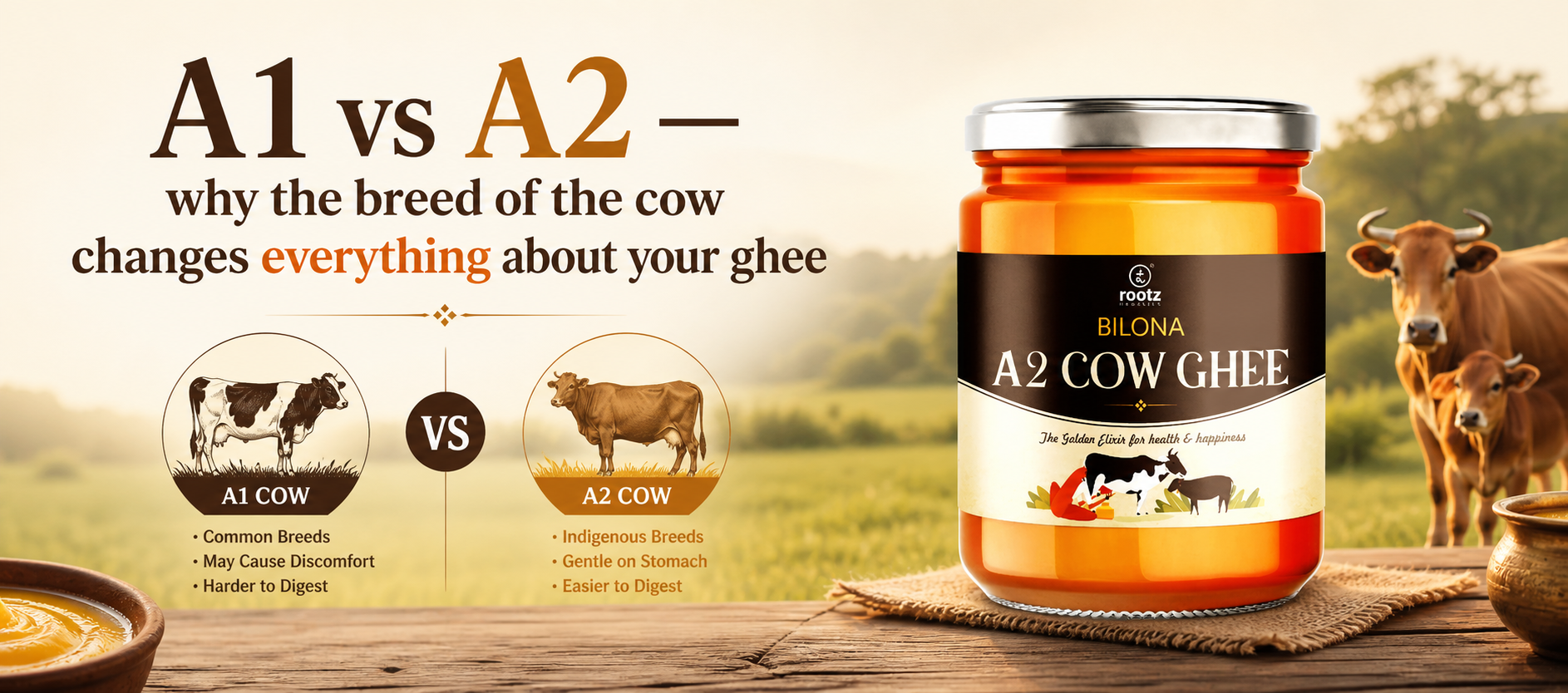
A1 vs A2 — Why the Breed of the Cow Changes Everything About Your Ghee
Walk into any Indian grocery store today and you will find ghee in all shapes and sizes — tins, jars, pouches. The labels say "pure cow ghee," "desi ghee," "premium ghee." But very few of them tell you the most important thing: what kind of cow produced the milk.
"The difference between A1 and A2 ghee is not a marketing gimmick. It begins at the molecular level — in a single amino acid — and ends in how your body feels after every meal."
In India, our relationship with ghee goes back thousands of years. Vedic texts describe it as the essence of the sun, the first offering in yagnas, and the foundational ingredient in Ayurvedic medicine.
For generations, Indian families used ghee made from native, indigenous cow breeds — and those cows, as it turns out, were always producing A2 milk. That changed when cross-bred and exotic breeds entered our dairy systems in the 20th century.
Today, most commercial ghee in India is made from A1 milk — and most people have no idea what that means for their health.
This guide breaks it all down: the science, the tradition, and the practical knowledge you need to make a smarter choice for yourself and your family.
What Are A1 and A2 Proteins in Milk?
Milk is primarily composed of water and fat, but it also contains proteins — the most abundant of which are whey and casein. Beta-casein is the most significant casein protein, and it comes in two genetic variants: A1 beta-casein and A2 beta-casein.
The structural difference between the two is remarkably small. Both are long chains of amino acids. The only difference lies at position 67 of that chain. In A2 beta-casein, the amino acid at position 67 is proline. In A1 beta-casein, that same position carries histidine.
The Molecular Difference at a Glance
- A2 Beta-Casein: Position 67 = Proline amino acid. Found in indigenous Indian cow breeds.
- A1 Beta-Casein: Position 67 = Histidine amino acid. Found in cross-bred and foreign cattle.
This single substitution determines how your digestive system processes the protein — and what by-products are released during digestion.
It might sound trivial — one amino acid difference in a chain of hundreds. But as we will see below, this single change has significant downstream consequences for digestion and overall wellness.
Which Cows Produce A2 Milk — and Which Don’t?
This is where breed becomes destiny. Native Indian cow breeds are genetically wired to produce only A2 beta-casein. These are the very breeds that Indian civilisation domesticated and nurtured for millennia — their milk is what our traditional dairy culture was always built upon.
Indigenous Indian Breeds That Produce A2 Milk
Some of the most celebrated native Indian breeds known to produce pure A2 milk include:
- Gir (Gujarat): Known for its high-quality milk, strong Ayurvedic significance, and a distinctive hump which carries the Surya Nadi (solar channel) according to traditional belief.
- Sahiwal (Punjab & Haryana): One of the best dairy breeds in Asia, naturally resistant to disease and highly productive in tropical climates.
- Rathi (Rajasthan): Hardy, adaptable, and producers of nutritious, easily digestible milk.
- Red Sindhi: Thrives in hot and humid conditions, produces milk with excellent nutritional density.
- Tharparkar: Dual-purpose breed from the Thar Desert region, known for producing naturally rich A2 milk.
Breeds That Typically Produce A1 Milk
Modern commercial dairy farming in India relies heavily on Holstein-Friesian and Jersey cows — both imported or cross-bred European breeds. These cattle produce A1 or mixed A1/A2 milk in large volumes. While they offer higher yields, the protein composition of their milk is fundamentally different from what indigenous breeds provide.
Key Insight: When you buy standard commercial ghee from a supermarket, you are almost certainly buying ghee made from the milk of cross-bred cows that produce A1 beta-casein. The A2 cow ghee that health-conscious Indians are increasingly seeking comes exclusively from indigenous, native breeds.
The BCM-7 Concern: What Happens When You Digest A1 Protein
Here is where the science becomes particularly relevant to your health. When A1 beta-casein is digested in the gut, it releases a peptide called Beta-Casomorphin-7 (BCM-7). This is an opioid-like molecule that does not form when A2 beta-casein is digested.
Research from New Zealand, Europe, and India has begun exploring the connection between BCM-7 and certain health issues. While the scientific consensus is still evolving, published studies have raised questions about BCM-7's potential role in digestive discomfort, inflammation, and other systemic effects in sensitive individuals.
By contrast, A2 beta-casein does not release BCM-7 during digestion, owing to the proline amino acid at position 67 — which acts as a structural barrier that prevents the cleavage of this peptide. This is widely cited as one of the primary reasons A2 milk and A2-based products are better tolerated by a large number of people who experience discomfort with regular commercial dairy.
Important Note
Ghee, being a clarified fat, contains very little residual protein from the original milk. However, the source milk and the process used to make the ghee still influence its overall nutritional composition, micronutrient density, and the presence of beneficial fatty acids.
This is why, for maximum benefit, both factors matter: A2 milk source and traditional preparation method.
A1 Ghee vs A2 Ghee: A Side-by-Side Comparison
Understanding the difference between A1 and A2 ghee becomes much clearer when we look at how they compare across key parameters that impact quality, nutrition, and overall experience.
Source Breed: A1 ghee is typically derived from milk produced by cross-bred or exotic cows such as Holstein-Friesian and Jersey. In contrast, A2 ghee comes exclusively from indigenous Indian breeds like Gir, Sahiwal, and Rathi, which are naturally adapted to local climates and produce A2 milk.
Beta-Casein Type: The fundamental difference lies in the protein structure. A1 ghee originates from milk containing A1 beta-casein (with histidine at position 67), whereas A2 ghee is made from milk containing A2 beta-casein (with proline at the same position).
BCM-7 Release: During digestion, A1 beta-casein can release BCM-7, an opioid-like peptide. A2 beta-casein, on the other hand, does not release BCM-7 due to the presence of proline, which prevents this breakdown.
Digestibility: Many individuals find A1 ghee harder to digest, especially those sensitive to conventional dairy. A2 ghee is generally considered easier on the gut and better tolerated.
Preparation Method: Commercial A1 ghee is usually made using industrial cream-separation processes designed for efficiency and scale. A2 ghee is traditionally prepared using the Bilona method, which involves hand-churning curd to extract butter before slow-cooking it into ghee.
Colour & Texture: A1 ghee often appears pale yellow with a smooth, uniform consistency. A2 ghee typically has a deeper golden hue and a slightly grainy, granular texture, reflecting its traditional preparation.
Aroma: The aroma of A1 ghee is usually mild and sometimes neutral. A2 ghee, in contrast, has a rich, nutty fragrance that is distinctly traditional and more pronounced.
Vitamin Content: A1 ghee generally contains lower levels of fat-soluble vitamins. A2 ghee is richer in essential vitamins such as A, D, E, and K2, owing to both the milk source and preparation method.
Omega Fatty Acids: A1 ghee tends to have lower levels of beneficial fatty acids. A2 ghee is known to be richer in Omega-3, Omega-9, and conjugated linoleic acid (CLA), which are valued for their health benefits.
Ayurvedic Value: A1 ghee does not hold a significant place in traditional Ayurvedic texts. A2 ghee, however, has been extensively documented and revered in Ayurveda for its therapeutic properties.
Smoke Point: A1 ghee has a smoke point of approximately 425°F (218°C), making it suitable for cooking. A2 ghee offers a slightly higher smoke point of around 450°F (232°C), making it especially well-suited for Indian cooking methods.
Price Range: A1 ghee is generally more affordable due to mass production. A2 ghee is priced higher because it is often produced in smaller batches using traditional, labour-intensive methods and sourced from indigenous breeds.
The Science-Backed A2 Ghee Benefits You Should Know
Understanding A2 ghee benefits goes far beyond the popular narrative of “it’s more natural.” The advantages are grounded in both nutritional science and centuries of Ayurvedic wisdom. Here is a detailed breakdown:
Superior Digestive Comfort
The absence of BCM-7 means the gut wall is not exposed to this opioid-like peptide. Many people who experience bloating or heaviness with regular ghee report significantly better tolerance with A2 ghee.
Brain & Nervous System Support
Ghee from native cows is rich in DHA (a type of Omega-3) and butyric acid — both vital for neurological development and cognitive function. Ayurvedic texts describe ghee as a Medhya Rasayana, meaning a brain tonic.
Better Nutrient Absorption
The fat-soluble vitamins in A2 ghee — particularly Vitamins A, D, E, and K2 — support bone density, immune response, and cellular repair. Vitamin K2 in particular is rare and critical for calcium metabolism.
Supports Metabolic Health
Conjugated Linoleic Acid (CLA), found in higher concentrations in grass-fed desi cow ghee, has been associated with improved insulin sensitivity and healthy body composition in published research.
Anti-Inflammatory Properties
Butyric acid — a short-chain fatty acid present in abundance in quality ghee — feeds the gut epithelium and plays a role in reducing intestinal inflammation and supporting the gut microbiome.
Skin & Immunity Nourishment
Applied topically or consumed regularly, A2 ghee has long been used in Ayurveda for skin nourishment, wound healing, and building ojas (the essence of immunity). Rich antioxidants further support this function.
These A2 ghee benefits become even more pronounced when the ghee is prepared using the traditional Bilona method — a process that is inseparable from what makes genuine A2 ghee truly superior.
The Bilona Method: The Ancient Process Behind Pure Ghee
If you have heard of A2 ghee, you have almost certainly heard of the Bilona method. And while it may sound like a branding term, it is actually a precise, centuries-old technique that directly influences the nutritional quality and authenticity of the ghee.
Step-by-Step: How Bilona Ghee Is Made
Sourcing A2 Milk: The process begins with milk obtained exclusively from verified indigenous cow breeds such as Gir or Sahiwal. Ethical sourcing is essential — the milk is collected only after the calf has been adequately fed.
Boiling and Cooling: The fresh milk is gently boiled to ensure purity and then allowed to cool naturally to room temperature.
Curd Preparation (Dahi): A natural starter culture is introduced to the cooled milk, allowing it to ferment overnight into thick, probiotic-rich curd.
Hand-Churning (Bilona): The curd is churned using a traditional wooden churner in a rhythmic circular or figure-eight motion. This slow, manual process separates fresh white butter (makkhan) from the buttermilk.
Slow Simmering: The extracted butter is then transferred to a heavy-bottomed vessel and heated over a low flame. It is slowly simmered until the milk solids settle at the bottom, leaving behind pure, aromatic golden ghee.
Straining and Storing: Finally, the ghee is carefully strained to remove any remaining milk solids, resulting in a clear, rich, and shelf-stable product.
Why the Bilona Method Matters
The curd fermentation step plays a crucial role in enhancing the nutritional profile of the ghee by naturally generating beneficial enzymes and probiotics. In contrast, most industrial ghee is produced directly from cream, bypassing the fermentation stage entirely.
This shortcut significantly reduces the enzymatic activity and micronutrient richness of the final product. Choosing organic A2 ghee made using the traditional Bilona method ensures that you receive the full benefits of both the milk source and the time-honoured preparation process.
How to Identify Genuine A2 Ghee in the Indian Market
The growing popularity of A2 ghee has unfortunately led to a wave of misleading labelling. Here is a practical checklist to help you identify the real thing:
What to Look For on the Label
Named Breed: Authentic A2 ghee clearly specifies the cow breed — such as Gir cow ghee or Sahiwal cow ghee. Vague terms like “Indian cow” or “desi ghee” do not guarantee A2 quality.
Bilona Method Mentioned: The preparation process should be transparently disclosed. Look specifically for the traditional Bilona method.
Grass-Fed and Pasture-Raised: Milk from cows raised on natural pastures has a richer nutritional profile compared to stall-fed animals.
No Additives or Preservatives: Pure ghee is naturally shelf-stable. The presence of additives or preservatives is a red flag.
Colour and Granularity: Genuine A2 bilona ghee typically has a deep golden-yellow colour and a slightly grainy or granular texture at room temperature — unlike the uniform pale yellow of mass-produced ghee.
Small-Batch or Artisanal Production: True A2 ghee is not mass-produced. Look for brands that are transparent about sourcing, farming practices, and batch sizes.
If you are planning to buy organic ghee online, always check whether the brand provides clear information about the cow breed, farm origin, and preparation method. Transparency is the first indicator of quality.
What Ayurveda Has Always Known About Cow Ghee
Long before modern nutritional science began examining A1 and A2 proteins, Ayurveda had already established a clear perspective: ghee made from indigenous Indian cows is considered therapeutically superior.
The Charaka Samhita, one of the foundational texts of Ayurvedic medicine, describes goghrita (cow ghee) as “the best of all fats.” It is traditionally associated with supporting memory, intelligence, digestion, vitality, and longevity.
In Ayurvedic philosophy, ghee is classified as a Tridosha pacifier — meaning it helps balance all three doshas (Vata, Pitta, and Kapha) when consumed in appropriate quantities.
Importantly, classical texts refer specifically to indigenous cow breeds with a characteristic hump. This hump is associated in traditional belief with the Surya Nadi, a channel said to absorb solar energy and enrich the quality of the milk. Whether understood symbolically or literally, this emphasis consistently points toward native breeds.
When you purchase from platforms that offer online organic grocery options rooted in this traditional philosophy, you are not just shopping for nutrition — you are participating in a food system that honours ancestral wisdom.
The Verdict: Does the Breed Really Change Everything?
Yes — and the reasoning is clear. The breed determines the protein structure of the milk. The protein structure determines what is released during digestion. The preparation method determines how much of the nutritional potential is preserved. And together, these factors define what ultimately reaches your body.
A2 ghee benefits are not hypothetical or purely marketing-driven. They are grounded in genetics, biochemistry, traditional food practices, and a food system that India preserved for thousands of years — until the shift toward industrial dairy production.
The encouraging reality is that today’s conscious consumers have the ability to return to these roots. By choosing carefully sourced, traditionally prepared ghee, you are making a decision that supports both your well-being and a more sustainable, transparent food ecosystem.
At Rootz Organics, we believe food should be honest, traceable, and genuinely nourishing — not just calorie-dense. Explore our range of clean-label dairy and wellness products, thoughtfully sourced from ethical farms across India.
Frequently Asked Questions
Q1: Is all desi ghee the same as A2 ghee?
Not necessarily. The term “desi ghee” in India broadly refers to ghee made in the traditional style, but it does not always guarantee A2 status. Desi ghee can still be made from cross-bred cows that produce A1 milk. True A2 ghee must come from verified indigenous breeds such as Gir, Sahiwal, or Rathi, and is ideally prepared using the traditional Bilona method. Always look for the specific breed mentioned on the label before purchasing.
Q2: Can people who are lactose intolerant consume A2 ghee?
In most cases, yes. Ghee is made by removing milk solids during the clarification process, which eliminates nearly all lactose and casein. This makes ghee inherently low in lactose. For those who are lactose intolerant, A2 ghee made through the Bilona method — which includes a curd fermentation step — is often even better tolerated than commercial ghee because the fermentation helps break down residual milk proteins. However, individuals with severe dairy allergies should consult a healthcare professional before adding any form of ghee to their diet.
Q3: Why is A2 ghee more expensive than regular ghee?
The higher price of A2 ghee is driven by multiple factors. Indigenous Indian breeds like Gir and Sahiwal produce significantly less milk compared to cross-bred cows such as Holstein-Friesian, making A2 milk naturally limited in supply. Additionally, the Bilona method is labour-intensive — it requires approximately 25 to 30 litres of A2 milk to produce just one kilogram of ghee. Ethical farming practices, including grass-fed diets, free-range conditions, and the absence of hormonal injections, also contribute to the cost. When you purchase authentic A2 ghee, you are paying for quality, traceability, and responsible sourcing.
Q4: How much A2 ghee should one consume daily for health benefits?
Both Ayurvedic tradition and modern nutrition guidance suggest moderation. Typically, 1 to 2 teaspoons (approximately 5–10 ml) per day is suitable for most healthy adults. It can be easily incorporated into daily meals such as dals, rotis, rice, or even warm milk. For therapeutic uses — such as digestive support or Panchakarma treatments — higher quantities may be recommended by an Ayurvedic practitioner, but these should not be self-prescribed.
Q5: How do I store A2 ghee to preserve its quality?
Authentic A2 ghee is naturally shelf-stable. Store it in a clean, dry, airtight glass jar at room temperature, away from direct sunlight and moisture. It typically remains fresh for 12 to 18 months when handled properly. Always use a dry spoon to avoid contamination, as even small amounts of water can lead to spoilage. Refrigeration is not required, but if stored in the fridge, the ghee may solidify and appear lighter in colour — this is completely normal and does not affect its quality. Simply bring it back to room temperature before use.
-
 August 6th, 2026
 -
 August 6th, 2026