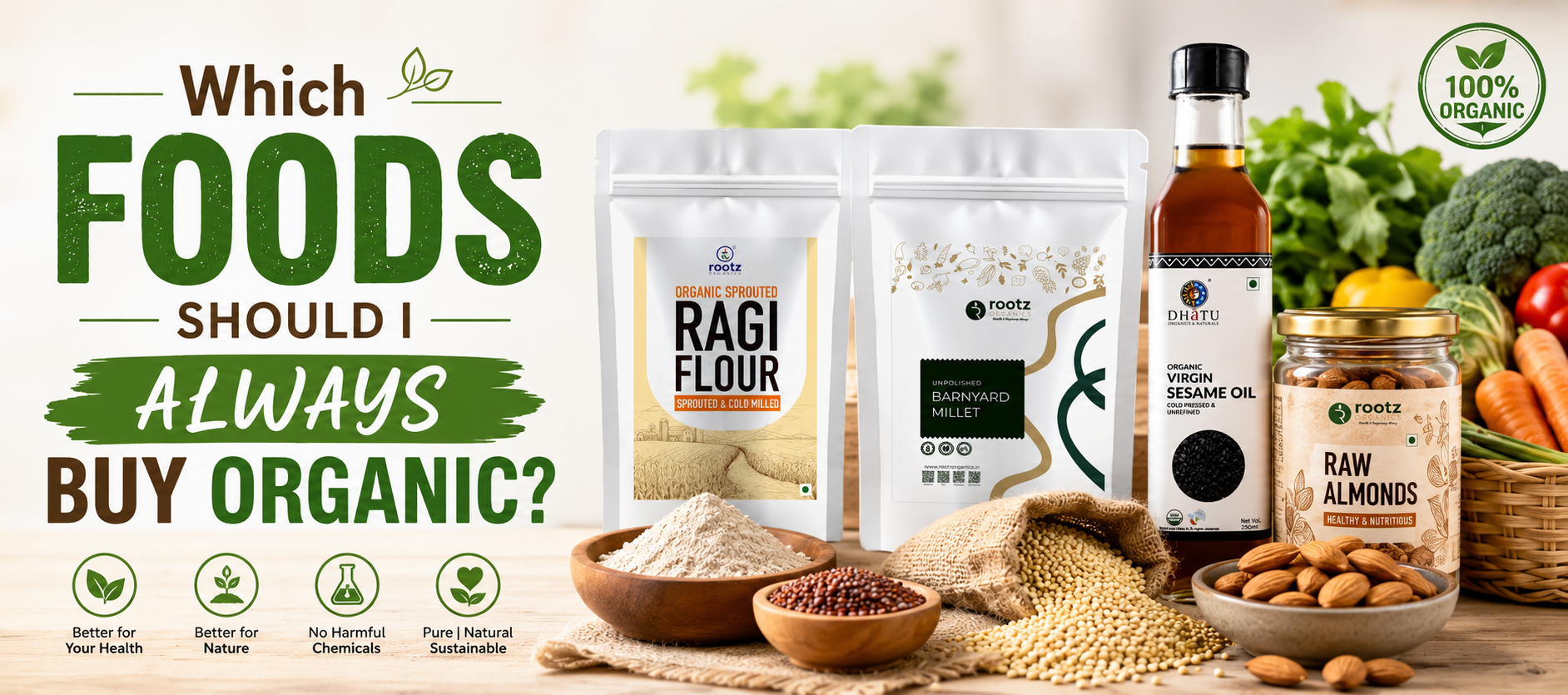
Which Foods Should You Always Buy Organic?
Quick answer: Thin-skinned fruits and leafy vegetables (grapes, spinach, tomatoes, capsicum), plus staples where the outer bran or husk is eaten whole, such as millets, ragi, and stone-ground flours, carry the highest pesticide load and benefit most from going organic. Thick-skinned produce like bananas, coconut, and pumpkin can usually be bought conventionally without much added risk.
Walking down a supermarket aisle in India today, almost every shelf has an "organic" version sitting beside the regular one. Few shoppers have the time, or the budget, to switch everything at once. The more useful question isn't "should I go fully organic," but "which foods actually matter." Choosing chemical free food for a handful of high-risk categories does more for your family's health than spreading a small organic budget too thin across everything.
This becomes especially relevant for families with young children, pregnant women, or anyone managing a chronic health condition, since these groups are more sensitive to cumulative pesticide exposure over time. A gradual, priority-based switch tends to stick far better than an ambitious overnight overhaul that gets abandoned within a month because the grocery bill doubled.
What Does "Buying Organic" Actually Mean?
Organic food is grown or processed without synthetic pesticides, chemical fertilisers, or genetically modified inputs, and it is certified against a defined standard such as India's NPOP or PGS-India. Certification means an independent body has verified the farming and processing methods, not just the final label. In India, this distinction matters because "natural" and "chemical-free" are marketing terms with no legal definition, while "organic certified" is not.
Why Some Foods Deserve Priority Over Others
Pesticide exposure isn't distributed evenly across the food you eat. It depends on how a crop is grown, how thin its skin is, and whether you consume the outer layer or discard it. A banana's peel is removed before eating, so residue on the skin rarely reaches the fruit inside. Spinach, on the other hand, is eaten whole, unwashed residue and all, which is why leafy greens consistently rank high on pesticide-monitoring lists.
The Centre for Science and Environment and FSSAI have both flagged repeated instances of pesticide residue exceeding safe limits in Indian produce, particularly in grapes, tomatoes, and capsicum. India also still permits several organophosphate pesticides that are restricted in the US and EU, which is one reason India-specific guidance is more useful here than imported "dirty dozen" lists built on American crop data.
Fruits and Vegetables With the Highest Residue Risk
Based on repeated testing patterns from Indian monitoring bodies, these categories are worth prioritising for organic purchase:
- Grapes – Frequently show residues from multiple fungicides at once, since the crop needs heavy spray cycles against powdery mildew.
- Spinach and other leafy greens – Eaten unpeeled and often under-washed, with a large surface area exposed to spray.
- Tomatoes – One of the most heavily sprayed vegetable crops in India due to pest pressure through the growing season.
- Capsicum and bell peppers – Thin skin and a growth pattern that traps residue in ridges near the stem.
- Apples – Imported and domestic apples are both commonly treated with post-harvest coatings and fungicides to extend shelf life.
- Strawberries – Grown close to the soil with a delicate skin that offers little protective barrier.
Produce with a thick, inedible rind, such as bananas, watermelon, pumpkin, and coconut, sits at the opposite end of the spectrum and is generally lower priority for an organic switch.
Grains, Pulses, and Flours: The Category Most People Skip
Fruits and vegetables get most of the attention in organic conversations, but grains and pulses deserve equal consideration in an Indian kitchen, since they form the base of nearly every meal. Wheat, rice, and pulses are typically treated with pesticides during cultivation and, in some cases, fumigated again during storage to prevent pest infestation before reaching the market.
For households managing gluten sensitivity or simply looking for cleaner everyday staples, a well-sourced range of gluten free flours made from ragi, jowar, and bajra offers a practical starting point, since these grains are naturally free from gluten and, when organically grown, avoid the residue concerns tied to conventional wheat cultivation.
Spices are another overlooked category. Non-organic turmeric, chilli powder, and coriander are sometimes adulterated with artificial colourants or treated with fumigants during storage, which is worth keeping in mind for ingredients used in nearly every dish.
Dairy and Ghee: Why the Source Matters as Much as the Product
Milk and ghee absorb whatever the animal has been fed, which means antibiotics, hormones, or pesticide-treated fodder can end up concentrated in dairy fat over time. This is one reason traditional Ayurvedic texts placed such emphasis on the breed of cow and the purity of its diet, long before modern food science examined the same question through a different lens.
Choosing a traceable organic a2 ghee sourced from indigenous cow breeds and made using the traditional bilona method is one way to reduce this exposure while staying within a familiar, everyday ingredient rather than an unfamiliar substitute.
Cooking Oils: A Category Where Processing Matters More Than Labelling
Refined oils go through a chemical extraction and bleaching process that can leave behind solvent traces and strip out the natural antioxidants present in the seed. Cold-pressed extraction avoids both issues, but cold-pressed alone doesn't guarantee the seed itself was grown without pesticides.
Sourcing organic oil online from certified organic seeds and traditional wood-pressing methods addresses both concerns at once: a cleaner extraction process paired with cleaner raw material, which is difficult to verify from a supermarket shelf without checking the certification on the label.
Millets: A Category Where Organic and Traditional Overlap
Millets occupy an interesting middle ground in this conversation. They are hardy, low-input crops that historically needed far fewer pesticides than wheat or rice to grow well, which makes organic millet cultivation more achievable and, in many cases, more affordable than organic versions of other staples.
Where sourcing does matter is in how the grain is processed after harvest. Choosing unpolished millets over their polished counterparts preserves the bran layer, where most of the fibre, iron, and calcium sit, since polishing strips away 60 to 70 percent of a millet's iron content and up to half its calcium.
Finger millet in particular is worth calling out. Stone-ground organic ragi flour retains significantly more of its natural calcium and iron than conventionally milled versions, making it a practical daily staple for bone health rather than an occasional health-food purchase. For households building out a broader millet-based diet, sourcing organic millets online from a single trusted supplier makes it easier to maintain consistency across foxtail, barnyard, kodo, and little millet varieties.
Baby Food and Pregnancy: A Category Worth Prioritising Early
Infants and young children eat far more food relative to their body weight than adults do, and their organs are still developing the capacity to process and eliminate chemical residues efficiently. This is one of the clearest cases where the case for chemical free food isn't about long-term probability, it's about a period of development where the margin for exposure is genuinely narrower.
For pregnant women, the same logic applies through a different pathway. Several studies tracking pesticide exposure during pregnancy have linked higher exposure levels with outcomes worth avoiding, including preterm birth risk, which is enough reason for many households to prioritise organic sourcing for this window even if the rest of the pantry stays mixed. Rice cereal, pureed vegetables, wheat-based weaning foods, and milk are the specific categories worth switching first, since they form the bulk of a baby's early diet.
It's worth being clear-eyed here: organic labelling on baby food doesn't automatically mean a product is nutritionally complete or medically necessary. It simply means the raw ingredients were grown and processed without synthetic pesticide and chemical fertiliser inputs, which is a meaningful but specific claim, not a substitute for a paediatrician's dietary guidance.
A Practical Framework for Prioritising Your Organic Budget
Rather than an all-or-nothing switch, most Indian households find it more workable to prioritise in this order:
- Start with what your family eats daily. Daily staples like atta, rice, dal, milk, and cooking oil carry more cumulative exposure than occasional purchases.
- Prioritise thin-skinned, unpeeled produce. Leafy greens, berries, tomatoes, and grapes sit higher on the risk list than thick-skinned fruit.
- Check for cooking method. Vegetables that are always cooked, such as brinjal or bitter gourd, see some reduction in residue through heat, unlike produce typically eaten raw.
- Look for children's food first. Babies and young children eat more food relative to their body weight, so baby food, milk, and cereal are worth prioritising early.
- Verify certification, not marketing language. A package that says "natural" or "farm fresh" carries no legal weight; look specifically for NPOP or PGS-India certification marks.
Reading Organic Labels in India: What Certification Actually Guarantees
India regulates organic claims under two main systems. NPOP (National Programme for Organic Production) applies primarily to larger-scale and export-oriented production, verified through third-party certification bodies. PGS-India (Participatory Guarantee System) is designed for smaller and community-based farmer groups, verified through a peer-review process rather than a single external auditor.
Both systems require documented farming practices, restricted input lists, and periodic inspection, which is meaningfully different from a brand simply choosing to print "organic" on a package without third-party verification. When sourcing from farmer groups directly, as many India-based organic brands do, checking which certification appears on the product, and cross-referencing it against the relevant government database, remains the most reliable way to confirm a claim.
The Bottom Line
Going fully organic overnight isn't realistic for most Indian households, and it isn't necessary either. Prioritising thin-skinned produce, daily staples like flour and dairy, and children's food gives you most of the benefit without the full cost of an all-organic kitchen. Over time, as certified organic options become more accessible and affordable across categories like millets, oils, and ghee, that priority list naturally shortens on its own.
Frequently Asked Questions
What are the most important foods to buy organic in India?
Leafy greens, grapes, tomatoes, capsicum, and strawberries carry the highest pesticide residue risk among fresh produce. Among staples, wheat flour, rice, pulses, and dairy are worth prioritising since they're consumed daily and in larger quantities than occasional fruit purchases.
Which foods are safe to buy non-organic?
Produce with a thick, inedible peel, such as bananas, watermelon, pumpkin, and coconut, generally carries lower residue risk because the outer layer that absorbs most pesticide spray is discarded before eating rather than consumed.
Is organic food actually pesticide-free in India?
Certified organic food is grown without synthetic pesticides and chemical fertilisers, though trace environmental contamination from neighbouring farms can occasionally occur. Certified organic residue levels are consistently and substantially lower than conventional produce in independent testing.
How can I tell if a product is genuinely organic and not just labelled that way?
Look specifically for the NPOP or PGS-India certification mark on the packaging rather than words like "natural" or "chemical-free," which have no legal definition in India. Genuine certification also comes with a traceable certificate number.
Is it worth buying organic millets and flours if I can't afford organic vegetables?
Yes. Millets and stone-ground flours are eaten daily in larger quantities than most fruits and vegetables, and unpolished, organically grown millets retain significantly more of their natural iron and calcium than polished, conventionally grown alternatives.
-
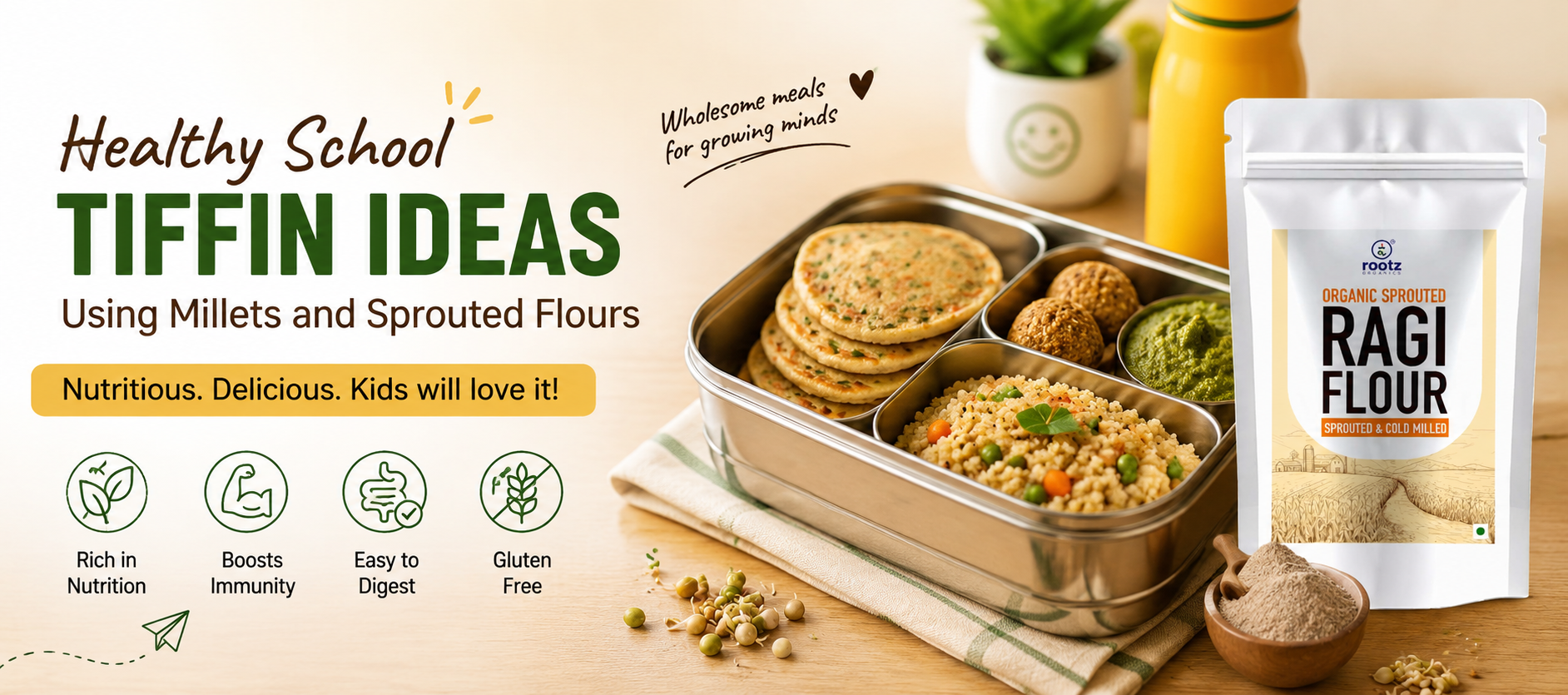
Healthy School Tiffin Ideas Using Millets and Sprouted Flours
July 22nd, 2026 -
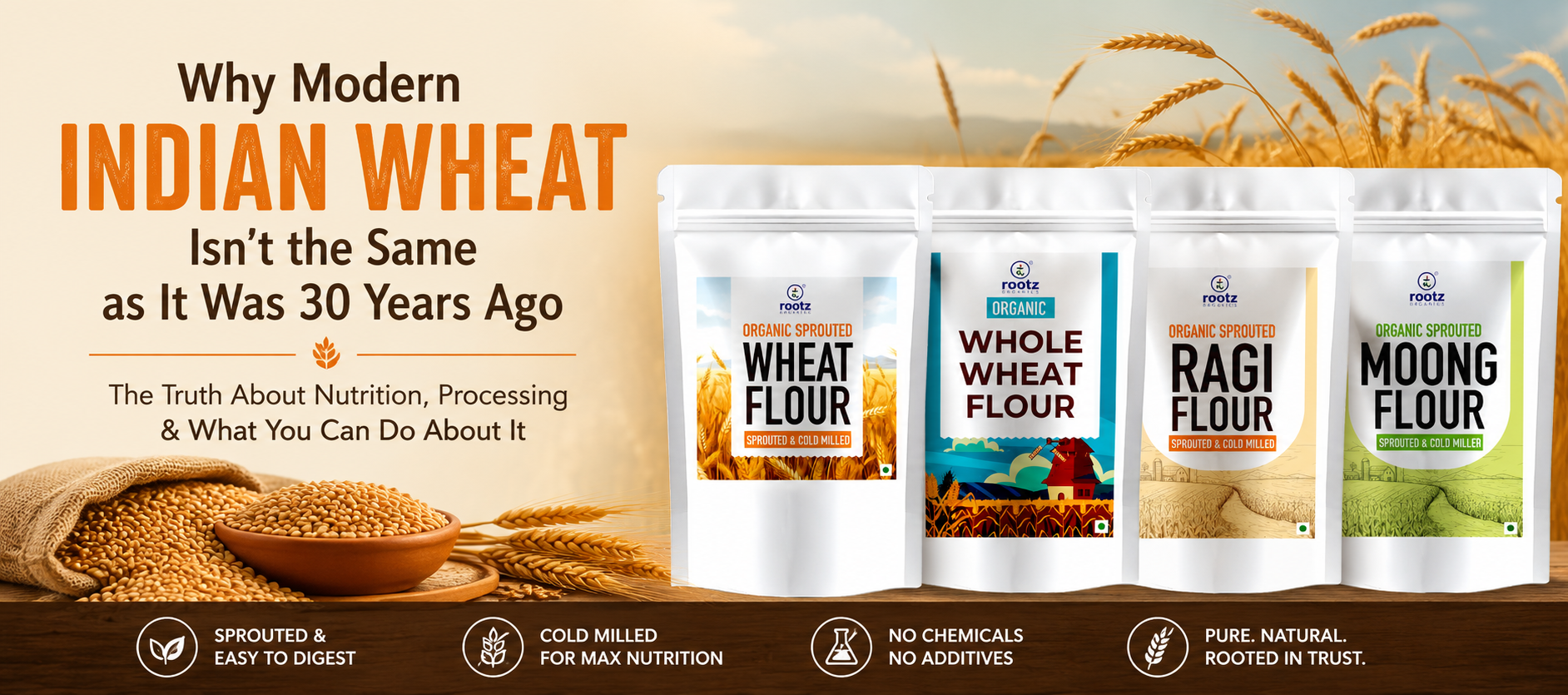
Why Modern Indian Wheat Isn't the Same as It Was 30 Years Ago
July 16th, 2026