Polished vs Unpolished Millets: What You Should Eat
Introduction: The Millet Revival Has a Problem Nobody Is Talking About
India is in the middle of a millet moment.
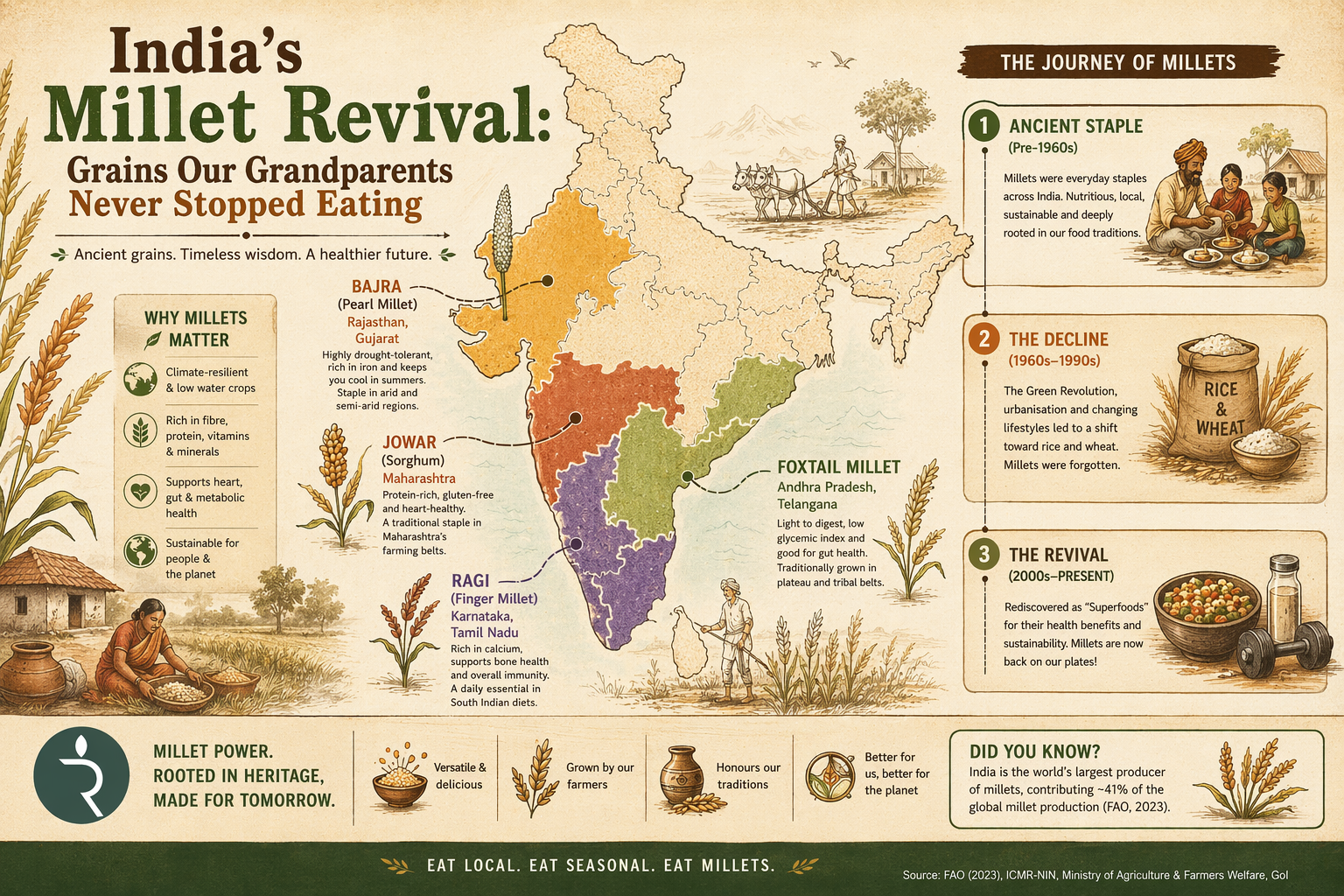
After decades of being quietly pushed aside by polished rice and refined wheat, millets are back. They are on restaurant menus in Mumbai and Chennai. They are in corporate lunch boxes in Bengaluru. They have been elevated to the status of a national food priority, with India championing the International Year of Millets in 2023. Ragi, jowar, bajra, foxtail millet, barnyard millet, little millet…grains that our grandparents ate out of necessity are now being sought out by a generation that has discovered, often after a health scare or a nutritionist's advice, that the oldest foods in Indian agriculture may also be the wisest.
But here is the thing nobody is saying loudly enough: buying millets is not the same thing as eating millets correctly.
Walk into any supermarket or organic store today and you will find millets in two fundamentally different forms, polished and unpolished. Most consumers pick up whichever packet looks cleaner, cooks faster, or costs less. Very few stop to ask what the difference actually is, or what that difference means for the nutrition that lands on their plate.
It turns out the difference is enormous. And understanding it could be the single most important thing you do with the millet habit you are trying to build.
First, Understand What a Millet Grain Actually Is
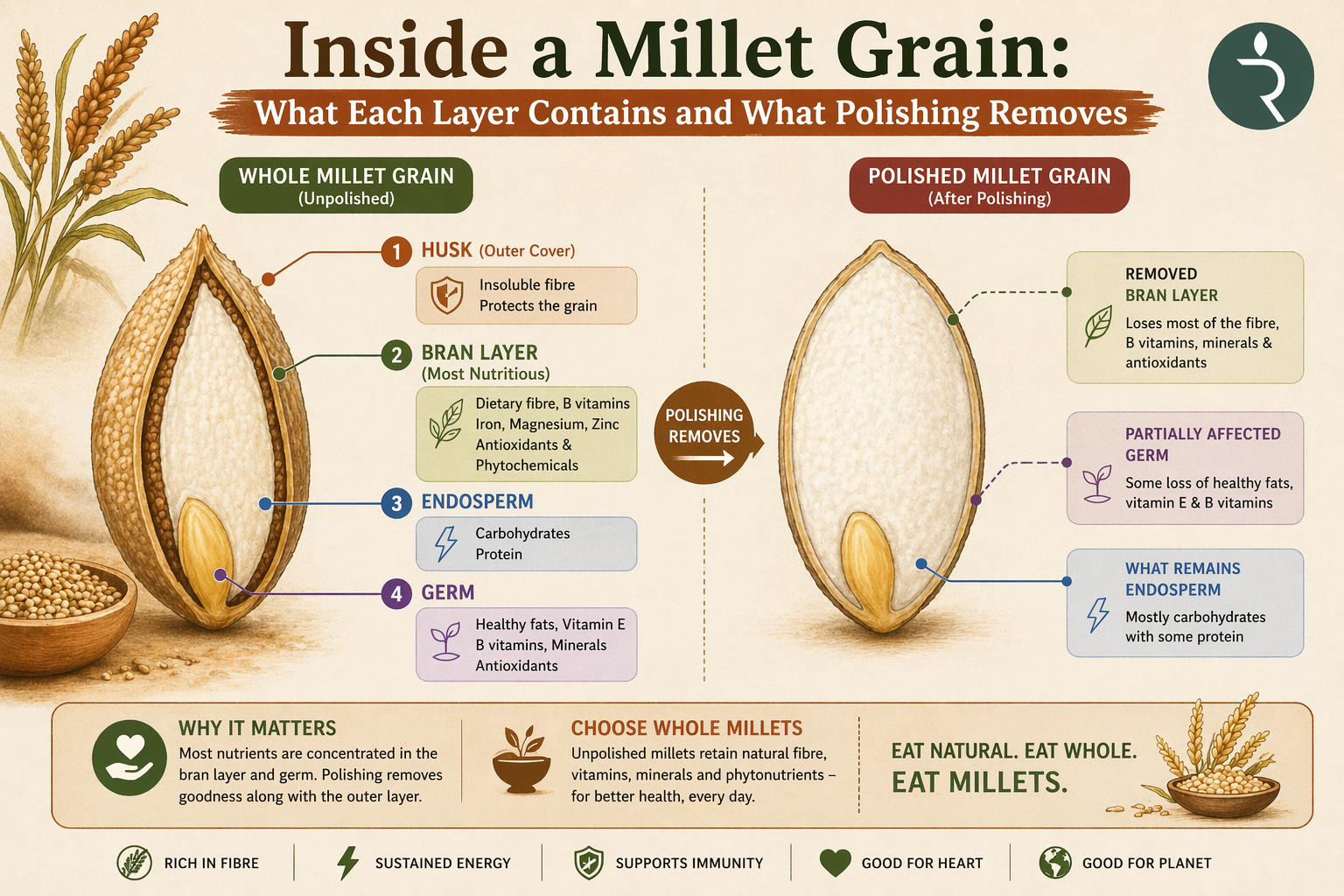
Before getting into polished versus unpolished, it helps to understand the structure of a millet grain. Like all whole grains, a millet kernel has three distinct layers, and each one does a specific job.
The outermost layer is the husk, which is inedible and must be removed regardless of how the millet is processed. Beneath the husk is the bran layer, a thin but extraordinarily nutrient-dense coat that contains the majority of the grain's dietary fibre, iron, calcium, zinc, B-vitamins, and antioxidants. At the very core is the endosperm, which is the starchy inner part of the grain, and finally the germ, the small embryo at the base that carries vitamins and healthy fats.
When you eat an unpolished millet, you are eating the bran, the endosperm, and the germ together. When you eat a polished millet, the bran has been mechanically removed, leaving mostly the endosperm behind.
That bran layer is where the story of this entire blog lives.
What Polishing Actually Does to a Millet
Polishing is a mechanical process in which millet grains, after de-husking, are run through abrasive rollers that scrape away the outer bran layer to make the grain look whiter, more uniform, and visually similar to polished white rice. The result is a grain that cooks faster, has a longer shelf life, and appeals to a consumer market conditioned by decades of white-grain aesthetics.
What it also does is strip away a staggering proportion of the grain's nutritional value.
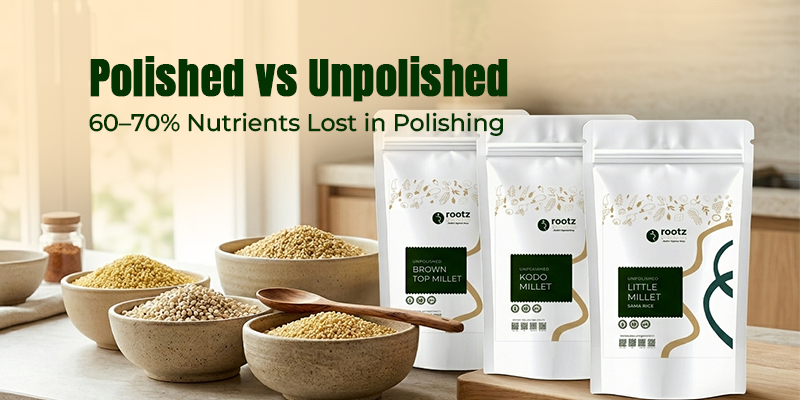
Polishing removes 60 to 70 percent of iron and up to 50 percent of calcium from millets. For example, unpolished little millet has 9.3 mg of iron per 100g. After polishing, this drops to approximately 3 mg. Similarly, calcium in foxtail millet drops from 31 mg to under 15 mg per 100g. These minerals are concentrated in the bran layer, which is the first thing polishing strips away.
Unpolished foxtail millet contains 8.9g of fibre per 100g, while polished foxtail millet drops to just 3.2g…a 64 percent loss. Iron drops from 4.6 mg to 2.8 mg per 100g.
Think about what this means in practice. You make the effort to switch from white rice to millet. You feel good about it. You read that millets are rich in iron, fibre, and minerals. But if the millet you are buying is polished, you are consuming a grain that has already had most of those benefits mechanically removed before it ever reached your kitchen.
Polished millet is the least nutritious option. Polishing removes most of the fibre, vitamins, and minerals, leaving mostly carbohydrates. In effect, a polished millet behaves more like a refined grain than a whole grain. You have paid for the name without getting the nutrition.
What Unpolished Millets Retain and Why It Matters
Unpolished millets are minimally processed grains in which only the inedible outer husk has been removed, leaving the nutritious bran layer, endosperm, and germ completely intact. Unpolished millets retain their natural nutrients, making them a far healthier option.
Here is what that intact bran layer delivers to your body:
- Dietary fibre that actually works. Unpolished millets contain 8 to 12g of fibre per 100g compared to 0.4g in white rice. This fibre keeps you full for 4 to 5 hours, reducing snacking and total calorie intake significantly. For Indian families dealing with weight management concerns, this is a meaningful daily advantage from a grain that requires no special preparation beyond soaking.
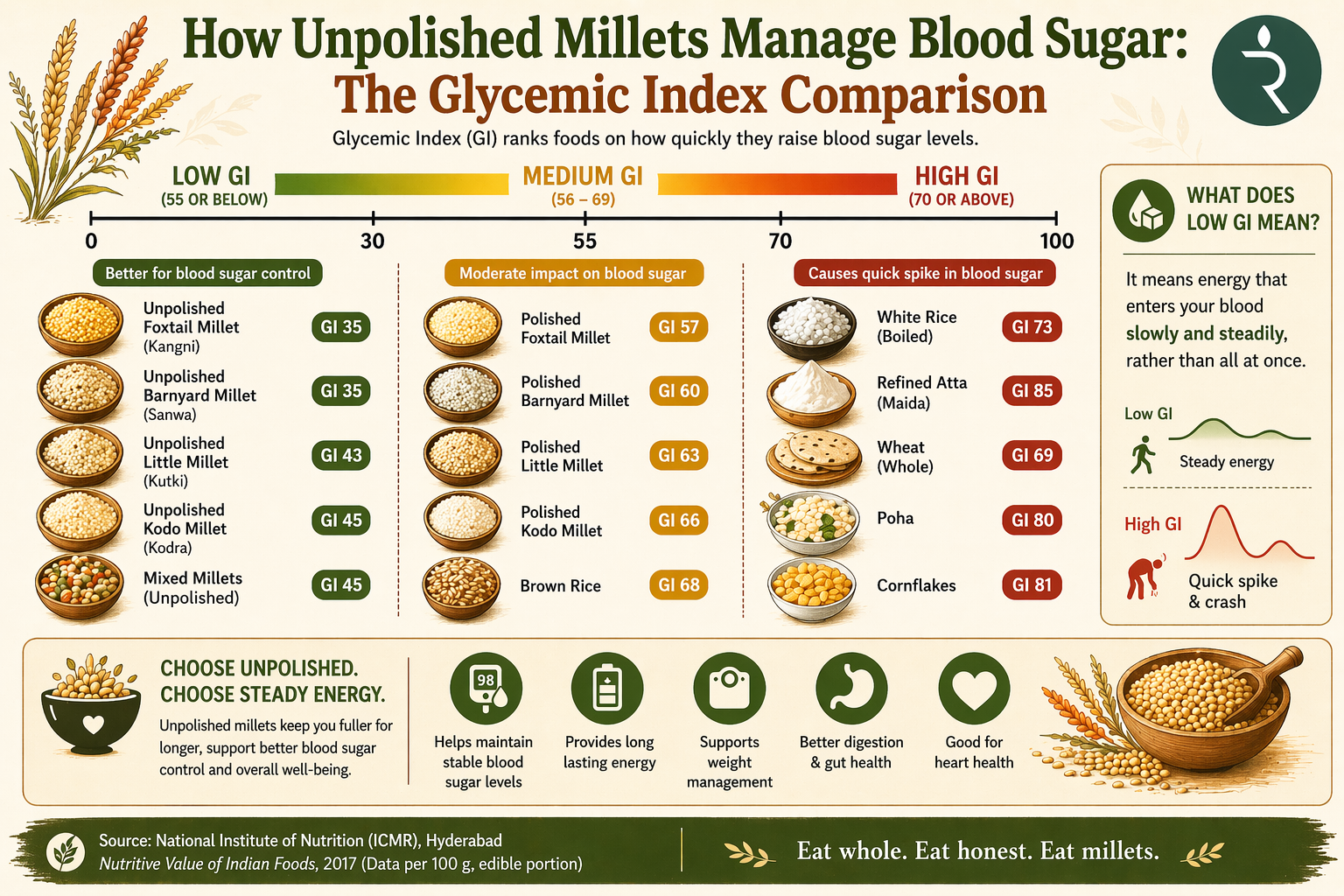
- Blood sugar stability that polished grains cannot offer. Millets have a low glycemic index and regular consumption helps manage fasting and post-prandial blood sugar levels, thereby reducing the risks of developing type 2 diabetes. Polishing removes the outer bran layer…the layer that contains 60 to 70 percent of the fibre, B-vitamins, iron, and minerals. For managing blood sugar, this bran layer is the most important part because fibre is what slows down sugar absorption. Polished millets lose most of their blood sugar lowering benefits and behave more like a refined grain.
- Protein that survives processing. The protein content of unpolished barnyard millet is 10.4g per 100g compared to 6.8g in polished barnyard millet. The nutraceutical components are more nutritionally superior in unpolished barnyard millet compared to the polished version.
- Antioxidants and lignans for long-term protection. Unpolished millets retain the outer layer rich in lignans, which are compounds responsible for preventing cell damage and cancer cell activity, making unpolished millets beneficial for medicinal and preventive health purposes.
In short: the fibre, the minerals, the antioxidants, the slow-release carbohydrates that make millets genuinely different from rice and wheat…all of it lives in the bran. All of it goes when you polish.
The Diabetes Connection India Cannot Afford to Ignore
India has more people living with diabetes than almost any other country in the world. The numbers are not slowing down. They are moving in the wrong direction, and they are moving younger.
The daily diet of most urban Indians…white rice, refined atta, polished grains, processed snacks is built almost entirely around high-glycemic foods that spike blood sugar rapidly and crash it equally fast. Millets have been celebrated as a solution to this pattern. And they are. But only in their unpolished form.
Millets on average have a glycemic index of 52.7, which is lower than white rice and refined wheat.Barnyard millet, one of the most powerful in this category, has a glycemic index as low as 41. These numbers reflect whole, unpolished grain. Once polished, the fibre that is responsible for slowing glucose absorption is largely gone, and the glycemic response of the grain climbs toward that of the refined grains it was meant to replace.
For families managing diabetes, pre-diabetes, or simply trying to avoid the blood sugar instability that characterises so much of modern Indian eating, the choice between polished and unpolished millets is not a preference. It is the entire point.
Semi-Polished Millets: The Middle Ground
It is worth acknowledging that the millet you find in most stores is not always one or the other. Semi-polished millets are increasingly common…grains where a portion of the bran has been removed but not all of it.
The semi-polished millet has a part of the bran layer removed, making the millet smoother and quicker to cook. It offers a decent amount of fibre and some vitamins and minerals. It is a compromise between nutrition and convenience.
Semi-polished millets are better than fully polished and are a reasonable transitional choice for families new to millets who find the texture of unpolished grain unfamiliar. But they are not equivalent to unpolished. If the goal is the full nutritional benefit that makes millets worth adding to your daily diet, unpolished is the standard to aim for.
"But Unpolished Millets Are Harder to Cook"
This is the most common reason people reach for the polished variety, and it is worth addressing directly rather than dismissing.
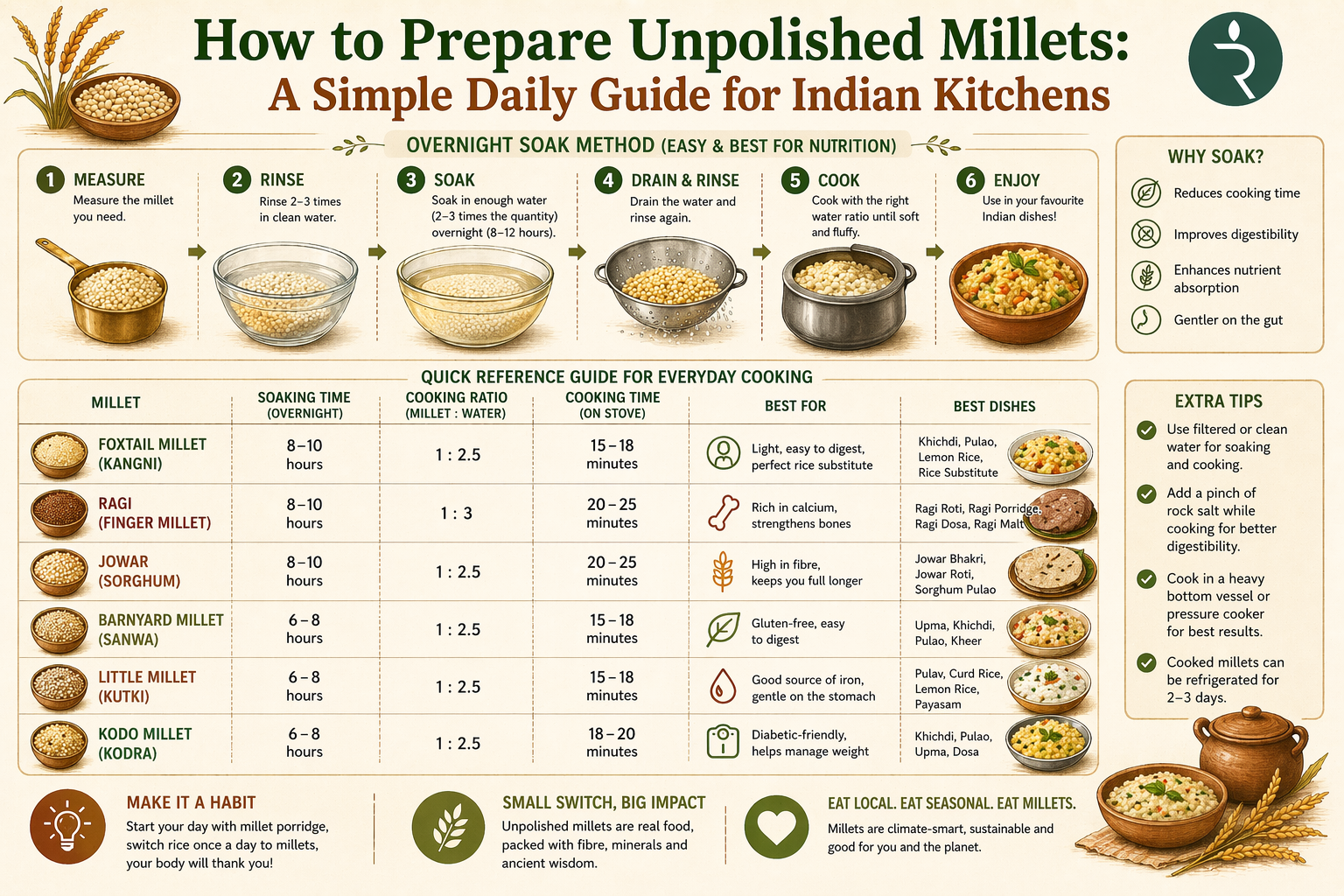
Unpolished millets do require a soaking step. Most varieties benefit from being soaked in water for six to eight hours before cooking, or overnight. This step serves two purposes: it softens the bran layer and significantly reduces the phytic acid content, which is a naturally occurring compound in the bran that can interfere with mineral absorption if not addressed.
Unpolished millets have a short shelf life and require long hours of soaking in water, preferably overnight, to avoid poor digestion.
Once soaked, they cook at roughly the same speed as rice. The textures are different from polished grain, nuttier, earthier, with more presence in the mouth and most people who make the switch find this difference becomes a preference within a few weeks. The ragi mudde, the foxtail millet khichdi, the jowar bhakri of traditional Indian cooking were all made from whole, unpolished grain. The soaking step is not an inconvenience added by modern health advice. It is simply how these grains were always prepared.
How to Identify Unpolished Millets When You Buy
The visual difference between polished and unpolished millets is noticeable once you know what to look for. Unpolished millets have a slightly rough, matte surface with natural colour variation — they may appear beige, off-white, grey, or brown depending on the variety. Polished millets look uniform, smooth, and often closer to white. They have been through a machine that smoothed and brightened them, and that visible smoothness is precisely the problem.
When buying millets, look for labels that explicitly say "unpolished" or "whole grain." Organic certification is an additional assurance that the grain was grown without synthetic pesticides — important because the bran layer, which you are now intentionally keeping, is also the part of the grain most exposed to any chemical residues used during cultivation.
At Rootz Organics our millets are sourced unpolished and certified organic, because getting the processing right means nothing if the grain was chemically treated in the field. Both matter, and we refuse to compromise on either.

Conclusion: The Millet You Buy Is Only Half the Decision
Millets are genuinely one of the most powerful food choices an Indian family can make. Ancient grains, grown in Indian soil for thousands of years, designed by nature to deliver exactly the slow energy, mineral density, and gut-supporting fibre that modern Indian diets are desperately short of.
But the benefits belong to the whole grain. To the bran layer that gets scraped away in polished varieties. To the fibre that slows glucose. To the iron and calcium that support growing children and working adults. To the antioxidants that protect cells over a lifetime of eating.
Choosing unpolished millets is not a complicated decision. It is a one-line addition to how you think about buying grain: if the bran is gone, so is most of what makes the grain worth eating.
Keep the bran. Keep the benefits. That is the whole story.
Millets the Way They Were Always Meant to Be Eaten
Rootz Organics brings you certified organic, unpolished millets sourced directly from Indian farms. Grown clean, processed minimally, and delivered with complete sourcing transparency.
Shop Rootz Organic Unpolished Millets | Whole grain. Genuinely organic. Delivered to your door.
The grain your ancestors ate. The nutrition your body needs. That is the Rootz way.
Health and Happiness always
FAQs
Q: What is the difference between polished and unpolished millets?
A: Unpolished millets retain their outer bran layer after the inedible husk is removed, keeping the grain's fibre, iron, calcium, B-vitamins, and antioxidants intact. Polished millets have this bran layer mechanically removed, leaving mostly starch and losing up to 60 to 70 percent of their nutritional value.
Q: Are unpolished millets better for diabetes?
A: Yes. The fibre in unpolished millets is responsible for slowing glucose absorption and maintaining blood sugar stability. Polished millets lose most of this fibre during processing and behave more like refined grains, significantly reducing their blood sugar management benefits.
Q: Do unpolished millets need to be soaked before cooking?
A: Yes, most unpolished millets benefit from soaking for six to eight hours or overnight before cooking. This softens the bran layer, reduces cooking time, improves digestibility, and reduces phytic acid content, which helps your body absorb the minerals in the grain more effectively.
Q: How do I know if the organic millets online I am buying are unpolished?
A: organic millets online have a slightly rough, matte surface with natural colour variation. Look for packaging that explicitly states "unpolished" or "whole grain." Organic certification is an added assurance that the bran layer you are keeping is also free from chemical residues applied during cultivation.
Q: Which unpolished millets are best for everyday Indian cooking?
A: Foxtail millet is the easiest transition as it cooks like rice. Ragi is ideal for rotis, porridge, and dosas. Jowar works well for bhakri and flour-based dishes. Barnyard millet is particularly recommended for those managing blood sugar due to its very low glycemic index of around 41.
-
 August 6th, 2026
 -
 August 6th, 2026