
From Chemical Farming to Organic Farming in India: A Farmer's Journey
Every bag of grain on a store shelf carries a story that starts years earlier, in a field. For a growing number of Indian growers, that story includes a turning point: the decision to walk away from synthetic inputs and rebuild a farm around living soil. This shift toward organic farming in India is not a single event but a multi-year process shaped by trial, patience, and a changed relationship with the land. Understanding what that journey actually involves — the setbacks as well as the gains — explains why organic produce looks, costs, and performs the way it does once it reaches a kitchen.
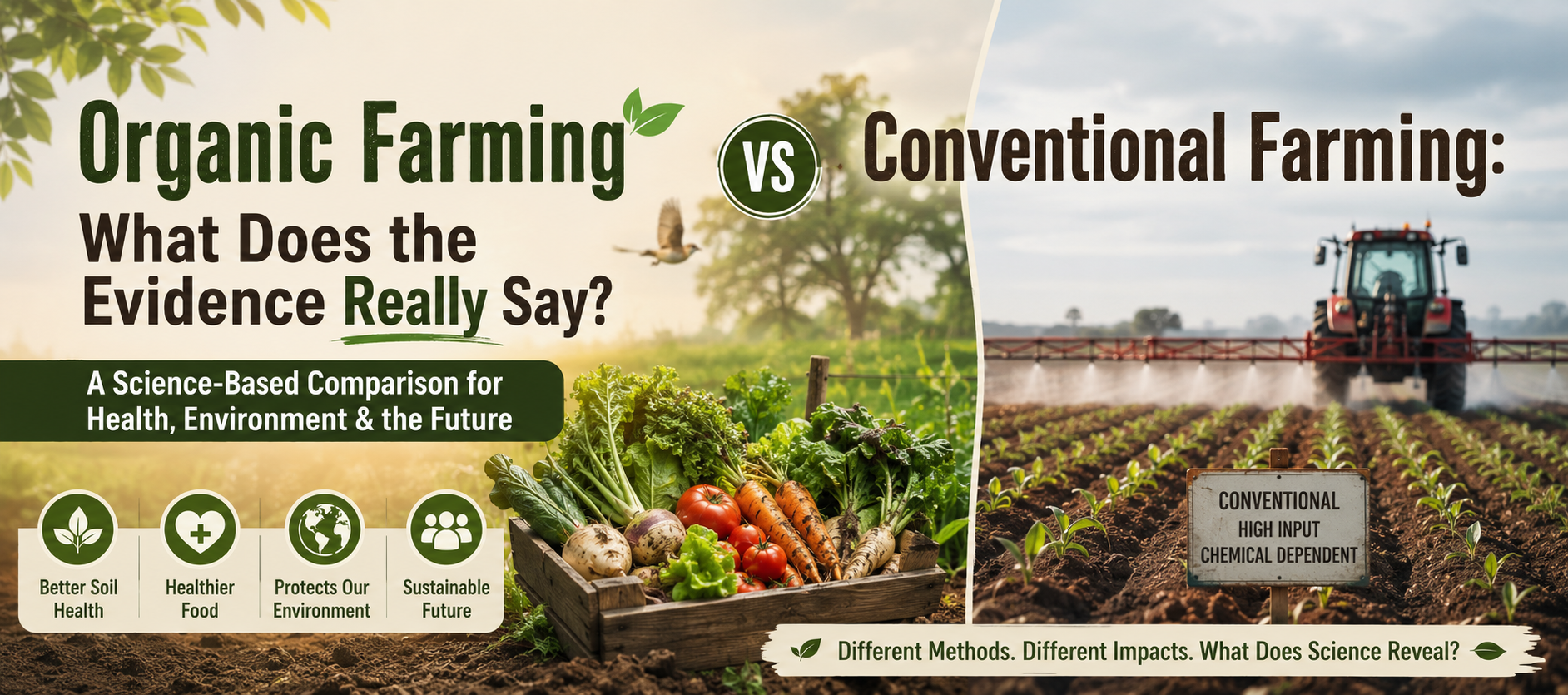
Organic farming is a method of growing crops and raising livestock without synthetic pesticides, chemical fertilisers, or genetically modified inputs, relying instead on compost, crop rotation, biological pest control, and natural soil-building practices. In India, it is regulated under two main frameworks — the National Programme for Organic Production (NPOP) for export-oriented and larger farms, and the Participatory Guarantee System (PGS-India) for smallholders selling domestically.
Why Farmers Start Questioning Chemical Agriculture
Most transitions begin with a practical problem, not an ideology. Input costs climb every season while yields on the same plot quietly decline, and that combination is usually the first signal something is wrong beneath the surface.
Continuous use of synthetic fertilisers pushes soil into a kind of dependency. Nitrogen-heavy inputs boost short-term growth but do little to replace organic matter, so microbial life that once broke down nutrients naturally begins to disappear. Farmers often describe soil that has "gone hard" — compacted, slow to absorb water, and unable to hold moisture through a dry spell the way it once did. Pesticide resistance compounds the problem: pests that chemicals controlled easily a decade ago now require stronger, more frequent doses, eating further into already thin margins.
Health concerns add another layer. Farmers handling concentrated pesticide sprays without adequate protective equipment report skin irritation, respiratory discomfort, and long-term exposure risks that rarely get discussed in input-shop conversations. For many, this — more than any market trend — is what finally tips the decision toward change.
A Season-by-Season Look at What Conversion Involves
A composite drawn from transition stories shared across farmer producer groups in Madhya Pradesh and Maharashtra illustrates the pattern well. A mid-sized wheat and pulses grower, farming close to five acres, spent nearly two decades on a conventional input cycle before deciding the returns no longer justified the cost or the toll on his health. What followed was not an overnight switch but a staged rebuilding of the farm's biology.
The first season focused entirely on soil recovery rather than yield. Chemical residues take time to break down, and pushing for a full harvest too early usually leads to disappointing results and discouragement. Compost pits were dug using farm waste and cattle dung, cover crops like sunn hemp were sown to fix nitrogen naturally, and a portion of the land was deliberately left less productive while microbial populations rebuilt themselves.
By the second season, yields had dropped by roughly a third compared to the chemical-farming baseline — a dip that is common and often the single biggest reason farmers abandon the transition midway. Those who persist typically see recovery beginning in year three, as soil structure improves and natural pest predators return to the ecosystem. By year four, many growers report yields approaching or matching their earlier conventional numbers, but with dramatically lower input costs and healthier soil that holds moisture better during erratic monsoons.
The Practical Steps of Moving to Organic Cultivation
While every farm differs by crop, soil type, and region, the conversion process broadly follows a consistent sequence:
- Soil testing and input audit: A baseline soil test identifies nutrient deficiencies, pH imbalance, and residual chemical load before any changes begin.
- Detox and rebuilding period: Synthetic inputs are stopped entirely, and compost, vermicompost, and green manure are introduced to restore organic matter.
- Crop diversification: Monocropping is replaced with rotations and intercropping — pulses, millets, and cover crops — to break pest cycles and rebuild soil nitrogen naturally.
- Natural pest and disease management: Neem-based sprays, pheromone traps, and beneficial insects take over the role chemical pesticides once played.
- Certification process: Farmers enrol under NPOP or PGS-India, which requires a mandatory conversion period — typically 24 to 36 months — during which the land is inspected and documented before produce can carry an organic label.
- Market linkage: Once certified, farmers connect with organic aggregators, farmer producer organisations, or direct buyers who pay a premium reflecting the lower yield-risk and higher input labour of the first years.
Farmers who diversify into traditional grains like ragi, jowar, and bajra during this phase often reach stable, profitable yields faster than those sticking rigidly to a single wheat crop. A stone-milled pack of organic ragi flour on a store shelf today usually started as exactly this kind of diversification decision made somewhere in year two or three of a farmer's conversion.
The Setbacks Nobody Puts on the Brochure
The transition period is genuinely difficult, and pretending otherwise does a disservice to farmers considering the switch. Reduced yields in years one and two put real financial pressure on households that depend on every harvest. Learning to read soil health without a bag of fertiliser as a shortcut takes time, and mistakes made during this learning curve — over-tilling, incorrect compost ratios, poor pest timing — can cost an entire season's crop.
Market access is another hurdle. Without an existing buyer network, a newly converting farm often has to sell its early, imperfect harvests at conventional prices, absorbing the full cost of organic inputs without the organic premium to offset it. This is precisely where cooperative structures and farmer producer groups make the biggest difference, pooling resources for certification costs and connecting smaller growers to buyers who specifically source organic staples.
What Certified Organic Agriculture Looks Like Across the Country Today
India now has one of the largest numbers of organic producers in the world, with adoption concentrated in states like Madhya Pradesh, Maharashtra, Rajasthan, and the northeastern hill states, where traditional low-input farming was already closer to organic practice before formal certification existed. This scale is exactly why organic farming in India has moved from a niche experiment to a mainstream agricultural category over the past decade, supported by state-level incentive schemes and growing urban demand for chemical-free staples. Millets, pulses, and traditional grain varieties have proven especially well suited to organic methods, since they evolved with lower dependence on synthetic inputs than hybrid wheat and rice varieties bred for the Green Revolution era.
Regional clusters have also emerged around specific crops rather than farms converting in isolation. Sikkim became India's first fully organic state, while pockets of Madhya Pradesh now specialise in organic soybean and wheat, and parts of Rajasthan focus on organic pulses suited to arid, low-rainfall conditions. This clustering matters because it allows shared composting infrastructure, joint certification audits, and collective bargaining with buyers — all of which lower the individual cost burden that makes the first few transition years so difficult for a lone farmer.
This is one reason India's unpolished millets supply chain has grown steadily — millet varieties are naturally hardier, require less irrigation, and respond well to compost-based fertility rather than chemical nitrogen. Farmers converting grain-heavy land often start with millets precisely because the crop tolerates the soil-rebuilding phase better than more input-dependent staples.
Soil studies consistently show that fields under long-term organic management carry higher organic carbon content and better water retention than adjacent conventionally farmed plots, which matters increasingly as monsoon patterns grow less predictable across Indian agricultural belts.
How Certification Actually Builds Consumer Trust
Certification is what separates a genuine organic claim from marketing language. Under NPOP, third-party certification bodies accredited by the Agricultural and Processed Food Products Export Development Authority (APEDA) inspect farms, verify input records, and test soil and produce samples before a farm can carry the organic label. PGS-India works differently, relying on peer review within a local farmer group alongside documented practices — a model designed specifically to make certification affordable for smallholders who cannot bear the cost of individual third-party audits.
Both systems require the multi-year conversion period mentioned earlier, which is why a farm cannot simply stop using chemicals one season and market its produce as organic the next. That waiting period is, in effect, the guarantee behind every certified organic label a consumer sees on a packet.
During the conversion window, produce is sometimes labelled "in-conversion" rather than fully organic — a distinction worth knowing if it appears on packaging, since it signals a farm that has stopped chemical inputs but has not yet completed the full audit cycle. Once certification is granted, annual re-inspections continue for as long as the farm holds the label, checking storage practices, input purchase records, and buffer zones between organic and conventional plots to prevent chemical drift from neighbouring farms.
From Field to Kitchen: Where This Journey Ends Up
The farmer's transition eventually becomes a household's everyday choice. Stone-ground gluten free flours made from ragi, jowar, and bajra trace back to exactly this kind of multi-year soil-rebuilding process, grown on land that spent its transition years under compost and crop rotation rather than synthetic nitrogen.
The same is true further down the plate. A bag from a curated selection of organic rice online represents paddy grown without residue-heavy pesticide programmes, on farms that went through the same multi-year certification wait described earlier.
An Expert Insight From the Sourcing Side
Working directly with more than 200 organic farmer groups across India makes one pattern unmistakably clear: the farms that convert successfully are rarely the ones chasing a quick premium. They are the ones treating the first two to three years as an investment in soil biology, willing to accept a smaller harvest in exchange for land that will outperform its chemical-era yields within five years. Buyers who understand and pay fairly for that transition period play a direct role in whether a given farmer's conversion succeeds or gets abandoned halfway.
This pattern repeats across regions rather than sitting with one or two model farms. A browse through organic millets online on any given week reflects dozens of these individual multi-year transitions, layered together into a single product catalogue.
Frequently Asked Questions
How long does it take to convert a farm to organic in India?
Certification under NPOP or PGS-India requires a documented conversion period of roughly 24 to 36 months, during which no synthetic inputs are used. Full soil recovery and yield stabilisation often take three to five years, though some crops like millets adjust faster than others.
Do organic farms in India produce lower yields than conventional farms?
Yields typically dip by 20 to 35 percent during the first one to two transition years as soil biology rebuilds. Many farms recover to near-conventional yield levels by year three or four, while gaining lower input costs and better long-term soil health.
What is the difference between NPOP and PGS-India certification?
NPOP relies on accredited third-party inspection bodies and is commonly used for export-oriented and larger farms. PGS-India uses peer review within local farmer groups, making certification more affordable and accessible for smallholders selling domestically.
Why do organic products cost more than conventional ones?
Prices reflect lower per-acre yields during and after transition, higher labour needs for composting and manual pest management, certification and audit costs, and the absence of yield-boosting synthetic inputs that lower per-unit production costs on conventional farms.
Which crops are easiest for Indian farmers to convert to organic first?
Millets, pulses, and traditional grain varieties are generally the easiest starting point, since they evolved with lower dependence on synthetic fertiliser and pesticides than hybrid wheat and rice varieties developed during the Green Revolution.
For households, supporting this journey doesn't require a farm visit. Browsing a wider catalogue of organic food products online — pulses, oils, and pantry staples alongside grains — is a practical, everyday way of continuing to fund exactly this kind of transition, one grocery order at a time.
A farmer's move from chemical to organic cultivation is rarely fast or without cost, but it consistently follows the same arc: a soil-rebuilding period of reduced yield, a certification process that takes two to three years to complete, and a payoff in soil health, input savings, and market access that compounds over time. Every certified organic product on a shelf represents a farmer who chose to absorb that transition risk — which is exactly what the certification label is there to verify.
-
 August 14th, 2026
 -
 August 6th, 2026
 -
 August 6th, 2026